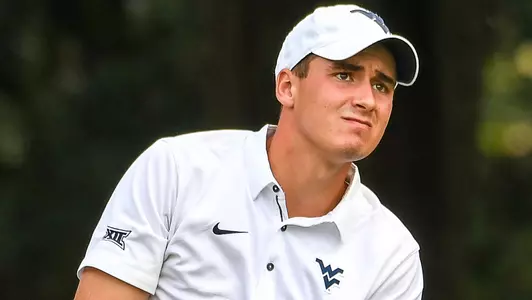
Photo by: Todd Drexler
Momentum Is Building for Covich’s Mountaineer Golf Program
October 26, 2018 04:00 PM | Golf
MORGANTOWN, W.Va. – Coaches can only do so much. Oftentimes they need help, too. West Virginia University golf coach Sean Covich got some big-time assistance a couple of years ago when the Mountaineer football team was playing Miami in the Russell Athletic Bowl in Orlando.
While the Mountaineers were in the Sunshine State preparing for their game against the Hurricanes in 2016, there was a bowl function going on beforehand at Isleworth Country Club and WVU director of athletics Shane Lyons and his executive senior athletic director Steve Uryasz were among those on the guest list.
Uryasz, having once worked at Texas Tech, was very familiar with Isleworth because the Red Raiders for years had served as one of the co-hosts of the Tavistock Collegiate Invitational, considered the premier fall tournament in college golf.
Uryasz understood well the value of being involved with the event as an important status symbol for any up-and-coming college golf program.
It was during that bowl function when he found out his old school was giving up its co-hosting responsibilities and Isleworth needed another school to help with the expenses to operate the tournament. Well, one thing led to another and WVU ended up making a commitment to take Texas Tech's place and co-host the 2017 event along with Central Florida.
This was yet another in a series of critical steps for West Virginia University golf, revived after more than 30 years of hibernation following its discontinuation in 1982.
Naturally, West Virginia's first step was hiring an ambitious, young coach with an engaging personality who could brush off initial disappointments with a smile and remain positive. Mississippi State assistant coach Sean Covich fit this requirement perfectly.
Then, once he was all in, Covich needed to find an adequate place/places for his team to practice. There are a bunch of terrific golf courses near WVU, but Covich wasn't sure how much his guys would have access to them, if at all.
"A big question to a kid when he comes on a visit is he wants to know where he is going to practice?" Covich explained earlier this week between bites of barbeque turkey, baked beans and macaroni and cheese in the banquet room at Isleworth Country Club. "And then how much? 'Yeah, you play Pete Dye, Mystic Rock and The Pines, but how much? Do you play it three times a week?'"
Once that was settled, several important smaller steps were taken to bolster Covich's spirits during those cold winter months when he was sitting in his kitchen and watching it snow, or turning his cell phone off when a recruit he wanted badly informed him he was going to a rival school for far less scholarship money than WVU was offering him.
One of those smaller steps was getting a team van to safely transport his players from campus to the nice courses they were allowed to practice at locally.
"If you come and see one of our tournaments, you are going to see 12 other team vans there – we're not the only ones to have one," Covich pointed out.
Then came an indoor golf studio, originally set up in the WVU Coliseum but since moved to the third floor of the Evansdale Crossing. That is the only place the players have to work on their games when the weather gets cold – that is until the proposed $5 million training facility on the site of the old White Day Golf Course just south of campus off Interstate 79 becomes a reality.
The initial process in making this practice facility an actuality has already begun, but the most critical step in identifying the funding sources for the complex have yet to be finalized. Only private funding will be used for this project.
Meanwhile, another small step was made when the team began flying to Florida for weekend practice rounds in early February to get the players ready for the spring season. This is something northern-climate programs such as Purdue, Illinois, Ohio State and Maryland have been doing for years and West Virginia began doing it a couple of years ago through the generosity of Mountaineer Athletic Club donors Sam and Susan Ross.
 "February is a rough month trying to get ready for the season," Covich explained. "We actually play two tournaments in February, and we can't even practice in Morgantown so this is necessary for our guys to get sharp before the spring season starts."
As a result, these enhancements have been contributing factors in the improved performance of the team. Eventually there were some tournament victories, the first coming during the fall a couple of years ago, and then continuing with this year's first-place finish at Pete Dye earlier this month.
All of this has been necessary for Covich just to try and keep his head above water in the No. 1 college golf conference in the country, which features annual powerhouses Oklahoma State and Texas. The Longhorns have produced such recognizable names as Jordan Spieth, Ben Crenshaw, Tom Kite, Justin Leonard and Mark Brooks.
Oklahoma State's list of standout golfers includes Rickie Fowler, Mike Holder, Scott Verplank, Charles Howell III and Hunter Mahan, to name a few.
Therefore, if you're going to run with the big dogs you have to be willing to get off the porch, which is why Uryasz, as WVU golf's lead administrator, was so determined to co-host the Tavistock Invitational despite the Mountaineers' lack of golf pedigree.
He understood that West Virginia might struggle initially - which it did last year finishing next to last and carding a 29-over-par team score – but he also knew getting involved with the event meant you get some say in who plays in it.
That immediately gave West Virginia clout and leverage it didn't have before to get into other tournaments that wouldn't have considered the Mountaineers otherwise.
"The first few years doing this was pretty hard putting together a schedule because we didn't exist and everybody knew we were going to be bad so they didn't want us in their tournaments," Covich explained.
Golf scheduling is no different than college basketball scheduling in that the power programs avoid playing the bottom-ranked teams because it will harm their overall rating, which is why co-hosting Tavistock was so vital from a program perspective.
Of equal importance, of course, is performing well, which the Mountaineers managed to do earlier this week.
West Virginia's middle-of-the-pack finish on Tuesday didn't register much more than a blip in local media circles, to borrow a phrase from Mike Krzyzewski, but the impact was seismic within the sport of college golf.
The teams the Mountaineers finished ahead of included No. 8 Illinois, No. 21 South Carolina, No. 26 Cal, No. 46 UCF and No. 48 North Texas.
Senior Max Sear's six-under-par 210 for the three-day event was good enough to tie him with Cal's Collin Morikawa and LSU's Michael Sanders for fifth place. Teammate Matthew Sharpstene was one stroke behind, tied with Arizona State's Mason Anderson for eighth place.
"There are guys in this tournament ranked in the single digits in the world amateur rankings that they beat," Covich marveled.
Equally impressive is what sophomore Logan Perkins did. The Locust Grove, Georgia, resident was dead last in the tournament after the first day when he carded an 82, but he battled back to shoot nine strokes better the following day and then finished with a two-under-par 70 on Tuesday to move up into a tie for 54thplace.
"For him to have a fresh mindset and put that behind him and have a round like that for the team was huge," Covich mentioned.
The overall team performance was also huge for West Virginia's team ranking, which has steadily climbed from No. 186 during Covich's first year to 132 two years ago to 90 at the conclusion of last season.
B.T. (Before Tavistock) the Mountaineers were No. 51 in the Golfstat rankings and A.T. (After Tavistock) they climbed 12 additional spots to No. 39.
That's ahead of such notable programs as Florida State, Purdue, Florida, UCLA, Ohio State, TCU, Mississippi State (Covich's old employer) and Nike U., Oregon.
To further put this into perspective, if West Virginia can maintain its ranking through the end of the spring season it would easily be good enough to get the Mountaineers into the NCAA Tournament as an at-large participant.
The only time a WVU golf team has ever competed in the national tournament was in 1947 when Harry Truman was president.
Golfweek writer Kevin Casey caught up with Covich during his 54-hole stroll around Isleworth Country Club for a feel-good profile on the WVU program that was posted on Golfweek's website earlier this week.
It's the first time WVU golf has ever gotten any national media attention, which represents another significant step for the program.
After all, Golfweek usually doesn't hang out in Verona, New York, Huntington, West Virginia, or Richmond, Virginia – some of the places the Mountaineers have played fall events in the past.
But Golfweek does go to Orlando because that's where it's based.
"Believe me, I've already forwarded the article on to a bunch of recruits," Covich laughed. "I feel like we're getting some momentum and just being a part of this tournament is special.
" But now … coming down here and competing is even better," he added.
West Virginia has one more major tournament left this fall in early November in Lahaina, Hawaii, where the Mountaineers will be facing more stiff competition.
It's another opportunity to maintain their momentum heading into the offseason when the players can catch up on academics and then compete in some big amateur tournaments in late December and early January.
That, too, is something Covich is finding himself taking more time to manage as better golfers find their way to Morgantown.
"We're starting to send more and more of our guys to play in these high-level amateur events down in Florida where the top college players are invited to play," he said. "It sort of bridges the gap from the fall to the spring and keeps them really sharp and in tournament mode …"
It was then that our conversation came to an abrupt end, "My phone is blowing up as we're talking, so I guess it must be good news," he said.
Yes, chances are it probably was more good news.
While the Mountaineers were in the Sunshine State preparing for their game against the Hurricanes in 2016, there was a bowl function going on beforehand at Isleworth Country Club and WVU director of athletics Shane Lyons and his executive senior athletic director Steve Uryasz were among those on the guest list.
Uryasz, having once worked at Texas Tech, was very familiar with Isleworth because the Red Raiders for years had served as one of the co-hosts of the Tavistock Collegiate Invitational, considered the premier fall tournament in college golf.
Uryasz understood well the value of being involved with the event as an important status symbol for any up-and-coming college golf program.
It was during that bowl function when he found out his old school was giving up its co-hosting responsibilities and Isleworth needed another school to help with the expenses to operate the tournament. Well, one thing led to another and WVU ended up making a commitment to take Texas Tech's place and co-host the 2017 event along with Central Florida.
This was yet another in a series of critical steps for West Virginia University golf, revived after more than 30 years of hibernation following its discontinuation in 1982.
Naturally, West Virginia's first step was hiring an ambitious, young coach with an engaging personality who could brush off initial disappointments with a smile and remain positive. Mississippi State assistant coach Sean Covich fit this requirement perfectly.
Then, once he was all in, Covich needed to find an adequate place/places for his team to practice. There are a bunch of terrific golf courses near WVU, but Covich wasn't sure how much his guys would have access to them, if at all.
"A big question to a kid when he comes on a visit is he wants to know where he is going to practice?" Covich explained earlier this week between bites of barbeque turkey, baked beans and macaroni and cheese in the banquet room at Isleworth Country Club. "And then how much? 'Yeah, you play Pete Dye, Mystic Rock and The Pines, but how much? Do you play it three times a week?'"
Once that was settled, several important smaller steps were taken to bolster Covich's spirits during those cold winter months when he was sitting in his kitchen and watching it snow, or turning his cell phone off when a recruit he wanted badly informed him he was going to a rival school for far less scholarship money than WVU was offering him.
One of those smaller steps was getting a team van to safely transport his players from campus to the nice courses they were allowed to practice at locally.
"If you come and see one of our tournaments, you are going to see 12 other team vans there – we're not the only ones to have one," Covich pointed out.
Then came an indoor golf studio, originally set up in the WVU Coliseum but since moved to the third floor of the Evansdale Crossing. That is the only place the players have to work on their games when the weather gets cold – that is until the proposed $5 million training facility on the site of the old White Day Golf Course just south of campus off Interstate 79 becomes a reality.
The initial process in making this practice facility an actuality has already begun, but the most critical step in identifying the funding sources for the complex have yet to be finalized. Only private funding will be used for this project.
Meanwhile, another small step was made when the team began flying to Florida for weekend practice rounds in early February to get the players ready for the spring season. This is something northern-climate programs such as Purdue, Illinois, Ohio State and Maryland have been doing for years and West Virginia began doing it a couple of years ago through the generosity of Mountaineer Athletic Club donors Sam and Susan Ross.
"February is a rough month trying to get ready for the season," Covich explained. "We actually play two tournaments in February, and we can't even practice in Morgantown so this is necessary for our guys to get sharp before the spring season starts."As a result, these enhancements have been contributing factors in the improved performance of the team. Eventually there were some tournament victories, the first coming during the fall a couple of years ago, and then continuing with this year's first-place finish at Pete Dye earlier this month.
All of this has been necessary for Covich just to try and keep his head above water in the No. 1 college golf conference in the country, which features annual powerhouses Oklahoma State and Texas. The Longhorns have produced such recognizable names as Jordan Spieth, Ben Crenshaw, Tom Kite, Justin Leonard and Mark Brooks.
Oklahoma State's list of standout golfers includes Rickie Fowler, Mike Holder, Scott Verplank, Charles Howell III and Hunter Mahan, to name a few.
Therefore, if you're going to run with the big dogs you have to be willing to get off the porch, which is why Uryasz, as WVU golf's lead administrator, was so determined to co-host the Tavistock Invitational despite the Mountaineers' lack of golf pedigree.
He understood that West Virginia might struggle initially - which it did last year finishing next to last and carding a 29-over-par team score – but he also knew getting involved with the event meant you get some say in who plays in it.
That immediately gave West Virginia clout and leverage it didn't have before to get into other tournaments that wouldn't have considered the Mountaineers otherwise.
"The first few years doing this was pretty hard putting together a schedule because we didn't exist and everybody knew we were going to be bad so they didn't want us in their tournaments," Covich explained.
Golf scheduling is no different than college basketball scheduling in that the power programs avoid playing the bottom-ranked teams because it will harm their overall rating, which is why co-hosting Tavistock was so vital from a program perspective.
Of equal importance, of course, is performing well, which the Mountaineers managed to do earlier this week.
West Virginia's middle-of-the-pack finish on Tuesday didn't register much more than a blip in local media circles, to borrow a phrase from Mike Krzyzewski, but the impact was seismic within the sport of college golf.
The teams the Mountaineers finished ahead of included No. 8 Illinois, No. 21 South Carolina, No. 26 Cal, No. 46 UCF and No. 48 North Texas.
Senior Max Sear's six-under-par 210 for the three-day event was good enough to tie him with Cal's Collin Morikawa and LSU's Michael Sanders for fifth place. Teammate Matthew Sharpstene was one stroke behind, tied with Arizona State's Mason Anderson for eighth place.
"There are guys in this tournament ranked in the single digits in the world amateur rankings that they beat," Covich marveled.
Equally impressive is what sophomore Logan Perkins did. The Locust Grove, Georgia, resident was dead last in the tournament after the first day when he carded an 82, but he battled back to shoot nine strokes better the following day and then finished with a two-under-par 70 on Tuesday to move up into a tie for 54thplace.
"For him to have a fresh mindset and put that behind him and have a round like that for the team was huge," Covich mentioned.
The overall team performance was also huge for West Virginia's team ranking, which has steadily climbed from No. 186 during Covich's first year to 132 two years ago to 90 at the conclusion of last season.
B.T. (Before Tavistock) the Mountaineers were No. 51 in the Golfstat rankings and A.T. (After Tavistock) they climbed 12 additional spots to No. 39.
That's ahead of such notable programs as Florida State, Purdue, Florida, UCLA, Ohio State, TCU, Mississippi State (Covich's old employer) and Nike U., Oregon.
To further put this into perspective, if West Virginia can maintain its ranking through the end of the spring season it would easily be good enough to get the Mountaineers into the NCAA Tournament as an at-large participant.
The only time a WVU golf team has ever competed in the national tournament was in 1947 when Harry Truman was president.
Golfweek writer Kevin Casey caught up with Covich during his 54-hole stroll around Isleworth Country Club for a feel-good profile on the WVU program that was posted on Golfweek's website earlier this week.
It's the first time WVU golf has ever gotten any national media attention, which represents another significant step for the program.
After all, Golfweek usually doesn't hang out in Verona, New York, Huntington, West Virginia, or Richmond, Virginia – some of the places the Mountaineers have played fall events in the past.
But Golfweek does go to Orlando because that's where it's based.
"Believe me, I've already forwarded the article on to a bunch of recruits," Covich laughed. "I feel like we're getting some momentum and just being a part of this tournament is special.
" But now … coming down here and competing is even better," he added.
West Virginia has one more major tournament left this fall in early November in Lahaina, Hawaii, where the Mountaineers will be facing more stiff competition.
It's another opportunity to maintain their momentum heading into the offseason when the players can catch up on academics and then compete in some big amateur tournaments in late December and early January.
That, too, is something Covich is finding himself taking more time to manage as better golfers find their way to Morgantown.
"We're starting to send more and more of our guys to play in these high-level amateur events down in Florida where the top college players are invited to play," he said. "It sort of bridges the gap from the fall to the spring and keeps them really sharp and in tournament mode …"
It was then that our conversation came to an abrupt end, "My phone is blowing up as we're talking, so I guess it must be good news," he said.
Yes, chances are it probably was more good news.

Players Mentioned



Mountaineer Invitational Recap
Thursday, April 16
Mic'd Up at Pete Dye
Tuesday, April 14
2026 Mountaineer Invitational Preview
Thursday, April 09
Hootie at Bulls Bay Recap
Friday, March 27