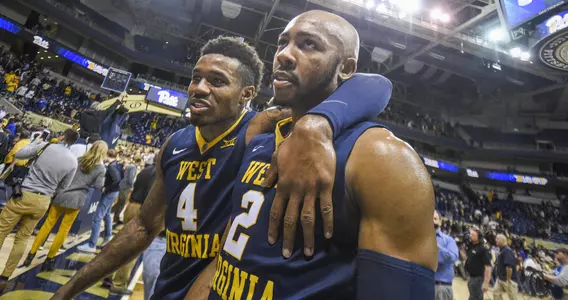
Photo by: All Pro Photography/Dale Sparks
WVU's Dynamic Duo Carter, Miles Thriving
December 13, 2017 03:41 PM | Men's Basketball
MORGANTOWN, W.Va. - During the second half of last Saturday's victory at Pitt, we got a better appreciation of the value of having a pair of seasoned, senior guards when Jevon Carter and Daxter Miles Jr. were forced to go to the bench with four fouls each.
The Mountaineers' double-digit lead dwindled to three in a snap of a finger, requiring coach Bob Huggins to put his two best players back into the game for the remaining 9:12.
Both managed to stay on the court and West Virginia escaped Oakland with a 69-60 victory.
"I liked the game better when Carter was sitting on the bench (in foul trouble)," Pitt coach Kevin Stallings said.
These two have already played 110 college games together, and will have 131 games under their belts before the start of postseason play. Having two senior guards who have played together for four years is like having a pair of aces up your sleeves.
Think about it: How often today do you see two four-year backcourt players spend their entire college careers together? It happens, but probably not as much as it once did before players began transferring to other four-year schools or was allowed to leave school early for the NBA Draft.
In 2016, Oklahoma's senior backcourt combo of Buddy Hield and Isaiah Cousins led the Sooners to the Final Four. Those two played 132 college games together.
Notre Dame guards Jerian Grant and Pat Connaughton helped the Fighting Irish to a 94-45 overall record and three trips to the NCAA Tournament, including an Elite Eight visit during their senior season in 2015.
They played 119 times together.
In 2012, Missouri's senior guard tandem of Marcus Denmon and Kim English helped the Tigers to four NCAA appearances and a record of 107-34. That's 141 games for both.
A year before that, BYU's senior backcourt combo of Jimmer Fredette and Jackson Emery won 114 of 141 games during their careers and helped the Cougars to a Sweet 16 trip in 2011.
Maryland's senior backcourt of Greivis Vasquez and Eric Hayes led the Terps to a 24-9 record and a third trip to the Big Dance in their fourth season together in 2010.
In 2008, Tennessee's Chris Lofton and JaJuan Smith helped the Volunteers to a 31-5 record and a trip to the Sweet 16.
Villanova's terrific senior backcourt of Randy Foye and Allan Ray earned All-America honors in 2006 after leading the Wildcats to the Elite Eight.
Indiana had success with its senior backcourt tandem of A.J. Guyton and Michael Lewis in 2000, as did Michigan State in 1995 with its two senior guards Shawn Respert and Eric Snow.
And perhaps the gold standard of modern backcourt tandems, Duke's Bobby Hurley and Thomas Hill, helped the Blue Devils to a four-year record of 119-26, two NCAA titles and three Final Four appearances.
They played 140 games together and combined to score 3,325 points, hand out 1,253 assists, grab 794 rebounds and generate 396 steals.
As you can see, while experience may not always guarantee success, it sure doesn't hurt.
West Virginia, too, has had some success with four-year guard tandems.
Who can forget what J.D. Collins and Johannes Herber did for John Beilein's Mountaineer teams in the mid-2000s, the duo helping WVU to records of 24-11 in 2005 and 22-11 in 2006? Those two can count an Elite Eight and Sweet 16 to their career résumés.
Or, what undersized guards Mike Boyd and Marsalis Basey managed to accomplish for Gale Catlett's WVU teams in the early 1990s?
Lowes Moore and Joe Fryz didn't play on great WVU teams, but their play together in the 1980 Eastern Eight tournament nearly helped the Mountaineers upset their way into the Big Dance.
Rod Thorn and Jim McCormick didn't play four varsity seasons together at WVU, but they did play together on the freshman team in 1960 and finished their Mountaineer careers with NCAA trips in 1962 and 1963.
The same goes for Rod Hundley and Clayce Kishbaugh, who helped West Virginia to three straight NCAA Tournament appearances after performing together on WVU's freshman squad in 1954.
But what Carter and Miles Jr. are aiming to accomplish together this season could be unmatched by any pair of four-year guards in school history.
A disclaimer: Any guard paired with Jerry West would be considered the greatest duo in school history, but West spent most of his Mountaineer career as a wing and didn't become a true guard until he got to the pros with the Los Angeles Lakers.
At any rate, Carter and Miles have helped West Virginia to an 88-29 record so far (.752 winning percentage), and have had the Mountaineers in the national rankings in all but just a handful of weeks during their college careers.
They've already made two trips to the Sweet 16 and are on pace to end their careers as the winningest backcourt tandem in school history.
When the season is finished, their stats and team success should also compare favorably with most of those other senior backcourts mentioned above, with the exception of Hurley-Hill.
Carter is now 24th in career scoring at WVU and should crack the school's top 10 when he's done. He already owns the Mountaineer record for career steals (256) and has an outside shot of breaking Steve Berger's school record for career assists with 574.
"He's a heck of a player," Virginia coach Tony Bennett said following Carter's 23-point, 10-rebound, seven-assist performance in the Cavaliers' recent 68-61 loss to the Mountaineers. "When you have a player the caliber of Carter, what he did is pretty darn good. He's physical and he's tough."
Miles Jr. is seven points shy of becoming West Virginia's 52nd 1,000-point scorer, and he is moving up the list in career steals as well, where he is currently in 17th place with 145.
Miles' play down the stretch in West Virginia's three key non-conference wins this year against Missouri, Virginia and Pitt was exceptional.
"Dax has put more time in this year than he has in previous years in terms of trying to study the game, study the opponent and getting in the gym," Huggins said.
And think back to what he did last year in late-season wins against Texas Tech and Iowa State. He is clearly playing at a much higher level than he did earlier in his career.
As for Carter, Huggins has repeatedly mentioned that he doesn't want him to be remembered solely for his defense. He is probably the best on-ball defender in the country today, for sure, but his offense has improved dramatically to the point where he is now second in the Big 12 in scoring averaging 19.4 points per game.
Miles is 10 places behind him in 12th place at 14.6 points per game.
These two are generating about 40 percent of West Virginia's offense so far this year. Eventually, they are going to get some scoring help from junior forward Esa Ahmad.
When that happens is anyone's guess.
In the meantime, it might be a good idea for those two to stay out of foul trouble. We saw last Saturday what can happen to the Mountaineers when they're not on the floor.
The Mountaineers' double-digit lead dwindled to three in a snap of a finger, requiring coach Bob Huggins to put his two best players back into the game for the remaining 9:12.
Both managed to stay on the court and West Virginia escaped Oakland with a 69-60 victory.
"I liked the game better when Carter was sitting on the bench (in foul trouble)," Pitt coach Kevin Stallings said.
These two have already played 110 college games together, and will have 131 games under their belts before the start of postseason play. Having two senior guards who have played together for four years is like having a pair of aces up your sleeves.
Think about it: How often today do you see two four-year backcourt players spend their entire college careers together? It happens, but probably not as much as it once did before players began transferring to other four-year schools or was allowed to leave school early for the NBA Draft.
In 2016, Oklahoma's senior backcourt combo of Buddy Hield and Isaiah Cousins led the Sooners to the Final Four. Those two played 132 college games together.
Notre Dame guards Jerian Grant and Pat Connaughton helped the Fighting Irish to a 94-45 overall record and three trips to the NCAA Tournament, including an Elite Eight visit during their senior season in 2015.
They played 119 times together.
In 2012, Missouri's senior guard tandem of Marcus Denmon and Kim English helped the Tigers to four NCAA appearances and a record of 107-34. That's 141 games for both.
A year before that, BYU's senior backcourt combo of Jimmer Fredette and Jackson Emery won 114 of 141 games during their careers and helped the Cougars to a Sweet 16 trip in 2011.
Maryland's senior backcourt of Greivis Vasquez and Eric Hayes led the Terps to a 24-9 record and a third trip to the Big Dance in their fourth season together in 2010.
In 2008, Tennessee's Chris Lofton and JaJuan Smith helped the Volunteers to a 31-5 record and a trip to the Sweet 16.
Villanova's terrific senior backcourt of Randy Foye and Allan Ray earned All-America honors in 2006 after leading the Wildcats to the Elite Eight.
Indiana had success with its senior backcourt tandem of A.J. Guyton and Michael Lewis in 2000, as did Michigan State in 1995 with its two senior guards Shawn Respert and Eric Snow.
And perhaps the gold standard of modern backcourt tandems, Duke's Bobby Hurley and Thomas Hill, helped the Blue Devils to a four-year record of 119-26, two NCAA titles and three Final Four appearances.
They played 140 games together and combined to score 3,325 points, hand out 1,253 assists, grab 794 rebounds and generate 396 steals.
As you can see, while experience may not always guarantee success, it sure doesn't hurt.
West Virginia, too, has had some success with four-year guard tandems.
Who can forget what J.D. Collins and Johannes Herber did for John Beilein's Mountaineer teams in the mid-2000s, the duo helping WVU to records of 24-11 in 2005 and 22-11 in 2006? Those two can count an Elite Eight and Sweet 16 to their career résumés.
Or, what undersized guards Mike Boyd and Marsalis Basey managed to accomplish for Gale Catlett's WVU teams in the early 1990s?
Lowes Moore and Joe Fryz didn't play on great WVU teams, but their play together in the 1980 Eastern Eight tournament nearly helped the Mountaineers upset their way into the Big Dance.
Best senior guard combo in @WVUhoops history?
— John Antonik (@JohnAntonik) December 12, 2017
Rod Thorn and Jim McCormick didn't play four varsity seasons together at WVU, but they did play together on the freshman team in 1960 and finished their Mountaineer careers with NCAA trips in 1962 and 1963.
The same goes for Rod Hundley and Clayce Kishbaugh, who helped West Virginia to three straight NCAA Tournament appearances after performing together on WVU's freshman squad in 1954.
But what Carter and Miles Jr. are aiming to accomplish together this season could be unmatched by any pair of four-year guards in school history.
A disclaimer: Any guard paired with Jerry West would be considered the greatest duo in school history, but West spent most of his Mountaineer career as a wing and didn't become a true guard until he got to the pros with the Los Angeles Lakers.
At any rate, Carter and Miles have helped West Virginia to an 88-29 record so far (.752 winning percentage), and have had the Mountaineers in the national rankings in all but just a handful of weeks during their college careers.
They've already made two trips to the Sweet 16 and are on pace to end their careers as the winningest backcourt tandem in school history.
When the season is finished, their stats and team success should also compare favorably with most of those other senior backcourts mentioned above, with the exception of Hurley-Hill.
Carter is now 24th in career scoring at WVU and should crack the school's top 10 when he's done. He already owns the Mountaineer record for career steals (256) and has an outside shot of breaking Steve Berger's school record for career assists with 574.
"He's a heck of a player," Virginia coach Tony Bennett said following Carter's 23-point, 10-rebound, seven-assist performance in the Cavaliers' recent 68-61 loss to the Mountaineers. "When you have a player the caliber of Carter, what he did is pretty darn good. He's physical and he's tough."
Miles Jr. is seven points shy of becoming West Virginia's 52nd 1,000-point scorer, and he is moving up the list in career steals as well, where he is currently in 17th place with 145.
Miles' play down the stretch in West Virginia's three key non-conference wins this year against Missouri, Virginia and Pitt was exceptional.
"Dax has put more time in this year than he has in previous years in terms of trying to study the game, study the opponent and getting in the gym," Huggins said.
And think back to what he did last year in late-season wins against Texas Tech and Iowa State. He is clearly playing at a much higher level than he did earlier in his career.
As for Carter, Huggins has repeatedly mentioned that he doesn't want him to be remembered solely for his defense. He is probably the best on-ball defender in the country today, for sure, but his offense has improved dramatically to the point where he is now second in the Big 12 in scoring averaging 19.4 points per game.
Miles is 10 places behind him in 12th place at 14.6 points per game.
These two are generating about 40 percent of West Virginia's offense so far this year. Eventually, they are going to get some scoring help from junior forward Esa Ahmad.
When that happens is anyone's guess.
In the meantime, it might be a good idea for those two to stay out of foul trouble. We saw last Saturday what can happen to the Mountaineers when they're not on the floor.

Players Mentioned

G
/ Men's Basketball
G
/ Men's BasketballCollege Basketball Crown Recap
Thursday, April 16
Ross Hodge, Honor Huff & Brenen Lorient | Oklahoma Postgame
Sunday, April 05
Ross Hodge, Treysen Eaglestaff & Brenen Lorient | Creighton Postgame
Saturday, April 04
Ross Hodge & Honor Huff | Stanford Postgame
Thursday, April 02