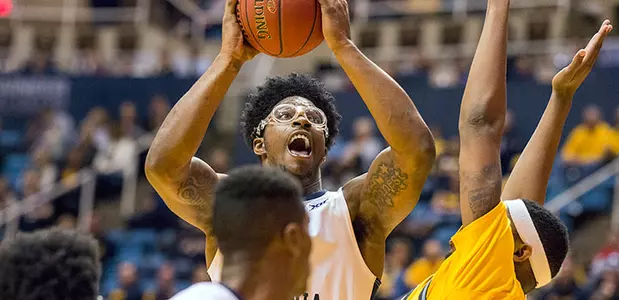
Williams-Main-12515.jpg
Williams' Place Among Top Power Forwards Secure
March 29, 2016 01:48 PM | Men's Basketball
Earlier today, West Virginia University junior forward Devin Williams announced he will enter his name into this year’s NBA draft.
A new NCAA rule put in place in January means Williams is permitted to go through the draft process, including attending draft camp (if invited), but he can pull out by May 25th as long as he doesn’t sign with an agent. So far he hasn’t, I am told.
But if Williams remains in the draft and does not return for his senior year, his three seasons at WVU have to rank among the most productive in school history for power forwards.
The 6-foot-9-inch, 255-pound Cincinnati resident averaged 13.3 points and 9.5 rebounds per game during a junior campaign that saw West Virginia win 24 regular season games, advance to the championship game of the Big 12 tournament and spend a good portion of the season ranked in the top 10.
A disappointing ending to his junior year against Stephen F. Austin in the first round of the NCAA Tournament does not diminish what Williams accomplished in three seasons as a Mountaineer player.
As a sophomore, he led WVU to a pair of NCAA Tournament wins against Buffalo and Maryland and a trip to the Sweet 16 to face Kentucky. His play around the basket was a key factor in West Virginia’s eight-game improvement in the win column in 2015, going from 17 victories and an NIT bid during his freshman season in 2014 to a 25-win season a year later.
In three seasons, Williams scored 1,134 points and grabbed 846 rebounds, including 299 offensive boards, against arguably the toughest competition in school history. West Virginia won 68 of the 103 games he played in for a .660 winning percentage.
So, if Williams chooses to stay in the draft, where does he rank among the school’s best power forwards?
That’s an interesting question because West Virginia has had some pretty good ones through the years, especially the last 25, 30 years or so.
Darryl Prue was an excellent four-man for four years in the mid-to-late 1980s, leading the Mountaineers to three NCAA Tournament appearances and a trip to the NIT. Prue’s three-year stats (1,047 points and 661 rebounds) are very comparable to Williams’, as was his team’s three-year record of 63-23. In four seasons the Washington, D.C., native scored 1,426 points and grabbed 865 rebounds.
Prue was an exceptional passer, he could put the ball on the floor and he was an excellent defender with 230 career steals, but his kryptonite came at the free throw line where he was just a 46.5 percent shooter.
Chris Brooks was another outstanding four-year power forward who played around the same time as Prue, and, his three-year stats are also very comparable to Williams’ (1,142 points and 506 rebounds).
Brooks was an explosive leaper who played much taller than his listed 6-feet-6 inches (he was probably closer to 6-5) and he was an outstanding finisher around the basket. Like Prue, however, Brooks struggled at the foul line where he made just 43.5 percent of his charity attempts. In four years Brooks accumulated 1,661 points and 755 rebounds.
More recently, Chris Moss, a 6-foot-8-inch, 240-pound power forward from Chesterfield, Virginia, is also a worthy comparison.
Moss’ three-year totals included 676 points and 499 rebounds playing against competition in the Big East very similar to what Williams faced in the Big 12. He also put up good numbers as a senior in 2002, averaging 17.5 points and 8.0 rebounds per game, but the Mountaineers struggled mightily that year and, really, for three out of the four seasons he played at WVU; Moss played on just one winning team during his four-year WVU career from 1999-2002. Moss' four-year totals include 1,167 points and 722 rebounds.
Calvin Bowman, Marcus Goree and Joe Alexander were really good forwards, too, but I would consider them 'tweeners because of their slender builds.
Of course, Kevin Jones' name has to be at the top of any list of WVU power forwards. His four-year numbers include a terrific senior season in 2012 when he averaged 19.9 points and 10.9 rebounds per game and SHOULD have been named Big East player of the year. Jones’ three-year totals were in line with the others - 1,165 points and 688 rebounds - and he was easily the best outside shooter of the group with 110 career 3-point field goals. The teams Kevin played on were also outstanding, including a run to the Final Four during his freshman year in 2010. KJ's four-year numbers include 1,822 points and 1,048 rebounds - now the measuring stick for all WVU power forwards.
And while Prue, Brooks, Moss and Jones played the position a little bit differently than Williams, there was one guy whose game was pretty similar to Devin’s - Ricky Robinson.
Robinson was about the same size as Williams (6-foot-8, 245 pounds) and although he was left-handed, he did most of his work close to the basket or along the baseline with medium-range jumpers.
Sounds familiar, huh?
And their three-year numbers were pretty close, too - Robinson scored 940 points and grabbed 510 rebounds during his first three seasons at WVU in 1991, 1992 and 1993. Robinson’s fourth year in 1994 saw him average 14.9 points and 8.1 rebounds per game, while shooting 50 percent from the floor and 60 percent from the free throw line.
That’s reasonably close to the numbers Devin put up this year.
However, the WVU teams Robinson played on were not quite as successful as Devin’s, the Mountaineers reaching the NCAA Tournament just once when Ricky was a sophomore in 1992 while playing in the Atlantic 10 Conference.
His other three years in Morgantown were spent playing in the NIT, including his senior season in 1994 when WVU got off to a great start by winning 13 of its first 15 games before faltering down the stretch.
That ‘94 season was one of the more disappointing campaigns in school history, although not because of anything Ricky did or didn’t do on the basketball court.
It would have been fascinating to see how Ricky would have fit in Huggins’ system, just as it was interesting watching Devin’s development under Huggins from his freshman year to where he is now.
The question is: Has Williams spent enough time with Huggs to parlay that into a productive professional career?
We’ll see.

Ross Hodge, Honor Huff & Brenen Lorient | Oklahoma Postgame
Sunday, April 05
Ross Hodge, Treysen Eaglestaff & Brenen Lorient | Creighton Postgame
Saturday, April 04
Ross Hodge & Honor Huff | Stanford Postgame
Thursday, April 02
Ross Hodge | College Basketball Crown Preview
Monday, March 30