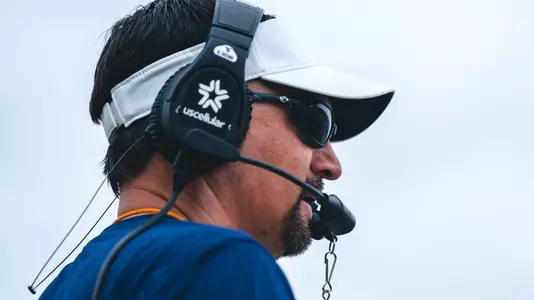
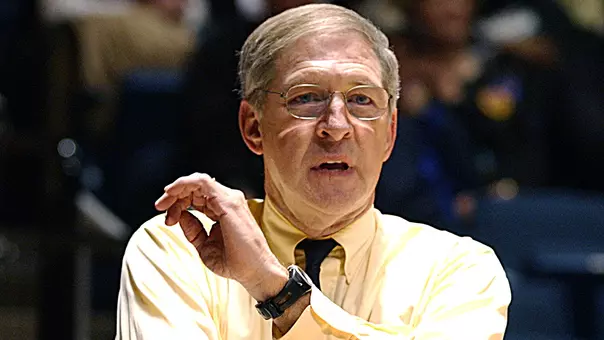
Photo by: WVU Athletic Communications
Football Notebook: Brown in Favor of NCAA Rule Changes for 2024
May 06, 2024 12:00 PM | Football, Blog
MORGANTOWN, W.Va. – West Virginia coach Neal Brown said late last month that he is in favor of college football having rules similar to professional football.
"As a casual fan, in terms of the game on Saturday or Sunday, it should look very similar," Brown said following the annual Gold-Blue Spring Game last month. "There are way too many differences right now, so it's somewhat confusing for the novice fan."
The NCAA Playing Rules Oversight Panel adopted three significant rule changes for 2024 that have been in place in the NFL for many years.
Beginning this fall, teams will be able to use coach-to-player communications via radio transmitters in helmets to an offensive and defensive player on the field. Those players will be identified by having a green dot on the back midline of their helmet.
Brown said they have been experimenting with the new communications system for a while now in practice in anticipation of the rule change.
"(During the spring game) we were really vanilla with it," he said. "We used it in the bowl game, and we've used it the last two springs, so it's not necessarily new to us, but we're using a different company now. I think it's going to help the game. It's going to help defenses as well. People are kind of underestimating that, but it's really going to help the defenses."
West Virginia's middle linebackers have been using the helmet communications system, but Brown indicated that it's still to be determined who will use it in the games this fall. Overall, he believes helmet communications will alleviate some of the sloppiness that can take place on the sidelines.
"If you feel like a team really has your signals, it gives you some options on how you want to communicate," he noted.
NFL teams have been communicating with quarterbacks via helmets since 1994, and NFL defenders have been doing so since 2008.
Tablets will also be permitted this year on the sidelines to view in-game video only. The video can include the game broadcast feed and camera angles from the sideline and the end zone.
Up to 18 active tablets for use in the coaching booth, sideline and locker room will be permitted. They cannot be connected to projection devices and cannot include analytics, data or data accessing capabilities.
Another rule synonymous with the NFL is the two-minute warning, its origins dating back to the early days of the league when game time was kept by a member of the officiating crew on the field. Its function was to serve as a checkpoint to make sure both teams were aware of the time remaining in the game.
When television became prominent in the late 1960s and early 1970s, the two-minute warning took on more significance as a means of building drama for the conclusion of the game.
College football is adopted a two-minute warning as a method of synchronizing end-of-game timing rules, according to secretary-rules editor Steve Shaw. It will also help avoid consecutive media time outs at the conclusions of each half.
"I think it's great for the officials and clock operators because the rules change under two minutes, so it's a good reminder for them," Brown said. "There is going to be some strategy involved from a coaching perspective. Do you take a timeout before the two-minute warning?"
The two-minute warnings at the end of the second and fourth quarters will not be an additional timeout, but rather serves as fixed stopping points when television will know it can take media breaks.
"As a casual fan, in terms of the game on Saturday or Sunday, it should look very similar," Brown said following the annual Gold-Blue Spring Game last month. "There are way too many differences right now, so it's somewhat confusing for the novice fan."
The NCAA Playing Rules Oversight Panel adopted three significant rule changes for 2024 that have been in place in the NFL for many years.
Beginning this fall, teams will be able to use coach-to-player communications via radio transmitters in helmets to an offensive and defensive player on the field. Those players will be identified by having a green dot on the back midline of their helmet.
Brown said they have been experimenting with the new communications system for a while now in practice in anticipation of the rule change.
"(During the spring game) we were really vanilla with it," he said. "We used it in the bowl game, and we've used it the last two springs, so it's not necessarily new to us, but we're using a different company now. I think it's going to help the game. It's going to help defenses as well. People are kind of underestimating that, but it's really going to help the defenses."
West Virginia's middle linebackers have been using the helmet communications system, but Brown indicated that it's still to be determined who will use it in the games this fall. Overall, he believes helmet communications will alleviate some of the sloppiness that can take place on the sidelines.
"If you feel like a team really has your signals, it gives you some options on how you want to communicate," he noted.
NFL teams have been communicating with quarterbacks via helmets since 1994, and NFL defenders have been doing so since 2008.
Tablets will also be permitted this year on the sidelines to view in-game video only. The video can include the game broadcast feed and camera angles from the sideline and the end zone.
Up to 18 active tablets for use in the coaching booth, sideline and locker room will be permitted. They cannot be connected to projection devices and cannot include analytics, data or data accessing capabilities.
Another rule synonymous with the NFL is the two-minute warning, its origins dating back to the early days of the league when game time was kept by a member of the officiating crew on the field. Its function was to serve as a checkpoint to make sure both teams were aware of the time remaining in the game.
When television became prominent in the late 1960s and early 1970s, the two-minute warning took on more significance as a means of building drama for the conclusion of the game.
College football is adopted a two-minute warning as a method of synchronizing end-of-game timing rules, according to secretary-rules editor Steve Shaw. It will also help avoid consecutive media time outs at the conclusions of each half.
"I think it's great for the officials and clock operators because the rules change under two minutes, so it's a good reminder for them," Brown said. "There is going to be some strategy involved from a coaching perspective. Do you take a timeout before the two-minute warning?"
The two-minute warnings at the end of the second and fourth quarters will not be an additional timeout, but rather serves as fixed stopping points when television will know it can take media breaks.
Saturday, September 12
Saturday, September 12
Saturday, September 12
Saturday, September 12