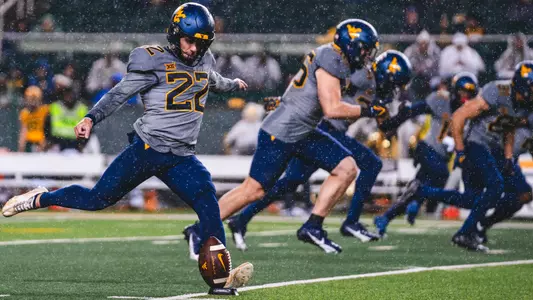
Photo by: WVU Athletic Communications
Mountaineers Putting Lots of Emphasis on Kickoff Coverage This Spring
April 19, 2024 02:20 PM | Football, Blog
MORGANTOWN, W.Va. – Neal Brown says covering kickoffs is as much science as anything and admitted earlier this week that his team didn't "master it" last season.
West Virginia's kick coverage unit allowed an NCAA-most three kickoff returns for touchdowns, and opponents averaged 25.19 yards per return, ranking the Mountaineers near the bottom FBS kick coverage units in the country last year.
Broken down, West Virginia was required to cover 42 out of 64 total kickoffs last year, meaning its touchback rate was 34.4%. That's slightly lower than the 38.1% touchback percentage in 2022 when the Mountaineers ranked 77thnationally in kick coverage.
In 2021, the touchback percentage was 22.6% for a kickoff unit that ranked 79th nationally, and in 2020, during the COVID year, only 16.3% of West Virginia's 43 kicks were downed in the end zone, although WVU managed to rank 39th nationally by allowing just 19.06 yards per return.
Brown's first season at West Virginia in 2019 saw its kick coverage unit surrender a 17.27 yards-per-return average with a touchback percentage of 48.8% to rank ninth nationally. That was also the last time the Mountaineers didn't allow a kickoff return for a touchdown for an entire season.
Clearly, touchbacks play a significant role in successful kickoff coverage. North Texas, the best kick coverage unit in the country last year, had just five of its 76 kickoffs returned for an average of 11.2 yards per return.
That's an impressive 93.4% touchback percentage.
Louisiana Tech had to cover only six of its 56 kickoffs while allowing11.67 yards per return, so getting the football deep into the end zone with at least four seconds of hang time is most desirable.
Another aspect that must be taken into consideration is overall linebacker and defensive backfield depth. Those two areas traditionally make up most of your kick coverage personnel, and those two areas have been plagued by depth issues the last three or four years for West Virginia.
Recruiting linebackers and defensive backs have been a major priority for the Mountaineers over the last three offseasons and their hard work is finally beginning to pay off.
Linebackers coach Jeff Koonz, who also helps oversee the kick coverage units, said earlier this week that he's now got six experienced linebackers this spring with portal additions Reid Carrico and Ty French, not to mention high school prospects Rickey Williams and Curtis Jones coming on board later this summer.
Also, injured linebackers Trey Lathan and Josiah Trotter are now back to full strength and have been performing well so far.
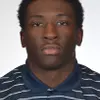
West Virginia has also gone hard into the transfer portal for secondary help, adding Northwestern teammates Jaheem Joseph and Garnett Hollis, Colorado State cornerback T.J. Crandell and Duquesne cornerback Ayden Garnes.
Those guys will join the other returning safeties, corners and linebackers to help bolster WVU's kick coverage responsibilities.
"The No. 1 issue we identified last year on kickoff was a personnel issue," Koonz admitted. "After that, we believe there are techniques that we can teach better from a coaching perspective to allow them to play faster. We're not really getting into the personnel side of it this spring, so we're fixing the technique part of it and then we will get the right pieces into the right spots when we get to the summer and into fall camp."
"Our bandits and spur bodies, those guys can run," Brown added. "(Defensive end) Sean Martin is a guy that runs well. He's 19 and 20 (mph) all the time on the GPS, so he's a guy that could even be a factor for us this year on kickoff, too."
Koonz indicated the staff has put a significant amount of time and effort into kickoff coverage this spring.
"We've done some version of kickoff every day," he noted. "It's been highlighted as a point of emphasis, but we're not going to line up with 10 across and have guys run down the field and fit up returns.
"All our special teams come down to techniques," he said. "There are about eight to nine movements, whether those are how to defeat blocks, how to avoid blocks or how to make blocks, because that's what special teams come down to. On cover units, you've got to avoid and defeat blocks and finish plays with tackles."
As Koonz mentioned, rarely do teams practice live kickoffs because of the great risk of injury. It remains the most dangerous play in football with one study conducted by the American Medical Association in 2018 revealing a staggering 10.93 concussions per 1,000 kickoffs.
Brown indicated on Wednesday that his team will probably practice less than five full-speed kickoffs during the fall before the Mountaineers take on Penn State in the season opener at Milan Puskar Stadium.
It's just simply too risky having too many full-speed collisions.
"We do a kick scrimmage where I know we do two live and then at the start (game preparation) we get maybe two or three more leading into the first game," Brown noted. "That's it, and it's hard.
"On special teams, punt and field goal are really the only ones we do all 11," he continued. "Most of it is part, part, whole, meaning in the spring we're going individual techniques and then we kind of pause. When I say pause, maybe it's the left guard and the left tackle on punt, or maybe it's the right upback, right returner and right end on kickoff return. On kickoff, maybe it's the ball guy and the capper and we're working those in pods, but we don't work all 11."
Which means the coaches won't really know for sure how their kick coverage unit is going to perform until the ball is kicked off in a game.
"Anything in football, you've got to be able to full-speed evaluate and teach," Koonz said. "For kickoff, to me, it's no different than on defense when we are going to do a half-line run fit period before we do a full run fit period with the entire team. Same thing in the pass game. We are going to do a seven-on-seven before we get the pass rush element into a team setting. It's the same for every unit.
"At the end of the day, we have to put it on film so guys understand their 1/11th job in relation to the other 10 guys," Koonz said. "How you phase that through an entire year is kind of where the magic is."
Brown mentioned there are some kickoff skill-specific drills and special team circuits that have been introduced this spring to help with coverage. He hopes those will make a difference on the kickoffs that don't reach the end zone and are returned.
"We missed a ton of tackles from just overrunning the ball from the backside, so now what we're really doing is we're working our wrap tackles where we're practicing it but not putting a bunch of force on their shoulders," he said. "A point of emphasis in the off-season was, 'How can we practice these tackles that we're missing on kickoffs without having 22 bodies out there?'"
Koonz also believes late in the season, when depth was becoming a serious issue for the Mountaineers, the staff probably moved guys around too much trying to get them in the perfect spots on kickoffs.
All three kickoff returns for touchdowns happened after Lathan went down with a season-ending injury at TCU, causing a trickle-down effect that ultimately impacted the kick coverage units.
"Statistically, yeah, they're skewed because we gave up two in one game and we gave up three in one year," Koonz said. "Nobody likes to sit up here and say this - and we had a lot of issues on kickoffs last year - but take away those returns and we're close to where we needed to be. Now, how can we grow the number of guys that we can put out there who know how to fit, who know how to avoid, who know how to defeat blocks and who know how to get the ball carrier down?
"But I love where we're going. The guys have taken ownership in it all the way across the board," Koonz concluded.
West Virginia wrapped up this week's spring work with a practice inside the stadium this morning. Just two practices remain next Tuesday and Thursday ahead of Saturday's Gold-Blue Spring Game inside Milan Puskar Stadium at noon.
West Virginia's kick coverage unit allowed an NCAA-most three kickoff returns for touchdowns, and opponents averaged 25.19 yards per return, ranking the Mountaineers near the bottom FBS kick coverage units in the country last year.
Broken down, West Virginia was required to cover 42 out of 64 total kickoffs last year, meaning its touchback rate was 34.4%. That's slightly lower than the 38.1% touchback percentage in 2022 when the Mountaineers ranked 77thnationally in kick coverage.
In 2021, the touchback percentage was 22.6% for a kickoff unit that ranked 79th nationally, and in 2020, during the COVID year, only 16.3% of West Virginia's 43 kicks were downed in the end zone, although WVU managed to rank 39th nationally by allowing just 19.06 yards per return.
Brown's first season at West Virginia in 2019 saw its kick coverage unit surrender a 17.27 yards-per-return average with a touchback percentage of 48.8% to rank ninth nationally. That was also the last time the Mountaineers didn't allow a kickoff return for a touchdown for an entire season.
Clearly, touchbacks play a significant role in successful kickoff coverage. North Texas, the best kick coverage unit in the country last year, had just five of its 76 kickoffs returned for an average of 11.2 yards per return.
That's an impressive 93.4% touchback percentage.
Louisiana Tech had to cover only six of its 56 kickoffs while allowing11.67 yards per return, so getting the football deep into the end zone with at least four seconds of hang time is most desirable.
Another aspect that must be taken into consideration is overall linebacker and defensive backfield depth. Those two areas traditionally make up most of your kick coverage personnel, and those two areas have been plagued by depth issues the last three or four years for West Virginia.
Recruiting linebackers and defensive backs have been a major priority for the Mountaineers over the last three offseasons and their hard work is finally beginning to pay off.
Linebackers coach Jeff Koonz, who also helps oversee the kick coverage units, said earlier this week that he's now got six experienced linebackers this spring with portal additions Reid Carrico and Ty French, not to mention high school prospects Rickey Williams and Curtis Jones coming on board later this summer.
Also, injured linebackers Trey Lathan and Josiah Trotter are now back to full strength and have been performing well so far.
West Virginia has also gone hard into the transfer portal for secondary help, adding Northwestern teammates Jaheem Joseph and Garnett Hollis, Colorado State cornerback T.J. Crandell and Duquesne cornerback Ayden Garnes.
Those guys will join the other returning safeties, corners and linebackers to help bolster WVU's kick coverage responsibilities.
"The No. 1 issue we identified last year on kickoff was a personnel issue," Koonz admitted. "After that, we believe there are techniques that we can teach better from a coaching perspective to allow them to play faster. We're not really getting into the personnel side of it this spring, so we're fixing the technique part of it and then we will get the right pieces into the right spots when we get to the summer and into fall camp."
"Our bandits and spur bodies, those guys can run," Brown added. "(Defensive end) Sean Martin is a guy that runs well. He's 19 and 20 (mph) all the time on the GPS, so he's a guy that could even be a factor for us this year on kickoff, too."
Koonz indicated the staff has put a significant amount of time and effort into kickoff coverage this spring.
"We've done some version of kickoff every day," he noted. "It's been highlighted as a point of emphasis, but we're not going to line up with 10 across and have guys run down the field and fit up returns.
"All our special teams come down to techniques," he said. "There are about eight to nine movements, whether those are how to defeat blocks, how to avoid blocks or how to make blocks, because that's what special teams come down to. On cover units, you've got to avoid and defeat blocks and finish plays with tackles."
As Koonz mentioned, rarely do teams practice live kickoffs because of the great risk of injury. It remains the most dangerous play in football with one study conducted by the American Medical Association in 2018 revealing a staggering 10.93 concussions per 1,000 kickoffs.
Brown indicated on Wednesday that his team will probably practice less than five full-speed kickoffs during the fall before the Mountaineers take on Penn State in the season opener at Milan Puskar Stadium.
It's just simply too risky having too many full-speed collisions.
"We do a kick scrimmage where I know we do two live and then at the start (game preparation) we get maybe two or three more leading into the first game," Brown noted. "That's it, and it's hard.
"On special teams, punt and field goal are really the only ones we do all 11," he continued. "Most of it is part, part, whole, meaning in the spring we're going individual techniques and then we kind of pause. When I say pause, maybe it's the left guard and the left tackle on punt, or maybe it's the right upback, right returner and right end on kickoff return. On kickoff, maybe it's the ball guy and the capper and we're working those in pods, but we don't work all 11."
Which means the coaches won't really know for sure how their kick coverage unit is going to perform until the ball is kicked off in a game.
"Anything in football, you've got to be able to full-speed evaluate and teach," Koonz said. "For kickoff, to me, it's no different than on defense when we are going to do a half-line run fit period before we do a full run fit period with the entire team. Same thing in the pass game. We are going to do a seven-on-seven before we get the pass rush element into a team setting. It's the same for every unit.
"At the end of the day, we have to put it on film so guys understand their 1/11th job in relation to the other 10 guys," Koonz said. "How you phase that through an entire year is kind of where the magic is."
Brown mentioned there are some kickoff skill-specific drills and special team circuits that have been introduced this spring to help with coverage. He hopes those will make a difference on the kickoffs that don't reach the end zone and are returned.
"We missed a ton of tackles from just overrunning the ball from the backside, so now what we're really doing is we're working our wrap tackles where we're practicing it but not putting a bunch of force on their shoulders," he said. "A point of emphasis in the off-season was, 'How can we practice these tackles that we're missing on kickoffs without having 22 bodies out there?'"
Koonz also believes late in the season, when depth was becoming a serious issue for the Mountaineers, the staff probably moved guys around too much trying to get them in the perfect spots on kickoffs.
All three kickoff returns for touchdowns happened after Lathan went down with a season-ending injury at TCU, causing a trickle-down effect that ultimately impacted the kick coverage units.
"Statistically, yeah, they're skewed because we gave up two in one game and we gave up three in one year," Koonz said. "Nobody likes to sit up here and say this - and we had a lot of issues on kickoffs last year - but take away those returns and we're close to where we needed to be. Now, how can we grow the number of guys that we can put out there who know how to fit, who know how to avoid, who know how to defeat blocks and who know how to get the ball carrier down?
"But I love where we're going. The guys have taken ownership in it all the way across the board," Koonz concluded.
West Virginia wrapped up this week's spring work with a practice inside the stadium this morning. Just two practices remain next Tuesday and Thursday ahead of Saturday's Gold-Blue Spring Game inside Milan Puskar Stadium at noon.

Players Mentioned

LB
/ Football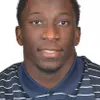
CB
/ Football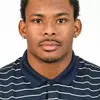
S
/ Football
LB
/ Football
DL
/ Football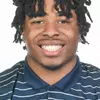
LB
/ FootballRoss Hodge, Treysen Eaglestaff & Brenen Lorient | Creighton Postgame
Saturday, April 04
Ross Hodge & Honor Huff | Stanford Postgame
Friday, April 03
Geimere Latimer | April 2
Friday, April 03
Coach Deke Adams | April 2
Friday, April 03