MORGANTOWN, W.Va. - Sixteen volunteers, a young coach with Midwest ties and a budget of less than $5,000 is how women's gymnastics began at West Virginia University in 1974.
Today, 50 years later, the sport is stronger than ever.
Gymnastics joined tennis and basketball as the three sports chosen to start WVU's women's sports program during the 1973-74 academic year. In the early 1970s, women's sports were blossoming throughout the country because of the Educational Amendments Act signed into law on June 23, 1972.
Contained within that was the Title IX provision that protected women from discrimination based on sex in educational programs and activities that receive federal financial assistance. That portion of the act was written by Indiana senator Birch Bayh, a strong women's rights advocate.
Today, the Educational Amendments Act is better known by its Title IX provision and is simply referred to as Title IX.
In places slow to adopt women's sports, Title IX provided the jolt necessary for action. Kittie Blakemore (WVU Athletics Communications photo).
West Virginia University School of Physical Education assistant professor Kittie Blakemore, later the Mountaineers' first women's basketball coach, was one of the leading women's sports advocates on campus at the time. Blakemore coordinated the women's intramural program at WVU and was also one of the co-authors of the women's sports constitution for the West Virginia Intercollegiate Athletic Conference (WVIAC) in 1969, even though WVU was not a member.
Blakemore, along with physical education colleagues Wincie Carruth and Martha Thorn, had spent several years unsuccessfully trying to get West Virginia to sponsor a women's sports program. Their efforts were consistently stonewalled because of a lack of funding.
However, in 1972, the handwriting was on the wall. WVU needed to find some money to create a women's sports program or else it was going to lose far more money in federal appropriations if it was not Title IX compliant, not to mention the Title IX lawsuits that were sure to follow.
Blakemore knew this and proceeded accordingly.
"You have a big land-grant institution that is going to lose a lot of federal money if they don't go with this," Blakemore recalled in 2013, seven years before her death. "With all of those kinds of things in your corner, you can certainly go after the possibility of starting this."
It took about nine month's-worth of haggling between the time the law was enacted in 1972 until the spring of 1973 when the decision was finally made to officially adopt women's sports at West Virginia.
The reason? There was uncertainty at the state level as to how to compensate West Virginia's new women's coaches.
"Well, when they finally realized that the coaches were already being paid (through the School of Physical Education as teachers), then they didn't have any question about it," Blakemore recalled.
In the meantime, Blakemore, Thorn and Carruth began researching the sports that were best suited to begin competing during the 1973-74 academic year. They ultimately chose tennis, basketball and gymnastics because all three were already competing on the club level at WVU.
Blakemore was selected to coach basketball, Thorn was picked to coach tennis and Nanette Schnaible, a native of South Bend, Indiana, and a Southern Illinois graduate, was tabbed by WVU director of athletics Leland Byrd to coach the first gymnastics team. Schnaible had been coaching the women's gymnastics team at SUNY-Brockport where she earned her master's degree in physical education.
Many of the 16 gymnasts that made up West Virginia's first squad in 1974 either came from the gymnastics club or enrolled in school in the fall when they found out that West Virginia was sponsoring a team that winter. None received scholarships.
A seven-meet schedule was hastily arranged, and the team's first competition was at Pitt on Saturday, Jan. 19, 1974. The Mountaineers, despite fielding an extremely inexperienced squad, upset the Panthers and won five of their seven meets that first season.
Schnaible, quoted in West Virginia University's student yearbook Monticola afterward, thought her young team made considerable improvement throughout the year.
"Our strong areas were floor and beam, whereas bars were our weaker point," she said. "The equipment hurt us a lot. At least the girls were used to competition and were used to being judged."
Schnaible left WVU after just one season to take a similar job at Montclair State, leaving the program to young and equally ambitious Linda Burdette. A Parkersburg native and a 1971 graduate of the WVU School of Physical Education, Burdette was involved in club gymnastics while pursuing her master's degree, and she also taught dance at Fairmont State and drama at WVU.
In subsequent years, Burdette improved West Virginia's schedule and elevated the program through the pursuit of more talented gymnasts. Helping things along was the decision in 1975 to award Board of Regents scholarships, which included tuition and registration fees. One of the stipulations to these Board of Regents scholarships, however, was that half of them were required to go to in-state students, a practice that continued for another few years before the restrictions were eliminated in 1980.
Teresa Lucas and Lavon Smith, two members of West Virginia's first team, were among the first gymnasts to receive athletic scholarships. The others were Keyser's Vanessa Rotruck and Charleston's Dana Davis.
In the late 1970s, as Burdette got additional financial support and began competing against more established programs, WVU gymnastics really began to blossom, as she once predicted it would in 1976. The average woman gymnast at West Virginia had roughly six year's-worth of training compared to 12-14 years for most of their regional competitors.
"Gymnastics at WVU will develop as the school grows," Burdette stated.
And it did.
In 1979, the WVU Coliseum was the host venue for the 14-team AIAW Midwest Regionals, and although West Virginia finished a disappointing 10th, it was a significant milestone for Burdette's program.
An even bigger development happened a couple years later when Burdette managed to convince Fairmont's Shari Retton to join the team. Shari Retton, older sister of Mary Lou Retton, was a key cog in the growth and development of WVU women's gymnastics (WVU Athletics Communications photo).
Shari and her younger sister, Mary Lou, came from an athletic family that included their father, Ronnie, a member of West Virginia's NCAA runner-up men's basketball team in 1959. Shari and Mary Lou attended gymnastics classes that Linda taught at WVU in the summertime and from that developed their love for the sport.
Mary Lou later opted to move to Houston and train with world-renowned coach Béla Károlyi, which led to her gold-medal-winning performance at the 1984 Olympic Games in Los Angeles, while Shari enrolled at WVU.
In a 1984 Pittsburgh Press interview with Maria Siriano, Shari explained her reasoning.
"When I look at all the pressure she's under, I don't think I'd want to be in that situation," she said. "(College gymnastics) is not as much pressure. Just in case I mess up, there are five other girls who can make up for it."
And while Mary Lou's name has become synonymous with USA gymnastics, Shari was the one who put West Virginia gymnastics on the map in 1982 during the final year West Virginia competed in the AIAW before transitioning to the NCAA.
Just a freshman, Shari helped West Virginia to a first-place finish at the regional championships and then to a third-place finish at nationals behind only Florida and Alabama.
West Virginia, seeded 10th, finished ahead of such schools as Georgia, Ohio State, BYU, Minnesota, Oklahoma State and Washington State. Retton became the first female to earn All-America status in any sport at WVU by capturing first-team honors in the all-around, floor exercise, uneven bars and vault.
West Virginia University women's gymnastics has been taken seriously ever since.
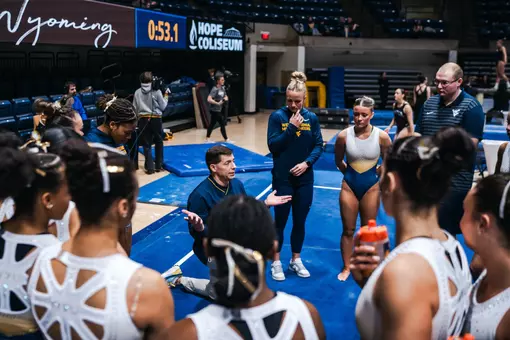
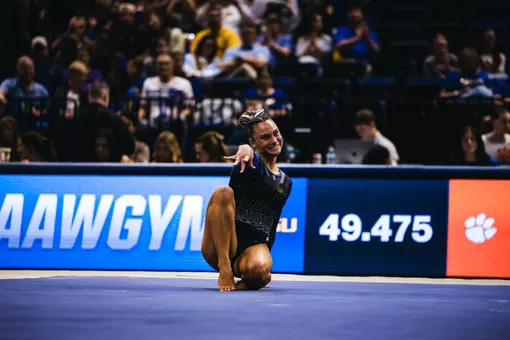
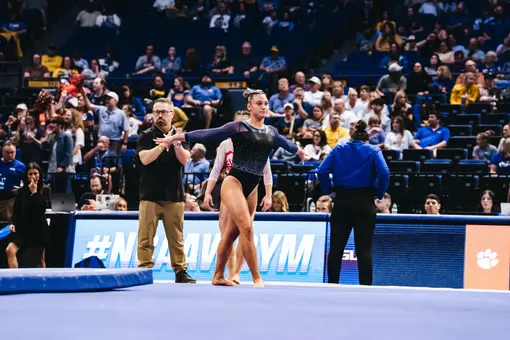
As NCAA members, the team has won 11 conference championships, qualified for nationals in 1995, 1999 and 2000, produced seven All-Americans and now trains in a state-of-the-art, 12,000-square-foot facility behind the WVU Coliseum named Cary Gym.
The late Burdette, who died suddenly earlier this year, retired in 2013 as the winningest coach in any sport at WVU with 644 victories in 37 seasons before passing the baton to Jason Butts.
In 41 years of NCAA competition, WVU gymnastics has qualified for NCAA regionals 38 times, including eight straight appearances heading into this season.
It's an impressive legacy of success born out of a group of 16 volunteer gymnasts, its young coach and a shoestring budget, supported by a vision from a handful of women's sports pioneers some 50 years ago in 1974.
For the next two months, the WVU Department of Intercollegiate Athletics is planning several initiatives to help commemorate the 50th year of women's gymnastics leading up to its March 2, 2024, alumni reunion weekend celebration.
Be sure to follow WVU gymnastics on social media for special videos, photos and postings, and remain logged on to WVUsports.com for additional features as we recognize 50 years of West Virginia University women's gymnastics.