Photo by: All Pro Photography/Dale Sparks
The Backstory to The Play
August 31, 2023 12:24 PM | Football, Blog
MORGANTOWN, W.Va. – Of course, there is always a backstory.
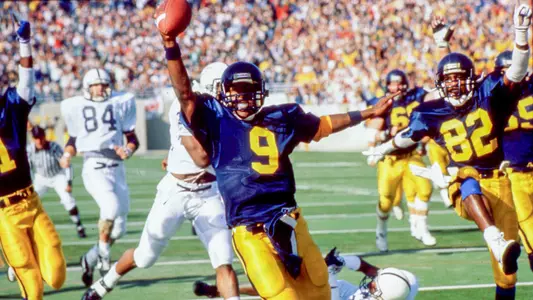
Every West Virginia football fan knows about The Play – Major Harris' wrong-way, 26-yard touchdown run on the opening drive of the Mountaineers' 51-30 romp over Penn State on Saturday, Oct. 29, 1988. A video of it quickly comes up on YouTube whenever you search the words "Major Harris" and "run."
It's only fitting that Penn State is once again on the schedule this year to help remind us of what will be the 35th anniversary of Harris' unforgettable run later this fall.
 It certainly stirred the memory of our Dwight Wallace, who is celebrating his 25th year on the Mountaineer Sports Network this season as its lead analyst. In 1988, Dwight mentored Harris as West Virginia's quarterbacks coach.
According to Wallace, by the time Penn State arrived on the schedule in 1988, Major had played enough games to where the coaching staff was beginning to feel comfortable putting more on his plate.
He survived some difficult games early in his career against Ohio State, Maryland and Pitt, and by the midway point of his sophomore season, he was really beginning to blossom into a more complete football player.
His terrific overall performance in a 59-19 victory over Boston College earned him the right to take on more, so offensive coordinator Mike Jacobs approached Wallace before the staff got together to begin putting in the game plan for Penn State the following week.
"We walked into our meeting and Mike said, 'Do you think Major could handle a (run) check?' We had him doing quite a bit in the passing game, but we had really not done too much with run checks at that point," Wallace recalled earlier this week. "So, I asked, 'What do you got?' He said, 'Here's what they're doing. They're reducing to the split end side.'"
Wallace then explained in more detail.
"Normally, they would line up with the end to our split end side in the boundary outside of our tackle. But a reduction slides that end down so that he's directly over the tackle, and now it kind of condenses to that side," he said. "Mike Jacobs thought that would be a good place to run our load option, which most of the time, really ended up being a keep for Major."
"When they reduce, what that does is it covers up their linebackers, so now your guard has a hard time getting to their linebacker because he's got a down-lineman over him and a down-lineman over the tackle," he continued. "You've really got a linebacker stacked over your guard, and what that does is if you run in the other direction, it's hard to block that backside linebacker. Penn State always liked to do that. They used to call him a "hit man" because he was nearly impossible to block and would make stops on the other side of the line of scrimmage."
By running the option right at it, that required the guard and the tackle to block the linemen overtop them. A fake to fullback Craig Taylor would occupy the linebacker, either by him tackling Taylor or by Taylor blocking him, leaving Major and the trail running back to run the option play.
Sometimes, the split end would block down on the linebacker, leaving the cornerback to defend Harris and the pitch man. That was the basic design of the play Harris was supposed to run.
"I said, 'Well, what's it look like?' Jacobs said, 'Well, he just has to identify the reduction.' I said, 'No problem, yes, he can do that. We'll just go to work on it in practice,'" Wallace said.
All during the week in practice leading up to the Penn State game, the scout team gave the looks the coaches wanted Major to identify, and he checked perfectly each time. He never missed it once.
"We cut our meeting time short, and we went onto the field for our walkthrough. We would come to the ball and have them show the overhang look, which meant we were going to run whatever we had called and then we'd come to the ball another time and show the reduction. Then Major would check," Wallace explained.
Major was good in half-line run, full-line run and during the team period.
"He didn't miss anything. We had emphasis drills, and he was good recognizing it there and then we went to just plugging it in during the team period, and he got those," Wallace said.
So, on the opening possession of the game, West Virginia gets the ball and begins marching down the field. Harris ran 18 yards to the Penn State 39 and running back A.B. Brown added a nine-yard gain to the 30.
Brown again carried the ball for four yards to the 26, setting up and first and 10.
"We're moving the ball, we had some successful plays and made some first downs and here comes the reduction," Wallace said. "Jacobs and I were both in the press box and Jacobs stands up and says, 'There it is!'
"Now I'm standing up, too, and we can see Major's head going up and down. We know he's talking. Jacobs is saying, 'He sees it! He's checking! He's checking …! OH MY GOD, HE'S GOING THE WRONG WAY! WHAT IN THE HELL IS HE DOING …?'"
Major had gotten to the line of scrimmage, noticed the reduction, but also saw the play clock winding down. The team had broken the huddle late, and he was frantically trying to get them lined up so he could look over the defense before the play clock expired.
In the confusion, he had forgotten which direction the play was going, right or left? The entire team went left, and Major went right - with no blockers in front of him. In the meantime, while all of this was happening below, Jacobs went from "OH MY GOD" to "MY GOD, WHAT A PLAY!"
"He was yelling, 'GREAT PLAY, GREAT PLAY, GREAT PLAY! Great job, Major!" Wallace laughed.
"Of course, when Major came off the field, I always had him come to the phones. Here, he had just broken all those tackles, scored a touchdown, people are going nuts and he gets on the phone and says, 'I'm sorry coach.' He was apologetic and I said, 'Hey Major, you'll get it next time, won't you?'" Wallace joked.
Major emphasizes the missing piece to the story was the play clock. Had it not run down, they run the play as it's designed. That means an option to the split end side, and Harris likely pitches the ball to Brown for a 10-yard gain.
Instead, he goes the wrong way and right into history!
"Over the years of everybody talking about it, the point that was lost is that the play clock was running down," Harris explained. "If they don't overload, you let the play go. But, in all of that, I got caught up in the check part so that's what happened.
"I think I did the check part, and nobody else knew about it. It's funny because two things were going on, and I'm trying to hurry up and get the play off," he noted.
Harris said those types of adjustments really helped him because Penn State did things schematically that could make it very difficult for offenses.
"Penn State was one of the top defenses in the country, so to be honest, that made my job easier when we put the 'check-with-me' in because now the defense has to play you honest," he said. "They couldn't just overload to one side or the other. That puts them in a more basic defense, and now you can kind of do what you want against them."
Later, Harris said the coaching staff even added a counter play off that.
"What's funny, after that we would do the option (to the split end side) and I would open up, fake like I was doing an option right, and I would go back left," he noted.
A year later, the Nittany Lions made their own adjustments.
Penn State knew Harris was too difficult to contain at the line of scrimmage, so it chose to go for the football whenever he got out into the open or was transitioning from a passer to a runner. In 1989, West Virginia outgained Penn State 369 to 262, but the Nittany Lions forced 11 fumbles, recovering five, and won 19-9.
"One thing about Penn State that was different than the other teams, to me, is that they taught their players to put their helmets on the ball," Harris recalled. "A lot of times, after you played Penn State, you had to ice your hands. Think about a helmet and a face mask coming in and hitting your hands; that hurt!"
It was undoubtedly their way of getting Harris back for the embarrassment they later felt after watching him run through their entire defense.
Every West Virginia football fan knows about The Play – Major Harris' wrong-way, 26-yard touchdown run on the opening drive of the Mountaineers' 51-30 romp over Penn State on Saturday, Oct. 29, 1988. A video of it quickly comes up on YouTube whenever you search the words "Major Harris" and "run."
It's only fitting that Penn State is once again on the schedule this year to help remind us of what will be the 35th anniversary of Harris' unforgettable run later this fall.
It certainly stirred the memory of our Dwight Wallace, who is celebrating his 25th year on the Mountaineer Sports Network this season as its lead analyst. In 1988, Dwight mentored Harris as West Virginia's quarterbacks coach.According to Wallace, by the time Penn State arrived on the schedule in 1988, Major had played enough games to where the coaching staff was beginning to feel comfortable putting more on his plate.
He survived some difficult games early in his career against Ohio State, Maryland and Pitt, and by the midway point of his sophomore season, he was really beginning to blossom into a more complete football player.
His terrific overall performance in a 59-19 victory over Boston College earned him the right to take on more, so offensive coordinator Mike Jacobs approached Wallace before the staff got together to begin putting in the game plan for Penn State the following week.
"We walked into our meeting and Mike said, 'Do you think Major could handle a (run) check?' We had him doing quite a bit in the passing game, but we had really not done too much with run checks at that point," Wallace recalled earlier this week. "So, I asked, 'What do you got?' He said, 'Here's what they're doing. They're reducing to the split end side.'"
Wallace then explained in more detail.
"Normally, they would line up with the end to our split end side in the boundary outside of our tackle. But a reduction slides that end down so that he's directly over the tackle, and now it kind of condenses to that side," he said. "Mike Jacobs thought that would be a good place to run our load option, which most of the time, really ended up being a keep for Major."
"When they reduce, what that does is it covers up their linebackers, so now your guard has a hard time getting to their linebacker because he's got a down-lineman over him and a down-lineman over the tackle," he continued. "You've really got a linebacker stacked over your guard, and what that does is if you run in the other direction, it's hard to block that backside linebacker. Penn State always liked to do that. They used to call him a "hit man" because he was nearly impossible to block and would make stops on the other side of the line of scrimmage."
By running the option right at it, that required the guard and the tackle to block the linemen overtop them. A fake to fullback Craig Taylor would occupy the linebacker, either by him tackling Taylor or by Taylor blocking him, leaving Major and the trail running back to run the option play.
Sometimes, the split end would block down on the linebacker, leaving the cornerback to defend Harris and the pitch man. That was the basic design of the play Harris was supposed to run.
"I said, 'Well, what's it look like?' Jacobs said, 'Well, he just has to identify the reduction.' I said, 'No problem, yes, he can do that. We'll just go to work on it in practice,'" Wallace said.
All during the week in practice leading up to the Penn State game, the scout team gave the looks the coaches wanted Major to identify, and he checked perfectly each time. He never missed it once.
"We cut our meeting time short, and we went onto the field for our walkthrough. We would come to the ball and have them show the overhang look, which meant we were going to run whatever we had called and then we'd come to the ball another time and show the reduction. Then Major would check," Wallace explained.
Major was good in half-line run, full-line run and during the team period.
"He didn't miss anything. We had emphasis drills, and he was good recognizing it there and then we went to just plugging it in during the team period, and he got those," Wallace said.
So, on the opening possession of the game, West Virginia gets the ball and begins marching down the field. Harris ran 18 yards to the Penn State 39 and running back A.B. Brown added a nine-yard gain to the 30.
Brown again carried the ball for four yards to the 26, setting up and first and 10.
"We're moving the ball, we had some successful plays and made some first downs and here comes the reduction," Wallace said. "Jacobs and I were both in the press box and Jacobs stands up and says, 'There it is!'
"Now I'm standing up, too, and we can see Major's head going up and down. We know he's talking. Jacobs is saying, 'He sees it! He's checking! He's checking …! OH MY GOD, HE'S GOING THE WRONG WAY! WHAT IN THE HELL IS HE DOING …?'"
Major had gotten to the line of scrimmage, noticed the reduction, but also saw the play clock winding down. The team had broken the huddle late, and he was frantically trying to get them lined up so he could look over the defense before the play clock expired.
In the confusion, he had forgotten which direction the play was going, right or left? The entire team went left, and Major went right - with no blockers in front of him. In the meantime, while all of this was happening below, Jacobs went from "OH MY GOD" to "MY GOD, WHAT A PLAY!"
"He was yelling, 'GREAT PLAY, GREAT PLAY, GREAT PLAY! Great job, Major!" Wallace laughed.
"Of course, when Major came off the field, I always had him come to the phones. Here, he had just broken all those tackles, scored a touchdown, people are going nuts and he gets on the phone and says, 'I'm sorry coach.' He was apologetic and I said, 'Hey Major, you'll get it next time, won't you?'" Wallace joked.
Major emphasizes the missing piece to the story was the play clock. Had it not run down, they run the play as it's designed. That means an option to the split end side, and Harris likely pitches the ball to Brown for a 10-yard gain.
Instead, he goes the wrong way and right into history!
"Over the years of everybody talking about it, the point that was lost is that the play clock was running down," Harris explained. "If they don't overload, you let the play go. But, in all of that, I got caught up in the check part so that's what happened.
"I think I did the check part, and nobody else knew about it. It's funny because two things were going on, and I'm trying to hurry up and get the play off," he noted.
Harris said those types of adjustments really helped him because Penn State did things schematically that could make it very difficult for offenses.
"Penn State was one of the top defenses in the country, so to be honest, that made my job easier when we put the 'check-with-me' in because now the defense has to play you honest," he said. "They couldn't just overload to one side or the other. That puts them in a more basic defense, and now you can kind of do what you want against them."
Later, Harris said the coaching staff even added a counter play off that.
"What's funny, after that we would do the option (to the split end side) and I would open up, fake like I was doing an option right, and I would go back left," he noted.
A year later, the Nittany Lions made their own adjustments.
Penn State knew Harris was too difficult to contain at the line of scrimmage, so it chose to go for the football whenever he got out into the open or was transitioning from a passer to a runner. In 1989, West Virginia outgained Penn State 369 to 262, but the Nittany Lions forced 11 fumbles, recovering five, and won 19-9.
"One thing about Penn State that was different than the other teams, to me, is that they taught their players to put their helmets on the ball," Harris recalled. "A lot of times, after you played Penn State, you had to ice your hands. Think about a helmet and a face mask coming in and hitting your hands; that hurt!"
It was undoubtedly their way of getting Harris back for the embarrassment they later felt after watching him run through their entire defense.
Friday, October 16
Wednesday, October 14
Wednesday, October 14
Wednesday, October 14