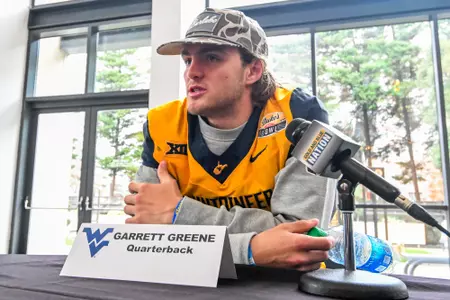
Photo by: All Pro Photography/Dale Sparks
Process-Oriented Greene Poised to Bear the Fruits of His Development
December 26, 2023 01:58 PM | Football, Blog
CHARLOTTE – There is a process in sports and sometimes it takes a while to reap the rewards of that process. Garrett Greene's development as a high-level college quarterback certainly falls into this category. Nobody knows this better than Garrett, who has been around elite athletes his entire life.
His grandfather, Dr. Charles P. Greene, was a longtime junior college baseball coach at Miami-Dade Community College/South where he led the school to 935 wins, two JUCO World Series appearances and the 1981 national championship.
Through the years, Charlie Greene's Miami-Dade/South and Demie Maineri's Miami-Dade/North teams used to have some legendary, knockdown, drag-out brawls on the baseball diamond.
The two programs back then were complete opposites.
Garrett's granddad came from the Bear Bryant school of coaching – no facial hair, strict rules and no fooling around. His teams were all business all the time.
"My dad always jokes that we made him soft," Garrett laughed of his 94-year-old grandfather, who will be watching Wednesday night's Duke's Mayo Bowl game against North Carolina at home on his television.
On the other hand, Maineri, who once played baseball for the Mountaineers and eventually earned a bachelor's degree from WVU in 1963, ran a much looser ship with such free-spirited players like Steve Carlton, Bucky Dent, Mickey Rivers and Mike Piazza.
That was the environment Garrett's father, Charlie Jr., grew up in when he played for his dad in the late 1980s. Charlie eventually made the big leagues as a catcher with the Mets, Orioles, Brewers and Blue Jays through the 2000 season before turning professional baseball into a lifetime occupation. For years, Charlie was involved in player development for the Brewers as their roving catching instructor. Today, he is their bullpen coach, so he clearly understands the value of the process.
Just like preparing a delicious meal, you can't skip steps by turning the flame a little bit higher. Sometimes, it just takes time.
In Garrett's case, he has always been an exceptional athlete and coaches going all the way back to pee-wee football have used his athleticism to their advantage. Growing up in Tallahassee, Florida, Greene once played middle school football with Jimbo Fisher's son, Trey. Naturally, Trey was the quarterback because his dad was the coach of the Florida State Seminoles.
Then, when Garrett advanced to high school, he started out as the team's running back until the fourth game of his sophomore year when he was switched to quarterback. During his senior year, Garrett flew so low under the radar screen that hometown Florida State didn't offer him a scholarship until signing day.
By that time, Garrett's ship had already left port for West Virginia, and at WVU, even more developmental time was required.
"He wasn't ready until he was ready and now since he's been ready, he's been highly productive," West Virginia coach Neal Brown explained earlier today, one day before the Mountaineers take on the 8-4 Tar Heels. "But he's still got a lot of growth he can make in his game."
More on that later.
Because Garrett has been around high-level athletes for most of his life, he understands the process it takes to become elite. He learned it from his family and absorbed it while hanging around such guys as Ryan Braun and Prince Fielder when they were advancing through the Milwaukee system.
When Garrett was a teenager, he actually helped out in the bullpen, catching 95-mile-per-hour fastballs when his dad was short a catcher.
So, Garrett saw how hard those guys worked to develop themselves as professional athletes. He also got a first-hand glimpse at team dynamics and how fragile it can be. For example, he learned quickly when riding the team bus with his dad that it was a pretty good idea to keep his mouth shut after losses.
All these valuable experiences have helped Garrett grow into the college quarterback he's become today. What he learned more than anything was the importance of competing.
Above all else, Garrett Greene is a competitor. That's his No. 1 attribute.
"No matter what it was as a kid, I wanted to compete," Greene explained. "I wasn't a great basketball player, but I wanted to compete. I was half-way decent in baseball and now football …"
"He's super-competitive, and I think that's a product of him being around sports his entire life," Brown noted. "The moments aren't too big for him, and I think that's another product of growing up around sports."
Garrett said when he was little, he would watch ESPN College GameDay, go outside and play all day and then come back in the house and watch the late-night football games with his father, although his dad never really pushed him into sports.
"My dad wouldn't care if I was just a regular student and didn't play any sports," Garrett admitted. "He wanted me to be happy. My older brother didn't play any sports really."
Charlie Greene doesn't inundate his son with lots of unsolicited advice, but rather occasionally sends him text messages of support before games.
"On game days he will text me, 'Don't be afraid to take the crumbs. You don't need the whole loaf all the time.' Crumbs can be good, and that's something I'm continuing to learn," Garrett said.
"It reminds me of a guy playing basketball and he's on a fast break and he pulls up for 3-pointers. Uncontested layups are fine," Brown explained. "The baseball version of that same deal is they are going to walk you some. Take your base. If you can get it between short and third, get it through there. But he's learning. I think his decision making has gotten quite a bit better as the year has gone on."
Greene is only a 53.1% passer this season because he frequently hunts for big plays, as evidenced by his 16.1-yards-per-completion average. He's also made big plays in the run game and operates best when the clock is winding inside of two minutes to go.
It seems like the less time there is on the clock the better Garrett Greene becomes. That's the competitor in him.
There are fundamental things Brown wants Greene to improve upon, but not at the expense of his play-making ability.
That work lies ahead for Garrett during the offseason.
"For him, it's about accuracy in the intermediate throws, and we've got to do a much better job throwing the ball to our left," Brown explained. "Then, some of his scrambles, being more accurate throwing the ball in those areas. Those are a couple of fundamental flaws he's got to get fixed and once he does, then I think you are going to see his completion percentage go up as much as eight-to-10 percentage points."
"It all starts with my feet, especially throwing left," Greene said. "Being a shorter guy, sometimes I try and fight to get my release point high. I don't really have a problem going to my right, but to my left, I try and lean to get it high and that leads to my inaccuracy. That's the main one. The other is tying my feet and my eyes together. My eyes will be going through my progressions and then my feet will get stuck on my second read."
Heading into Wednesday night's game against North Carolina, Greene has accounted for nearly 3,000 yards from scrimmage and 28 total touchdowns. He's coming off a 269-yard, two-touchdown passing and a 103-yard, two-touchdown rushing performance in WVU's come-from-behind victory over Baylor.
That's not too shabby for a guy one preseason magazine called "the worst starting quarterback in the Big 12."
Of course, that is the lock screen Garrett keeps on his cellphone. Knowing him, it will probably never come off.
"I had a decent year this year, but it wasn't up to my expectations nor to what I'm fully capable of, so just staying the course and finding those few things that really make the difference to becoming a better quarterback …" Greene said.
"I've still got to prove a lot more people wrong," he added.
"His background speaks to his parents because his family, particularly his dad and his grandfather, have been involved in high-level sports, and they understand patience, so they've had patience," Brown admitted. "Garrett's development has not been the same and I credit him, too, because he had patience, and he didn't get caught up in comparisons. They allowed him to grow and develop.
"We're all a product of where we came from and who we were around, but his has really been a lifetime of preparing him to be a leader within athletics," Brown said.
Selfishly, senior offensive tackle Doug Nester, playing his final game tomorrow night, wishes it would have come a little bit sooner. He believes Mountaineer Nation is about to witness the fruits of Garrett Greene's development as a starting quarterback.
"He's a little fireball. He is such a competitor, and he gets everyone going," Nester concluded.
His grandfather, Dr. Charles P. Greene, was a longtime junior college baseball coach at Miami-Dade Community College/South where he led the school to 935 wins, two JUCO World Series appearances and the 1981 national championship.
Through the years, Charlie Greene's Miami-Dade/South and Demie Maineri's Miami-Dade/North teams used to have some legendary, knockdown, drag-out brawls on the baseball diamond.
The two programs back then were complete opposites.
Garrett's granddad came from the Bear Bryant school of coaching – no facial hair, strict rules and no fooling around. His teams were all business all the time.
"My dad always jokes that we made him soft," Garrett laughed of his 94-year-old grandfather, who will be watching Wednesday night's Duke's Mayo Bowl game against North Carolina at home on his television.
On the other hand, Maineri, who once played baseball for the Mountaineers and eventually earned a bachelor's degree from WVU in 1963, ran a much looser ship with such free-spirited players like Steve Carlton, Bucky Dent, Mickey Rivers and Mike Piazza.
That was the environment Garrett's father, Charlie Jr., grew up in when he played for his dad in the late 1980s. Charlie eventually made the big leagues as a catcher with the Mets, Orioles, Brewers and Blue Jays through the 2000 season before turning professional baseball into a lifetime occupation. For years, Charlie was involved in player development for the Brewers as their roving catching instructor. Today, he is their bullpen coach, so he clearly understands the value of the process.
Just like preparing a delicious meal, you can't skip steps by turning the flame a little bit higher. Sometimes, it just takes time.
In Garrett's case, he has always been an exceptional athlete and coaches going all the way back to pee-wee football have used his athleticism to their advantage. Growing up in Tallahassee, Florida, Greene once played middle school football with Jimbo Fisher's son, Trey. Naturally, Trey was the quarterback because his dad was the coach of the Florida State Seminoles.
Then, when Garrett advanced to high school, he started out as the team's running back until the fourth game of his sophomore year when he was switched to quarterback. During his senior year, Garrett flew so low under the radar screen that hometown Florida State didn't offer him a scholarship until signing day.
By that time, Garrett's ship had already left port for West Virginia, and at WVU, even more developmental time was required.
"He wasn't ready until he was ready and now since he's been ready, he's been highly productive," West Virginia coach Neal Brown explained earlier today, one day before the Mountaineers take on the 8-4 Tar Heels. "But he's still got a lot of growth he can make in his game."
More on that later.
Because Garrett has been around high-level athletes for most of his life, he understands the process it takes to become elite. He learned it from his family and absorbed it while hanging around such guys as Ryan Braun and Prince Fielder when they were advancing through the Milwaukee system.
When Garrett was a teenager, he actually helped out in the bullpen, catching 95-mile-per-hour fastballs when his dad was short a catcher.
So, Garrett saw how hard those guys worked to develop themselves as professional athletes. He also got a first-hand glimpse at team dynamics and how fragile it can be. For example, he learned quickly when riding the team bus with his dad that it was a pretty good idea to keep his mouth shut after losses.
All these valuable experiences have helped Garrett grow into the college quarterback he's become today. What he learned more than anything was the importance of competing.
Above all else, Garrett Greene is a competitor. That's his No. 1 attribute.
"No matter what it was as a kid, I wanted to compete," Greene explained. "I wasn't a great basketball player, but I wanted to compete. I was half-way decent in baseball and now football …"
"He's super-competitive, and I think that's a product of him being around sports his entire life," Brown noted. "The moments aren't too big for him, and I think that's another product of growing up around sports."
Garrett said when he was little, he would watch ESPN College GameDay, go outside and play all day and then come back in the house and watch the late-night football games with his father, although his dad never really pushed him into sports.
"My dad wouldn't care if I was just a regular student and didn't play any sports," Garrett admitted. "He wanted me to be happy. My older brother didn't play any sports really."
Charlie Greene doesn't inundate his son with lots of unsolicited advice, but rather occasionally sends him text messages of support before games.
"On game days he will text me, 'Don't be afraid to take the crumbs. You don't need the whole loaf all the time.' Crumbs can be good, and that's something I'm continuing to learn," Garrett said.
"It reminds me of a guy playing basketball and he's on a fast break and he pulls up for 3-pointers. Uncontested layups are fine," Brown explained. "The baseball version of that same deal is they are going to walk you some. Take your base. If you can get it between short and third, get it through there. But he's learning. I think his decision making has gotten quite a bit better as the year has gone on."
Greene is only a 53.1% passer this season because he frequently hunts for big plays, as evidenced by his 16.1-yards-per-completion average. He's also made big plays in the run game and operates best when the clock is winding inside of two minutes to go.
It seems like the less time there is on the clock the better Garrett Greene becomes. That's the competitor in him.
There are fundamental things Brown wants Greene to improve upon, but not at the expense of his play-making ability.
That work lies ahead for Garrett during the offseason.
"For him, it's about accuracy in the intermediate throws, and we've got to do a much better job throwing the ball to our left," Brown explained. "Then, some of his scrambles, being more accurate throwing the ball in those areas. Those are a couple of fundamental flaws he's got to get fixed and once he does, then I think you are going to see his completion percentage go up as much as eight-to-10 percentage points."
"It all starts with my feet, especially throwing left," Greene said. "Being a shorter guy, sometimes I try and fight to get my release point high. I don't really have a problem going to my right, but to my left, I try and lean to get it high and that leads to my inaccuracy. That's the main one. The other is tying my feet and my eyes together. My eyes will be going through my progressions and then my feet will get stuck on my second read."
Heading into Wednesday night's game against North Carolina, Greene has accounted for nearly 3,000 yards from scrimmage and 28 total touchdowns. He's coming off a 269-yard, two-touchdown passing and a 103-yard, two-touchdown rushing performance in WVU's come-from-behind victory over Baylor.
That's not too shabby for a guy one preseason magazine called "the worst starting quarterback in the Big 12."
Of course, that is the lock screen Garrett keeps on his cellphone. Knowing him, it will probably never come off.
"I had a decent year this year, but it wasn't up to my expectations nor to what I'm fully capable of, so just staying the course and finding those few things that really make the difference to becoming a better quarterback …" Greene said.
"I've still got to prove a lot more people wrong," he added.
"His background speaks to his parents because his family, particularly his dad and his grandfather, have been involved in high-level sports, and they understand patience, so they've had patience," Brown admitted. "Garrett's development has not been the same and I credit him, too, because he had patience, and he didn't get caught up in comparisons. They allowed him to grow and develop.
"We're all a product of where we came from and who we were around, but his has really been a lifetime of preparing him to be a leader within athletics," Brown said.
Selfishly, senior offensive tackle Doug Nester, playing his final game tomorrow night, wishes it would have come a little bit sooner. He believes Mountaineer Nation is about to witness the fruits of Garrett Greene's development as a starting quarterback.
"He's a little fireball. He is such a competitor, and he gets everyone going," Nester concluded.


Players Mentioned

QB
/ Football
OL
/ FootballTV Highlights: WVU 59, K-State 54
Wednesday, January 28
Treysen Eaglestaff, Honor Huff & Jasper Floyd | Kansas State Postgame
Wednesday, January 28
Ross Hodge | Kansas State Postgame
Wednesday, January 28
WRES: Wyoming Recap
Monday, January 26