It’s Almost Time!
August 24, 2022 09:00 AM | Football, Blog
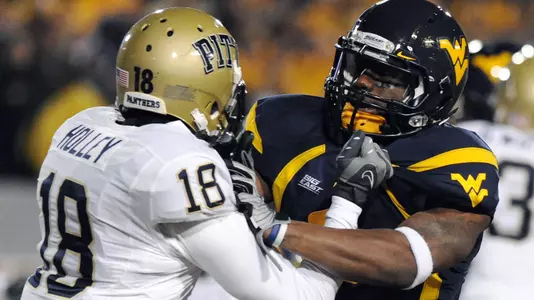
MORGANTOWN, W.Va. – It has been 11 long years, but Pitt week is once again nearly upon us.
There have been some pauses in the rivalry … three years in the late 1890s, a couple of years between 1910-13 and again between 1913-17, then a four-year interruption from 1939-43 when Pitt was seeking membership in the Western Conference (Big Ten) and needed to make room on its schedule in hopes of an invitation that was never to come.
But never has the pause button remained on for as long as the current hiatus, which finally ends next Thursday night at Acrisure Stadium in Pittsburgh.
Long considered among the most colorful rivalries in college football history, the Pitt-West Virginia football game was one of the sad casualties of realignment a decade ago. Back in 2011, when Pitt left the Big East for the Atlantic Coast Conference and West Virginia followed suit by joining the Big 12 a few months later, there was a feeling that this football game was going to be put on hold for a while until the dust settled.
But 11 years?
Last spring, Athlon Sports listed the 25 greatest college football rivalries of all-time and the Backyard Brawl was ranked 11th – this despite the game not being played since Barack Obama was living in the White House!
Do you realize this football game has produced 126 first-team All-Americans, 37 College Football and 12 Pro Football Hall of Fame members (soon to be 13 when Chuck Howley finally gets his due) and more than 450 NFL players?
Do you know that every game since 1995 has appeared on national television, that the two schools have a combined 58 bowl game appearances through the 2011 season and that from 1950 until 2011, at least one team has been nationally ranked in 26 of the games? By the way, you can add another one when West Virginia and 17th-ranked Pitt hook up as soon as the calendar flips to September.
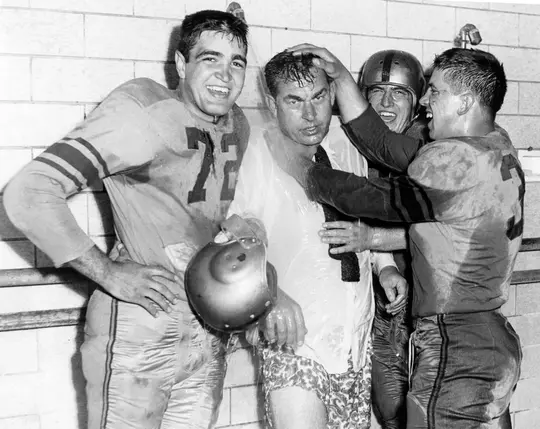
Were you aware that 12 times since 1985, more than 60,000 fans have attended Backyard Brawls including the 66,731 that braved frigid temperatures to watch the 2002 game in Pittsburgh – still the fifth-largest crowd in Pitt football history? Three of the top-five-attended football games at Milan Puskar Stadium also happen to involve the Panthers.
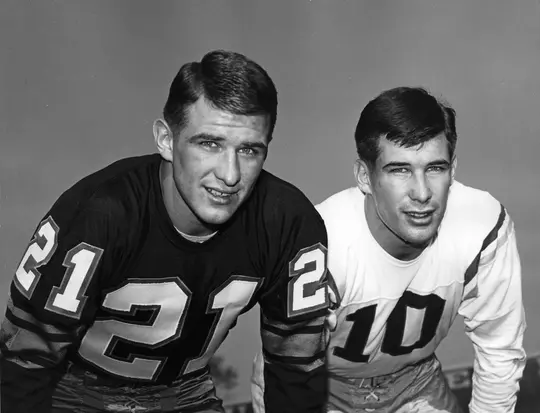
It’s a game that has featured high school teammates, cousins and, yes, even brothers once playing against each other. That happened in 1963 when Pitt All-American halfback Paul Martha squared off against younger brother, Richie, a defensive back for the Mountaineers.
To amplify this point, there are not many college football rivals that are situated closer than Pitt and West Virginia, the two schools separated by only 75 miles of interstate highway. Before the construction of I-79, however, college football’s elite usually steered clear of attending West Virginia games in Morgantown because of the city’s inaccessibility. A prominent Eastern sportswriter once said that you got to WVU by taking a flight into Pittsburgh and then “swinging by vines” down to Morgantown.
Talk about inaccessible … that’s inaccessible!
Nevertheless, the games have been super-competitive, particularly since 1963 when Pitt finally agreed to playing the series on a home-and-home basis. Before that, it was West Virginia that was mostly required to swing by vines up to Pittsburgh for games at either Pitt Stadium, Forbes Field or Exposition Park.
Since that fateful year in 1963, which included the assassination of John F. Kennedy, West Virginia has won 25 games, Pitt 22, with two ties. The point differential during those last 48 games is just three, in WVU’s favor. Pitt has shut out West Virginia three times and West Virginia has blanked Pitt twice. Pitt won seven games in a row from 1976-82 and West Virginia won five in a row from 1992-96 … that’s how close this rivalry has been over the course of time.
Most of my knowledge of the game is the result of the work of many others before me, such as the late Forrest B. Crane, WVU’s director of publicity back in the 1940s. This is what Forrest wrote in 1947 when West Virginia finally ended its 19-year victory drought against the Panthers.
His story was titled, Maybe This Will Be The Year!
You Pitt people are aware of it, of course, but not nearly so aware of it as every man, woman and child in West Virginia that it has been 19 years since we Mountaineers last tasted victory over your Panthers on the football field.
That was a great day in 1928 when our boys set your boys back on their heels, 9-6. You didn’t think we could do it. It had been five years since we had done it before. The Mountaineers sort of ganged up on you. This is to say they refused to play dead just because you had been tanning their hides with regularity …
Other Mountaineers teams since have made the annual trek to Pittsburgh with the same determination and the avowed promise of bringing a fat Panther scalp back to Morgantown, but since 1928 victory has escaped our boys …
Nineteen years is a long time to wait. It’s seemed two or three times that long to us because there is no rival our Mountaineers would rather whale the daylights out of than your Panthers. Each successive defeat has added more pain to the pain that was already there.
C.E. “Ned” Smith, editor of the Fairmont Times who observed more than 50 WVU-Pitt games in person, wrote this about the rivalry:
In the years before the roads were paved and the journey to Pittsburgh from Northern West Virginia consumed an entire day, the annual football trek would be well under way on the Thursday preceding the game. Then, for three or four days, the William Penn Hotel, which was at that time decidedly “noncommercial” would entertain what might be described as a cross between and American Legion Convention and the liberation of all the wild animals in Ringling’s menagerie. Other gatherings may have surpassed it in sheer destructive force, but none have approached it in the matter of pulling out all the stops and permitting hell-raising to be unconfined. We do not mean vandalism and destructiveness were rampant. Far from that. For those who would oversimplify, it was just one great big time.
Some of it was slightly on the bizarre side. Take, for example, an old friend of ours now dead, who passed the word around that he was entertaining in the main ball room, which is on the 17th floor of the hotel, with a 4-o’clock-in-the-morning dance. He engaged the ball room, rounded up a large and expensive band, which, at the appointed hour, struck up the grand march. Our friend was the only person in the huge room. It was a Saturday night of the game and the West Virginia crowd, hardly as it was, could not keep its collective eyes open for a 4 a.m. added attraction …
In those days, Sunday always was the cold, gray day dawn of the morning after. The tumult and the shouting died, the captains and the kings were not in evidence. Sunday night saw the annual retreat back into the hills over the bumpy roads. As the last of the revelers climbed into his Packard, he would have his parting word, “Licked again by Cracky. But wait till next year!”
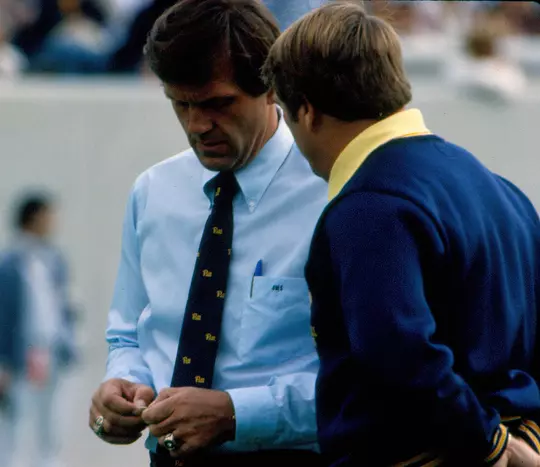
The late Eddie Barrett, whose work as WVU’s publicity director during its second Golden era in the 1950s was later deemed WVU Sports Hall of Fame worthy, was occasionally cryptic but always passionate about the game.
His knowledge was vast and his willingness to share it generous. When the two schools met for the 100th time in 2007, he was compelled to send a 1,000-word essay to the WVU Alumni Office. Here is a sampling …
Since Washington & Jefferson went “simon pure” (no football scholarships) in the 1920s and Penn State dropped Pitt (decades later), this has been THE game for both the Mountaineers and the Panthers. It’s where “West By Gawd Virginia!” originated, the Backyard Brawl pitting the country boys against the city slickers, their campuses a little more than an hour apart.
Some of the best high school football played anywhere re-matches teammates and opponents in this game. It’s no secret the boys from Pennsylvania wanted to show that Pitt made a mistake by not recruiting them, and West Virginians for generations labored in the shadows of big corporations like U.S. Steel and Gulf Oil, which were headquartered in Pittsburgh …
West Virginia counts (the 2007 game) as the 100th in the series, while Pitt does not include the nine games when it was known as Western University of Pennsylvania … In the first meeting, in 1895, Fielding H. Yost led West Virginia to an 8-0 victory. This native of Fairview, West Virginia, became “Hurry Up” Yost of point-a-minute fame as coach of the University of Michigan (Michigan 130, West Virginia 0, 1904). But after early success, what made this game so important to West Virginia was the very difficulty it had: Two stretches of nearly 20 years without a victory and often without even a touchdown. The great Ira Errett Rodgers never beat Pitt, so after Armin Mahrt scored the only winning field goal by dropkick in our history, afterwards in the William Penn Hotel, a Mountaineer, known only to God, upon seeing his heroes enter the dining room, rose up and roared: “West by Gawd Virginia!” …
I saw my first Pitt-West Virginia game in 1947, a bitter, cold, snowy day in Pitt Stadium. Gene Corum, who could usually be found on the bottom of any pileup, impersonated the referee by shouting “I see who’s got it” and taking it away from the enemy before the pile uncovered. The fumble would have been the only touchdown of Corum’s entire career but when the snow was brushed off, it was the 10-yard line instead of the goal line. West Virginia won, 17-2, to end another drought of nearly two decades.”
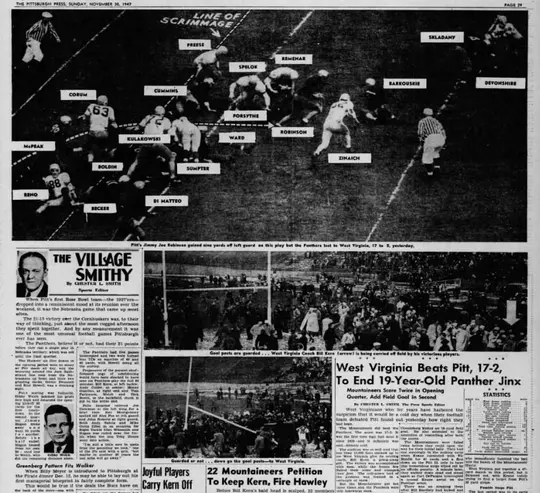
The 1947 game was also Jack Fleming’s first official year serving as the “Voice of the Mountaineers.” His daughter, the late Sandy Yakim, a cheery and pleasant local elementary school teacher who turned into a fierce Pitt hater on Saturdays, for years served as her father’s spotter for home football games and away games in Pittsburgh.
It is Sandy’s voice that you hear screaming at the top of her lungs in the background of her dad’s description of Willie Drewery’s zig-zagging, 74-yard touchdown return during West Virginia’s 28-10 victory up in Pittsburgh in 1984.
Sandy learned a lot about the Panthers from her father and once described his first Pitt game working on WVU’s payroll for us in 2007.
Nineteen-forty-seven was the first year dad broadcast football games for the Mountaineers and the Pitt game that year was one of the most memorable of his career. The Mountaineers hadn’t beaten the Panthers in 19 years but that game broke the drought. And the circumstances were unbelievable. A fan attacked dad’s spotter, Vic Peelish, a late fill-in while he recovered from football injuries.
The drunken Panther fan punched Vic in the face through the open window of the booth and Vic retaliated by grabbing a chair and throwing it out the window. Meanwhile, a fog was setting in as the close of the game was approaching with the score: WVU 17, Pitt 0 – or at least this is what dad thought.
With all of the excitement and commotion going on down below (and up above) he left the stadium that evening only to discover later that the Panthers had scored a safety and the real score was WVU 17, Pitt 2.
Fleming, WVU’s legendary play-by-play man whose broadcasting exploits later earned him College Football Hall of Fame recognition, never put pen to paper in terms of his thoughts about the Backyard Brawl, as far as I could tell.
But in 1987, he once gave a lengthy response in a Dominion-Post question and answer article concerning his longtime love/hate relationship with Pittsburgh. Fleming was both loved and hated by Pittsburghers while working as the Steelers’ play-by-play man for four of their six Super Bowl championship seasons. His well-known West Virginia heritage and his close affiliation with the beloved Black and Gold always irritated Pitt supporters who also rooted for the Steelers.
The huge masses of people in Pittsburgh are not interested in the rivalry between West Virginia and Pitt. But there are a few fanatics and maybe the support group – contributors and certain people in the athletic department – who do get worked up – but I have no quarrel with the city of Pittsburgh.
One night, while I was filling in for Myron Cope on his talk show, a man called up and complained, “You knock the city of Pittsburgh.” I told him he was wrong – that I’ve never done that. He said, “Well, you made fun of the Civic Arena.” I replied, “Well, Ray Goss and whoever is with him on Duquesne broadcasts make fun of it, saying how cold and dark it is and so on.” I have talked about the Civic Arena and I’ve said Pitt’s Fitzgerald Field House, despite renovations, still isn’t a great place to play basketball, but I have not knocked the city of Pittsburgh …
The thing with the university (Pitt), this gets stretched out of shape. I think rivalries are super. I have enjoyed that with Beano Cook over the years. We get incensed with him, and he got incensed with us, but we always came out as friends.
You can name the great people that have been at Pitt, Doc Carlson, for one, but I think it becomes absolutely strange when the supporters of an athletic program become so vehement that they want a man fired or chased out of town because he pulls for one team down the road. This is ridiculous. You have to have rivalries or there’s nobody to play against. For the people that come around and throw eggs at my house – and that has to be one in a million – or the Pitt fan who poured urine over my head during a basketball tournament or the people who threatened after one incident to bomb my apartment – this is the fringe.
I can’t think that the real people at the University of Pittsburgh feel this way. I consider it a great, old rivalry … I think these rivalries have to exist and you have to have some fun with them. You compete on the field and you compete on the air and you compete in the press box from time to time, and when the time comes, you have to walk away and say, “Hey, we’ll see you next year.”
Speaking of the wise-cracking Cook, who turned those wise cracks into a great career, he worked all of the Pitt-West Virginia games for the Panthers from 1956 until 1966 when he decided to become a TV star. Of the rivalry he once told Pittsburgh Post-Gazette's Ron Cook, “I tell you, The Pittsburgh Press circulation department used to root for West Virginia, because if West Virginia beat Pitt, on Sunday they sold 20,000 extra papers.”
Incidentally, Beano also uttered this, “For me, any discussion of the afterlife comes with one simple caveat: If I make it to heaven, I hope there's no local news. If there is, I will ask to go the other way.”
This has absolutely nothing to do with the Backyard Brawl, but it is worth repeating nonetheless!
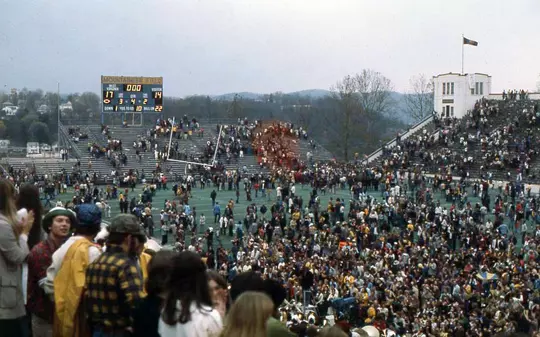
The longest funeral procession in the history of mankind!- Bill Evans, describing the long line of cars traveling back to West Virginia following the Mountaineers' 1955 defeat in Pittsburgh
University of Pittsburgh historian Sam Sciullo Jr. has certainly been busy fielding lots of questions about the rivalry these days. How do I know? Because he's been passing a lot of them on to me once he's finished. Sam saw his first WVU-Pitt game in 1966 and he has an incredible knowledge of the rivalry. His generous historical contributions to both schools have been invaluable.
Here is a small portion of what he wrote in Mountaineer Illustrated prior to the 2007 game:
I made my first visit to Morgantown to see Pitt play in 1967, when I was in the third grade. I attended those earliest games with my father, a Pitt graduate and attorney who became very active in Pitt athletics around that time. The Panthers only made three or four first downs in that game, a 15-0 loss …
… As a teenager, I became more aware of my surroundings. I knew that the main road leading into Morgantown, and straight to old Mountaineer Field - was Beechurst Avenue. I realized we were getting close when my stomach began hurting. The sight of the stands, observed through cracks in other buildings, showed a considerable number of spectators already in their seats, as comfortable as they could be on those old wooden bleachers. And why did the WVU students make so much noise before kickoff?
Fairmont Times editor Bill Evans described his depressing experience driving back to West Virginia following the sixth-ranked Mountaineers’ 26-7 upset loss at 17th-ranked Pitt in 1955, calling it “the longest funeral procession in the history of mankind!”
Mickey Furfari, whose newspaper did not print on Sundays back in the 1950s, actually covered West Virginia’s great 1952 triumph at Pitt for the rival Fairmont paper without a byline. He did so because Bill Evans was covering a speech United Mine Workers of America president John L. Lewis made in Pittsburgh that same afternoon.
Pittsburgh Press sportswriter Russ Franke, whom many believe is responsible for coming up with the Backyard Brawl moniker, also used the catchy phrase “monastic solitude” to describe how open Bill Pilconis was on his 5-yard touchdown catch to defeat West Virginia in 1970. The loss, of course, was the handiwork of first-year WVU coach Bobby Bowden, whose team blew a 35-8 halftime lead.
And, finally, we turn to the late D.A. “David” Christopher, who once did for West Virginia University athletics what I do today way, way back in the 1920s, ‘30s and ‘40s. His 19-year tenure in WVU’s Athletic Office spanned from 1923 until 1942 and he was usually the guy people sought for historical questions.
Christopher’s diligent research and writings of the early days of WVU sports helped form the basis of our knowledge of Mountaineer athletics today. A few years ago, his daughter Elizabeth Burger, a Charleston resident, sent me copies of his personal papers, which included this from one of Mickey Furfari’s Fan-Fare columns in 1956:
Regarding the 1925 Pitt defeat, the lone one that year, we have a score to settle with Andy Gustafson, now coach at Miami University whose Hurricanes are to be met this year. Picking up a fumble by Ryan, on his way to a winning touchdown, Gustafson got behind a wall of Panthers, and ran 85 yards for the deciding tally for Pitt. Gustafson, here we come. We don’t forget. It could have been a fourth straight for West Virginia just as easily as the 1924 setback prevented a third victory. The 1925 game was the first for W.Va. in the new Pitt Stadium.
Also included among his personal items was this poem he penned on West Virginia Day, 1924:
West Virginia!
Born midst strife of bravest men,
True to the cause with glory fought;
State of the beautiful hill and glen,
Laden with riches no monarch bought.
Rich with the wealth of farm and mine,
Tilled by the farmer with ruddy cheek,
Mined with the pick along the creek,
Sheltered by forests of oak and pine.
Dotted with trails of the laurel green,
Landmarks and homes of pioneers old;
Countless the bowers so oft unseen,
Roadside and meadows of hearts of gold.
Home of the patriots, God-fearing men,
Home of the scholar with book and pen,
Risen to glory by country acclaimed,
Helped by its statesmen in history famed.
Loved by its people, loyal and true,
Where sunsets are golden, skies always blue;
Filled with the faith of the fathers still,
Living in spirit of dale and hill,
West Virginia ! West Virginia!
These are just a few of the many stories, remembrances and personal reflections that have been passed on to me over the course of the last 30 years. Hopefully, these stories (and others) will continue to live on, along with this great football game.
After all, 11 years is an awful long time! Too long, actually.