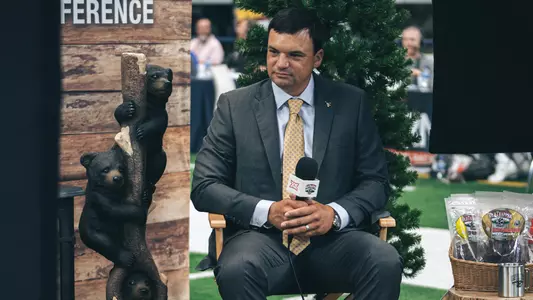
Photo by: WVU Athletic Communications
The Backyard Brawl Has Mountaineers’ Full Attention As Opener Looms
July 15, 2022 03:04 PM | Football, Blog
MORGANTOWN, W.Va. – Neal Brown and his players have returned from Big 12 media days held in Arlington, Texas, earlier this week and can now turn their full attention to the season opener against Pitt at newly christened Acrisure Field on Thursday, Sept. 1.
In reality, Brown said his team's attention has been on the Panthers from the moment they returned to campus following last year's disappointing Guaranteed Rate bowl loss to Minnesota. What better way to get a bad taste out of your mouth than by facing your longest and most bitter rival?
Brown understands rivalry games. All you have to do is go back and look at how he prepared his team for last year's game against Virginia Tech, a 27-21 Mountaineer victory at Milan Puskar Stadium.
"The Backyard Brawl, it's going to be my first one, and it's been fun for me learning the history of that and where the real passion lies within our fan base and talking to our former players," he said Wednesday afternoon.
An avid reader and information consumer, Brown will tap all of the resources at his disposal to help get his football team up to speed on the Pitt Panthers.
First and foremost for him will be educating a squad of players that hail from many different parts of the country about the rivalry. By the way, the oldest guys on his team were still in grade school the last time the game was played in 2011, a 21-20 WVU victory in Morgantown.
Brown will tell them the Backyard Brawl is a unique rivalry because you don't fly three hours one way to play the game, get back on an airplane and not see the other team again until the following season.
West Virginia and Pitt are separated by about 75 miles of interstate highway.
Brown will tell them this is a unique rivalry because, despite the proximity of the two campuses, one school is located in the city and the other is in the country. There is nothing quite like city versus country when it comes to disputes.
When Garrett Ford Sr. (WVU wide receiver Bryce Ford-Wheaton's grandfather) used to recruit for Bobby Bowden and Frank Cignetti, he said there were distinct areas in Western PA where Pitt got its players and West Virginia got its players.
"We always seemed to get our guys from the outside areas, on the perimeter," Ford once recalled.
That meant Pitt was usually getting the players from Baldwin, Whitehall, Duquesne, Clairton, McKeesport, West Mifflin, Swissvale, Shaler, Monroeville, Penn Hills and Aliquippa. West Virginia's guys came from the smaller towns south and even west of the city … places such as Burgettstown, Waynesburg, Masontown, Fredericktown, Carmichaels, Charleroi, Vanderbilt, Brownsville, Uniontown, Connellsville and on over into Somerset County.
For many years, Washington, Pennsylvania, sort of served as an unofficial Mason-Dixon Line for West Virginia and Pitt when it came to recruiting players.
Of course, when Pitt was really bad in the mid-1990s, West Virginia was getting Western PA players from everywhere. How else could guys like Mike Logan (McKeesport), Charles Fisher (Aliquippa) and Marc Bulger (Squirrel Hill and right around the corner from Pitt) fall through the cracks?
Brown will tell them this is a unique rivalry because the two schools wear the same colors. Can you imagine Michigan wearing Ohio State scarlet and gray or Notre Dame sporting USC's gold and cardinal or Alabama wearing Auburn blue?
What about Oklahoma wearing burnt orange?
"It's just the idea that they've got the same colors you've got on," All-American linebacker Darryl Talley once said. "That isn't right. Somebody needs to take those colors off!"
Brown will tell them this is a unique rivalry because the two universities have proud and dignified heritages, financed, in part, through the hard work, sweat and labor of many. Pittsburgh was once a city forged in steel – U.S. Steel, Gulf Oil and other Fortune 500 companies were headquartered there – but it was the thousands of West Virginians who went underground to dig out the coal through the years that helped fuel Pittsburgh's thriving industrial economy.
Former West Virginia assistant coach Bill Kirelawich used to call the football rivalry "the mines versus the mills."
"If you take Pennsylvania and West Virginia and you put them together, there is not a whole lot of difference," Hall of Fame linebacker Sam Huff once told me. "There were the steel mills in Pennsylvania and the coal mines in West Virginia, and we were basically raised the same way – tough."
Brown will tell them this is a unique rivalry because high school teammates, cousins and, yes, even brothers have played against each other.
 Family allegiances were put to an extreme test in 1963 at Mountaineer Field when Pitt's star halfback Paul Martha squared off against his younger and much feistier little brother Richie, a defensive back for the Mountaineers.
Richie was so intense that he used to bite his hand between his thumb and index finger whenever he got mad as a kid, which was quite often. When Richie played football games, he would have one hand in his mouth and the other ready to unload on whomever he was trying to tackle.
Paul was the family celebrity, the Shadyside Academy graduate, consensus All-American, first-round draft pick, well-known attorney and NFL and NHL team executive. Richie wasn't. He went to Wilkinsburg High and then on to West Virginia so he could take a few shots at his big-shot brother – two siblings living in the same house but growing up on different sides of the railroad tracks!
How often do you see that?
Brown will tell his guys that Pitt fans have always viewed Penn State as their biggest rival, not West Virginia, when it comes to the pecking order of red-letter football games. Your typical Golden Panther talking points go as such … Penn State is the game we want to win the most and West Virginia is the game we DON'T WANT TO LOSE.
This goes back many, many years and is purely a result of value. For many years, what value did Pitt fans see in beating West Virginia teams that frequently lost to inferior opponents?
What about losing? What value was the loss to the Mountaineers in Morgantown in 1975 when West Virginia was defeated by Tulane that same season, also in Morgantown? What was the value in losing to the Mountaineers in 1972 when Temple beat WVU that same year?
But Don Nehlen eventually changed this dynamic soon after arriving in 1980. The first thing everybody asked Nehlen when he took the WVU job was when was he going to beat Pitt? When was he going to beat Penn State?
His response was brilliant. After all, he grew up in Ohio, knew Woody Hayes and was taught the game at Bo Schembechler's knee.
"We need to beat those other teams on our schedule first, and then the Pitt and Penn State games will take care of themselves," Nehlen explained.
Once that was settled, Nehlen's teams upset Florida in the Peach Bowl, stunned Oklahoma nine months later in Norman, knocked off Maryland, Boston College and Syracuse and pretty soon, those Golden Panthers could see some value in beating ole West Virginia.
Unfortunately for them and fortunately for West Virginia, that didn't happen too often. Since 1983, which was Nehlen's first full recruiting cycle at WVU, the Mountaineers have won 18 times, the Panthers nine with two ties.
The one tie in 1989 is still considered a loss to Mountaineer fans, by the way.
Nearly every West Virginia victory in the series before 1983 was considered an upset. Most of Pitt's wins since then have been upsets as well.
Certainly, Pitt fans take great delight in its 2007 victory over 28½-point favorite West Virginia in Morgantown. That was the closest West Virginia got to the national championship game during the BCS era. Had the Mountaineers gotten there, many believe they could have won it all.
Brown happens to have a person on his staff who can tell his guys all about that 2007 football game in vivid detail, right down to its bitter end.
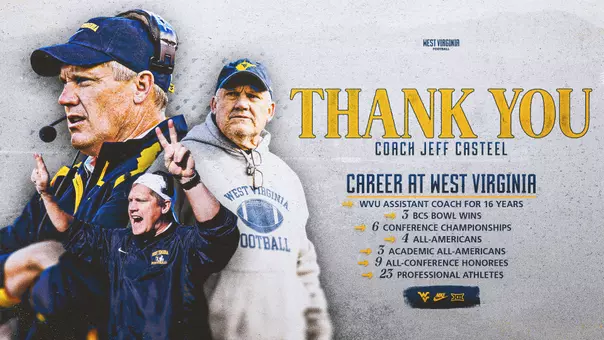
"Jeff Casteel is on our staff as an analyst and he's been great - really kind of an historian for me in teaching us about that game," Brown said.
As a matter of record, Casteel was involved in seven wins and just three losses during his 10 seasons coordinating West Virginia defenses from 2002-11. He can tell you anything you want to know about the three losses. The seven wins are a blur. I learned that once from talking to Barry Switzer, who said it was often difficult to remember the wins but impossible to forget the losses.
At any rate, based on what you read, West Virginia is probably going to be an underdog when the 105th game is played later this fall.
Brown will mention that to his players as well.
"When we came back after the bowl game, (the Backyard Brawl has) been a carrot for our club," he said. "We had a countdown clock we started doing and (as of Wednesday) it's 50 days until we play that game. For our players, it's given them a sense of urgency in their preparation for the year."
Enjoy the rest of your July. Football season is right around the corner.
In reality, Brown said his team's attention has been on the Panthers from the moment they returned to campus following last year's disappointing Guaranteed Rate bowl loss to Minnesota. What better way to get a bad taste out of your mouth than by facing your longest and most bitter rival?
Brown understands rivalry games. All you have to do is go back and look at how he prepared his team for last year's game against Virginia Tech, a 27-21 Mountaineer victory at Milan Puskar Stadium.
"The Backyard Brawl, it's going to be my first one, and it's been fun for me learning the history of that and where the real passion lies within our fan base and talking to our former players," he said Wednesday afternoon.
An avid reader and information consumer, Brown will tap all of the resources at his disposal to help get his football team up to speed on the Pitt Panthers.
First and foremost for him will be educating a squad of players that hail from many different parts of the country about the rivalry. By the way, the oldest guys on his team were still in grade school the last time the game was played in 2011, a 21-20 WVU victory in Morgantown.
Brown will tell them the Backyard Brawl is a unique rivalry because you don't fly three hours one way to play the game, get back on an airplane and not see the other team again until the following season.
West Virginia and Pitt are separated by about 75 miles of interstate highway.
Brown will tell them this is a unique rivalry because, despite the proximity of the two campuses, one school is located in the city and the other is in the country. There is nothing quite like city versus country when it comes to disputes.
When Garrett Ford Sr. (WVU wide receiver Bryce Ford-Wheaton's grandfather) used to recruit for Bobby Bowden and Frank Cignetti, he said there were distinct areas in Western PA where Pitt got its players and West Virginia got its players.
"We always seemed to get our guys from the outside areas, on the perimeter," Ford once recalled.
That meant Pitt was usually getting the players from Baldwin, Whitehall, Duquesne, Clairton, McKeesport, West Mifflin, Swissvale, Shaler, Monroeville, Penn Hills and Aliquippa. West Virginia's guys came from the smaller towns south and even west of the city … places such as Burgettstown, Waynesburg, Masontown, Fredericktown, Carmichaels, Charleroi, Vanderbilt, Brownsville, Uniontown, Connellsville and on over into Somerset County.
For many years, Washington, Pennsylvania, sort of served as an unofficial Mason-Dixon Line for West Virginia and Pitt when it came to recruiting players.
Of course, when Pitt was really bad in the mid-1990s, West Virginia was getting Western PA players from everywhere. How else could guys like Mike Logan (McKeesport), Charles Fisher (Aliquippa) and Marc Bulger (Squirrel Hill and right around the corner from Pitt) fall through the cracks?
Brown will tell them this is a unique rivalry because the two schools wear the same colors. Can you imagine Michigan wearing Ohio State scarlet and gray or Notre Dame sporting USC's gold and cardinal or Alabama wearing Auburn blue?
What about Oklahoma wearing burnt orange?
"It's just the idea that they've got the same colors you've got on," All-American linebacker Darryl Talley once said. "That isn't right. Somebody needs to take those colors off!"
Brown will tell them this is a unique rivalry because the two universities have proud and dignified heritages, financed, in part, through the hard work, sweat and labor of many. Pittsburgh was once a city forged in steel – U.S. Steel, Gulf Oil and other Fortune 500 companies were headquartered there – but it was the thousands of West Virginians who went underground to dig out the coal through the years that helped fuel Pittsburgh's thriving industrial economy.
Former West Virginia assistant coach Bill Kirelawich used to call the football rivalry "the mines versus the mills."
"If you take Pennsylvania and West Virginia and you put them together, there is not a whole lot of difference," Hall of Fame linebacker Sam Huff once told me. "There were the steel mills in Pennsylvania and the coal mines in West Virginia, and we were basically raised the same way – tough."
Brown will tell them this is a unique rivalry because high school teammates, cousins and, yes, even brothers have played against each other.
Family allegiances were put to an extreme test in 1963 at Mountaineer Field when Pitt's star halfback Paul Martha squared off against his younger and much feistier little brother Richie, a defensive back for the Mountaineers.Richie was so intense that he used to bite his hand between his thumb and index finger whenever he got mad as a kid, which was quite often. When Richie played football games, he would have one hand in his mouth and the other ready to unload on whomever he was trying to tackle.
Paul was the family celebrity, the Shadyside Academy graduate, consensus All-American, first-round draft pick, well-known attorney and NFL and NHL team executive. Richie wasn't. He went to Wilkinsburg High and then on to West Virginia so he could take a few shots at his big-shot brother – two siblings living in the same house but growing up on different sides of the railroad tracks!
How often do you see that?
Brown will tell his guys that Pitt fans have always viewed Penn State as their biggest rival, not West Virginia, when it comes to the pecking order of red-letter football games. Your typical Golden Panther talking points go as such … Penn State is the game we want to win the most and West Virginia is the game we DON'T WANT TO LOSE.
This goes back many, many years and is purely a result of value. For many years, what value did Pitt fans see in beating West Virginia teams that frequently lost to inferior opponents?
What about losing? What value was the loss to the Mountaineers in Morgantown in 1975 when West Virginia was defeated by Tulane that same season, also in Morgantown? What was the value in losing to the Mountaineers in 1972 when Temple beat WVU that same year?
But Don Nehlen eventually changed this dynamic soon after arriving in 1980. The first thing everybody asked Nehlen when he took the WVU job was when was he going to beat Pitt? When was he going to beat Penn State?
His response was brilliant. After all, he grew up in Ohio, knew Woody Hayes and was taught the game at Bo Schembechler's knee.
"We need to beat those other teams on our schedule first, and then the Pitt and Penn State games will take care of themselves," Nehlen explained.
Once that was settled, Nehlen's teams upset Florida in the Peach Bowl, stunned Oklahoma nine months later in Norman, knocked off Maryland, Boston College and Syracuse and pretty soon, those Golden Panthers could see some value in beating ole West Virginia.
Unfortunately for them and fortunately for West Virginia, that didn't happen too often. Since 1983, which was Nehlen's first full recruiting cycle at WVU, the Mountaineers have won 18 times, the Panthers nine with two ties.
The one tie in 1989 is still considered a loss to Mountaineer fans, by the way.
Nearly every West Virginia victory in the series before 1983 was considered an upset. Most of Pitt's wins since then have been upsets as well.
Certainly, Pitt fans take great delight in its 2007 victory over 28½-point favorite West Virginia in Morgantown. That was the closest West Virginia got to the national championship game during the BCS era. Had the Mountaineers gotten there, many believe they could have won it all.
Brown happens to have a person on his staff who can tell his guys all about that 2007 football game in vivid detail, right down to its bitter end.
"Jeff Casteel is on our staff as an analyst and he's been great - really kind of an historian for me in teaching us about that game," Brown said.
As a matter of record, Casteel was involved in seven wins and just three losses during his 10 seasons coordinating West Virginia defenses from 2002-11. He can tell you anything you want to know about the three losses. The seven wins are a blur. I learned that once from talking to Barry Switzer, who said it was often difficult to remember the wins but impossible to forget the losses.
At any rate, based on what you read, West Virginia is probably going to be an underdog when the 105th game is played later this fall.
Brown will mention that to his players as well.
"When we came back after the bowl game, (the Backyard Brawl has) been a carrot for our club," he said. "We had a countdown clock we started doing and (as of Wednesday) it's 50 days until we play that game. For our players, it's given them a sense of urgency in their preparation for the year."
Enjoy the rest of your July. Football season is right around the corner.

Players Mentioned

WR
/ FootballRoss Hodge | Oklahoma State Postgame
Wednesday, February 25
Alumni Series | Barb Navarini Higgins
Tuesday, February 24
Oklahoma State Recap
Sunday, February 22
Ross Hodge | TCU Postgame
Sunday, February 22