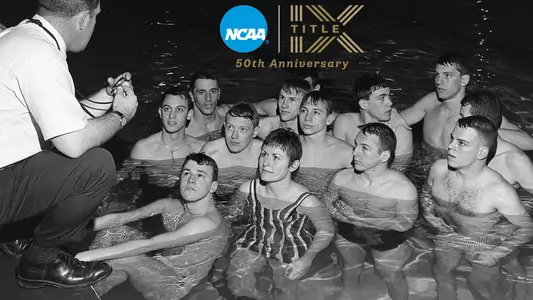
The Amazing Story of WVU Trailblazer Bette Hushla
June 24, 2022 09:00 AM | Men's Swimming & Diving, Women's Swimming & Diving, Blog
MORGANTOWN, W.Va. – Tucked deep inside a filing cabinet in a storage room we call “the dungeon” is a 9 x 12-inch, clasped manila file folder with the name Bette Hushla scribbled in black marker on the left-hand side. Underneath her name is the inscription “Swimming.”
The folder contains photos and some tattered newspaper clippings of Bette’s one season competing for the West Virginia University men’s swimming and diving team.
Yes, you read that correctly … THE WEST VIRGINIA UNIVERSITY MEN'S SWIMMING AND DIVING TEAM!
The year was 1965, which was seven years before Title IX became a federal law and 10 years before West Virginia University sponsored its first women’s team.
It was also before the Women’s Liberation Movement began to really find its bearings in 1970 when 600 women attended the first-ever WLM conference at Ruskin College in Oxford, England. And, it was just a couple of years after Betty Friedan’s ground-breaking book The Feminine Mystique was published in 1963.
Bette Hushla wasn’t the first women to compete in intercollegiate athletics at West Virginia University – the late Marilee Hohmann (Veasey) earned that distinction as a member of the rifle team in 1961 – but Bette was the one who really got people around the country thinking about the opportunities (or lack thereof) for women in college sports in the mid-1960s.
There were other females back then trying to do similar things, such as Wheeling’s Fern Lee “Peachy” Kellmeyer, who was a member of the University of Miami’s men’s tennis team in 1964. Kellmeyer continued advocating for women’s rights as Marymount College’s athletic director, spearheading lawsuits aimed at gaining college scholarships for females. Kellmeyer later worked for the World Tennis Association and was inducted into the International Tennis Hall of Fame in 2011 and the West Virginia Sportswriters Hall of Fame in 2014.
And while Kellmeyer and others took on the fight to try and improve women’s rights, Bette Hushla wasn’t out to make a point or prove that she was better than men – she simply wanted to swim in college.
Growing up just outside of Rochester in Williamson, New York, Hushla came from a family of swimmers. Her father, Fred Hushla, who worked as an industrial engineer at Eastman Kodak, teamed with his wife, Beatrice, to run the area’s touted AAU swimming program, which included Bette and her younger sister Marianne. In fact, Bette's father was considered one of the most prominent all-around sportsmen in upstate New York, once serving as the national chairman of the U.S. Luge Committee.
By the time Bette was 16, she possessed most of the area swimming records and owned the world’s fourth-fastest time in the 100-yard backstroke, according to her sister. Her long-course clocking was only three-tenths of a second off the winning time in the 1960 Rome Olympics, and three different occasions she represented the United States in competitions held in Canada. After graduating high school as class valedictorian, Hushla set her sights on competing in the 1968 U.S. Olympic Trials.
But how?
How could she do so while also pursuing a college education?
There were no college opportunities for women’s swimmers in the 1960s and her only alternatives were either USA Swimming or remaining in the AAU ranks, which was a pretty expensive endeavor in the days before Mark Spitz. Hardly anyone could afford to compete as an amateur back then.
So Bette’s solution was to try and find a college men’s program that would allow her to compete while pursuing a degree in either history or music. West Virginia University offered both, and its swimming program was in dire need of good swimmers.
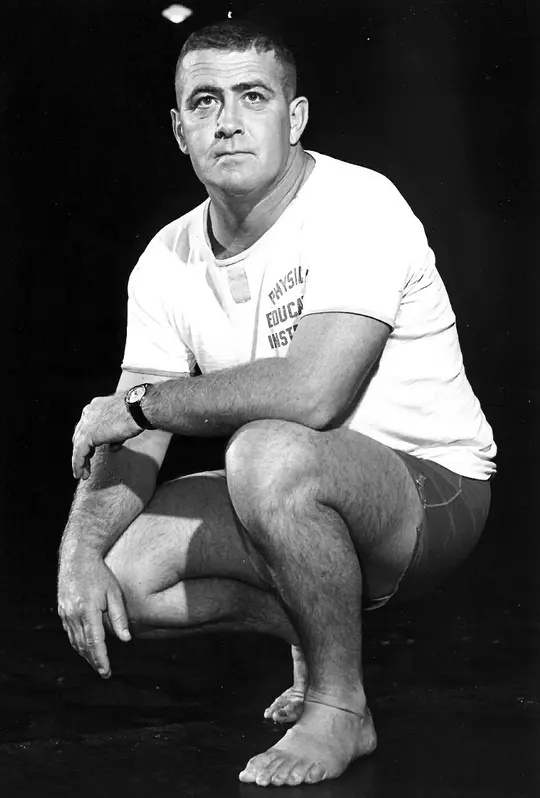
On June 19, 1964, high-strung, chain-smoking Jack Lowder, a Durham, North Carolina, native who earned degrees at Wake Forest and North Carolina State, became West Virginia’s seventh swimming and diving coach in its 12-year history. For the mathematically challenged like myself, that averages out to more than one coach every two years!
Lowder was an assistant professor at Maryland whose swimming expertise came primarily from the youth ranks. In taking the West Virginia job, his main goal was to earn a doctorate degree in education, so a lengthy coaching tenure in Morgantown was not in the cards.
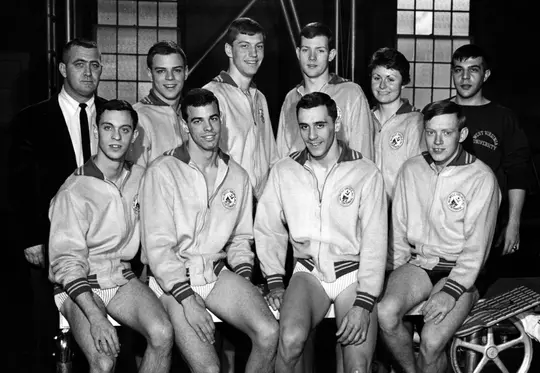
Outside of the Crago brothers, Ron and Larry, the WVU program Lowder inherited in the summer of 1964 didn’t possess many good swimmers and was considered the worst in the Southern Conference. There were about a half-dozen or so guys remaining on campus when he took over, including South Bend, Indiana, native Phil Minnes.
“Up until my senior year of high school, I didn’t even know if I was going to go to college,” Minnes recalled.
Pittsburgh’s Ray Brace was another swimmer Lowder inherited. Brace was also a backup halfback on the Mountaineer football team until Lowder offered him some more scholarship money to concentrate solely on swimming. Brace didn’t need much convincing, though, when Washington, D.C., All-American halfback Garrett Ford arrived on campus.
Brace and Minnes became the team’s co-captains.
What Lowder had was a roster full of freestylers, but hardly anyone to cover the backstroke, breast stroke and butterfly events.
“I didn’t know backstroke from beans,” Minnes chuckled. “I pretty much tried not to drown.”
But Bette Hushla did know the backstroke. She happened to be a freshman on campus in the winter of 1964 studying music (she was an accomplished vocalist and pianist). When Hushla introduced herself to Lowder, and he started digging deeper into her swimming background, he immediately saw a solution to his backstroke problem.
There was no rule that said she couldn’t compete. Hohmann performed two seasons for the rifle team in 1961-62 and Tricia Kinsella was another accomplished shooter on campus at the time Bette was in school, so the athletic administration was supportive of Bette swimming with the men’s varsity team.
Getting an opportunity to swim collegiately was one of the reasons why Bette came to West Virginia in the first place. She also had family from her mother’s side living in the Mountain State, so things seemed to be lining up nicely for her. What better way to stay in top shape by training with the men to take a shot at the 1968 Olympic Trials, she likely thought?
“She’s the best backstroker we’ve got,” Lowder told a reporter in 1965.
For some of the guys who were on the team, however, their memories are vague as to how Hushla was formally introduced to them, although Pittsburgh’s Gene Reiff does recall there being a bit of skepticism.
“Initially, when we were told she was going to swim with us it was sort of like, ‘Oh, wow, what’s going on here?’” he said. “I didn’t quite grasp it at first, but at the same token, we didn’t have a lot of depth back then. As a matter of fact, when I came to the University in the spring of ’64, I think there were only like five or six guys on the entire team.”
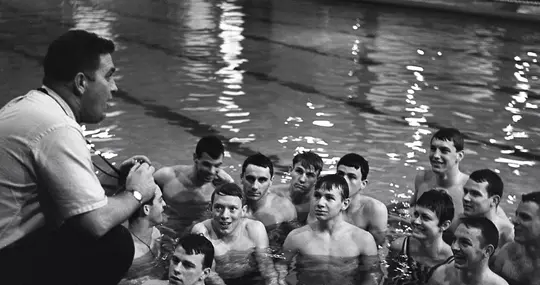
To those who knew Lowder, allowing Bette to swim on the men’s team was somewhat of a surprising decision considering his great reluctance to make any sort of waves. When the team traveled to away meets, one prankster sitting in the backseat of the car would usually yell out “ICE!” and then watch Lowder’s frantic reaction. He usually jumped out of his seat, nearly wrecking the car.
On one particular occasion, while the swimmers were eating together after a meet in Grove City, Pennsylvania, a couple of guys were horsing around and one of them accidentally bumped the waitress on the back of her leg. The waitress became visibly upset.
“This is going to end up being in all of the newspapers,” a worried and concerned Lowder complained to them. When the restaurant owner, watching from behind the counter, came out and agreed that it was just an accident and an honest misunderstanding, Lowder was greatly relieved. Needless to say, controversy and Jack Lowder were not comfortable companions.
“He had a great personality, and he got along well with everybody, including the other coaches and teams,” Brace recalled.
“A great guy,” WVU’s Sports Hall of Fame coach Kevin Gilson recalled. “He was very nice to me. I had him in class when I was at Maryland and then when I finished at Maryland, he offered me a (graduate assistant) position with him at West Virginia.”
Immediately, Bette’s teammates took a liking to her, admiring her work ethic and her easy-going demeanor. However, there were many unresolved issues when she was allowed to join the team.
Where was she going to dress? When visiting teams were using the girl’s locker room, Bette used to dress behind a curtain in the coach’s office.
What about opposing teams? How would they react when Bette got into the pool? When Bette tried to swim an exhibition race against Fairmont State during her freshman year in 1964, the Falcon swimmers nearly revolted. A similar deal occurred when WVU opened its season the following year at Carnegie Tech.
When West Virginia swam against Georgetown and American University in Washington, D.C., and Bette finished second in her race, the Georgetown backstroker she beat got out of the water, ran to the locker room, showered and left the facility. Georgetown coach Joe Rogers told Washington Post reporter Byron Roberts afterward that he wasn’t certain if he’d ever see him again. Later that year, Hushla made Sports Illustrated’s “Faces in the Crowd” section after winning races in six of the eight meets she entered.
Now let’s be clear, Bette wasn’t the best backstroker in the Southern Conference that year, but she was good enough to qualify for the conference championship meet held in Williamsburg, Virginia, on March 3, 1965.
“I’m fairly good,” she humbly told Roberts in 1965, “but I can’t beat the best girls, and I’m lucky to beat some of the boys.”
Hushla was permitted to swim in all of the Southern Conference meets that season, including the home finale in the Mountainlair Pool against Virginia Tech when she was part of the winning 400-yard freestyle relay team that also consisted of Brace, Minnes and Reiff.
That was Feb. 20, 1965.
Ten days later, the Southern Conference ruled that Hushla was ineligible to compete in its championship meet taking place at William & Mary College. The ruling covered all sports, including rifle, which also affected Kinsella.
“Our tournaments are for the male species,” Southern Conference commissioner Lloyd P. Jordan told The Associated Press. “We don’t have any girls in any of our tournaments. As far as the office is concerned, the ban against girls participating is in the book.
“I am truly in favor of women participating in athletics, but with their own,” he added.
The Southern Conference’s ruling hit West Virginia University like a tidal wave. A protest, organized by Betty Boyd, WVU’s dean of women, garnered nearly 2,000 signatures in one day and was sent via telegram to the conference office in Richmond.
Bette’s story received national news coverage with her plight getting attention as far away as California in the Los Angeles Times.
As an institution, West Virginia University was no stranger to these sorts of controversies. The school was the first to introduce Black athletes to Southern Conference competition when Phil Edwards competed for the WVU track and field team in 1961. It was the first to introduce Black football players to the league in 1962 when freshmen Dick Leftridge and Roger Alford broke the color barrier. And, it was also the first Southern Conference school to have Black basketball players when Fritz Williams, Jimmy Lewis, Ed Harvard, Norman Holmes and junior college transfer Carl Head were on the team for its season opener against VMI at the Charleston Civic Center on Dec. 1, 1965.
In this regard, WVU was far ahead of the curve compared to its regional rivals such as Maryland, Duke, Wake Forest, North Carolina, Virginia and Virginia Tech.
Our tournaments are for the male species. We don’t have any girls in any of our tournaments. As far as the office is concerned, the ban against girls participating is in the book.- Southern Conference commissioner Lloyd P. Jordan
Today, West Virginia’s University’s popular slogan is Mountaineers Go First.
“Here, going first is in our blood …” it begins. “It’s in our sweat. And it’s in our nature. So we will go above. We will go beyond. And when everyone else goes back, Mountaineers #GOFIRST.”
For the better part of the last 60 years, which includes the introduction of female Mountaineer mascots Natalie Tennant, Rebecca Durst and Mary Roush, West Virginia University has consistently practiced what it preaches.
“Shame on Bette Hushla for being a girl,” wrote sportswriter Walt Whittaker soon after it was announced that she was not allowed to compete. “The Southern Conference – at least the Executive Committee – just will not put up with it. Imagine, Bette Hushla, a girl.
“What Bette needs is a bit of advice,” he continued. “First of all, she should never have been born a girl. Second, since she was, she should have taken up bridge and canasta and ballet.
“Third, since she was allowed to participate during the regular season, she should have had enough respect for the male ego to finish in a more womanly position: last, for instance.”
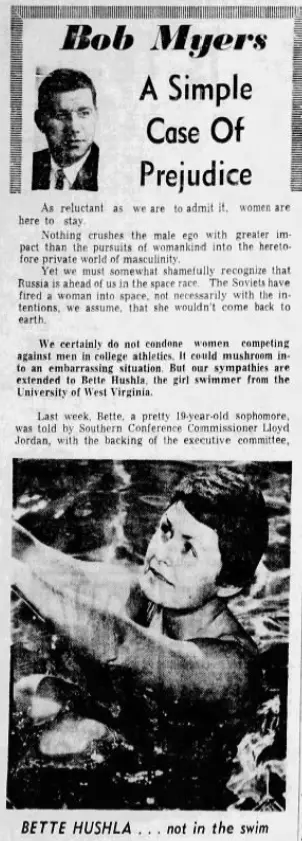
Charlotte News sportswriter Bob Myers also took a crack at the subject a week later.
“Bette’s plight puts another light on the situation,” he wrote. “West Virginia has always been a proud basketball school steeped in winning tradition.
“I ask Mr. Commissioner, what if Rod Hundley had been Hilda Hundley, if Jerry West had been Mae West, if Rod Thorn had been Rose Thorn? What if George King were Jessica King, Buddy Quertinmont were Beulah Quertinmont and Bob Camp were Becky Camp? They would have had to play the Texas Cowgirls in last night’s eliminations at Philadelphia.”
He concluded, “(the books) must have been rewritten since 1962 for that year West Virginia records indicate Marilee Hohmann was a member of the Mountaineers’ rifle team. She did compete in the conference championship.”
The vote was eight in favor of banning Hushla and one against, West Virginia being the lone dissenting vote.
“(Athletic Director) Red Brown and I both argued against it as long as we could, but everybody else favored it,” School of Physical Education Dean Ray O. Duncan said at the time. “The other members claimed the original intent of the rule was to limit athletic participation to male students. They pointed out the use of the pronoun ‘he’ or ‘his’ in referring to athletes. Any question on it never came up before this past year.”
“I’m just so disappointed,” Lowder admitted. “It’s so extremely unjust. Here is a young girl who has worked very hard all year – aiming for this tournament – and now she is told only a day and a half before the opening round that she can’t compete.
“The only reason they will give is that she is a woman. It has reached a sad point when men begin to worry about women in athletics,” he said.
“The Southern Conference (ban), I can vividly remember,” Brace said. “They were trying to find a way all year long to disqualify her from competing in the championship. They finally determined that she was not wearing an approved swimsuit, and I can remember Bette telling coach Lowder, ‘That’s okay, I’ll swim in just a Speedo then.’ Jack said, ‘No, Bette, we can’t do that, particularly since your event is the backstroke (meaning she would be facing everyone while out of the water)!’ I really think she was serious about doing this and calling their bluff.”
Her surviving teammates, as well as Gilson, a graduate assistant coach for Lowder that season, all agree that Bette would have scored points for West Virginia in the championships. In fact, she ended the season as the team’s third-leading point-getter behind only co-captains Minnes and Brace.
Again, this wasn’t some stunt Bette was pulling to try and prove a point. First of all, Lowder wouldn’t have allowed it and, secondly, her teammates wouldn’t have supported her if that was the case. They had genuine admiration for her as a person, and their respect for her as a swimmer grew each day she trained with them.
“She always seemed like a happy, cheerful person to me,” Reiff recalled. “For a lack of a better description, we just considered her to be one of the guys. Nobody saw her any differently. I felt she earned her stripes and had the right to be there.”
“Bette had the right personality to do this – soft-talking, easy to get along with and happy to be there,” Brace added. “We acted like gentlemen to a lady whom we considered a teammate and a friend. That was the environment we had on the team.”
“In my opinion, she was very humble and low-key,” Minnes observed. “She didn’t flaunt who she was and what she was. She had good work ethic and a very pleasant personality, but she stayed pretty much to herself.”
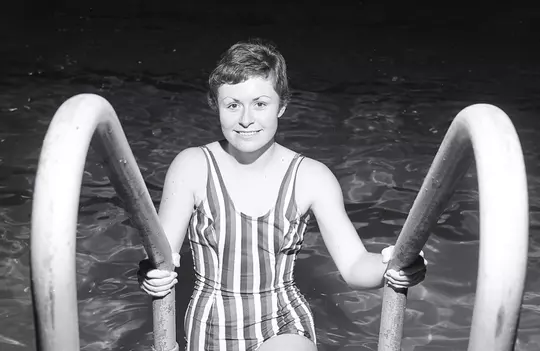
The Southern Conference ruling effectively ended Bette’s swimming career. She was listed on the 1966 team roster but opted not to swim. A story in the school newspaper, The Daily Athenaeum, cited stomach ulcers brought on from the controversy as the reason for her early retirement. Bette indicated then that she considered transferring to another school, as Kinsella did, but she liked West Virginia University, developed many close friendships and decided to remain in school to complete her degree.
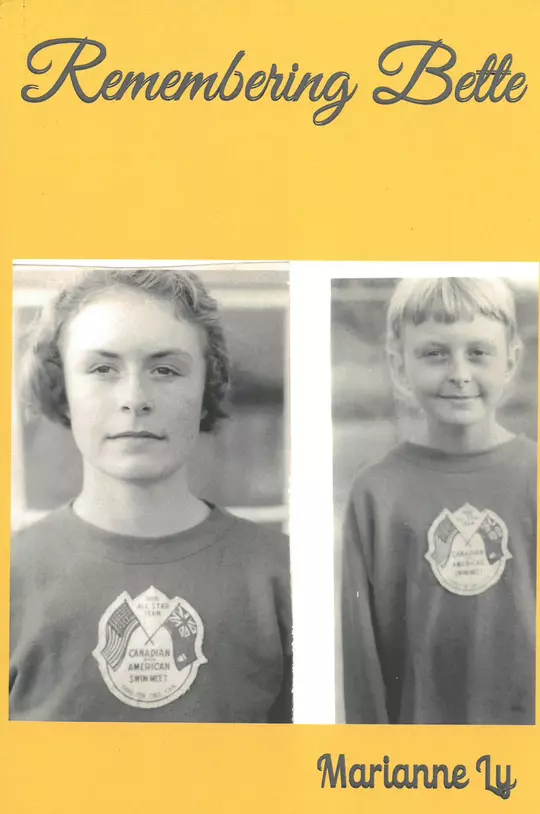
Hushla, who died from COVID-19 in the spring of 2020 in Trenton, New Jersey, lived a remarkable and interesting life. Soon after her passing, Bette’s sister, Marianne Ly, explored her sister’s legacy in a book titled Remembering Bette, which is available for purchase online at Amazon.com. It deals mostly with their childhood growing up together on a farm near Rochester, their youth swimming careers and then their relationship later in life as adults. Marianne wrote little about Bette’s experiences as a trailblazing West Virginia University female athlete in the mid-1960s because Bette simply didn’t talk about it. That door to her life was closed permanently. From the moment she quit swimming she never got into the pool again, even to swim leisurely, according to Ly.
The Southern Conference’s decision to prohibit Bette from competing may have prematurely ended her promising swimming career, but it didn’t define her life, nor did it defeat her. And in subtle, unspoken ways, Bette had a profound impact upon her classmates and teammates attending WVU in the mid-1960s who are now approaching the twilight years of their lives.
“I was really surprised when I went to her sister’s (Amazon.com author) page and it said Bette was ranked No. 4 at that time,” admitted Minnes, who after serving in Vietnam returned to live and work in his native Indiana. “You wouldn’t have known that from talking to her.
“She was in an environment with a bunch of guys that accepted her, but she didn’t wear her heart on her sleeve,” Minnes added.
After receiving his degree in industrial engineering, Brace went on to have a fabulous career working at The Hershey Company, advancing to senior vice-president of global operations at the time of his retirement in 2007. He was inducted into the Candy Hall of Fame that year in recognition of his 41 years of outstanding service to the company.
Brace still manages an 80-acre dairy farm just outside of Hershey.
“Bette was such a tough competitor, strong-willed, and I’m sure the Southern Conference (banning) really tugged at her heartstrings,” Brace said. “She paved a path for other females, and sometimes it’s tough to be the first, but when you look back on it, it always takes that first person to do it.
“That was Bette.”
Reiff, a retired physical therapist now living in Stuart, Florida, admits to seeing Bette in a much different light today. When he was swimming in college, he was just a 20-something-year-old living one day to the next – like most college students.
“The age I am now, all of the history I read and the things I get involved in with regards to Southern history, the Civil War and all that stuff – and now you are asking me to think about Bette – it’s amazing how much of an influence she really was to us all in such a silent way.
“She was years ahead of the (Women’s Liberation) movement and therefore, she had the weight of the world on her shoulders when you really think about what we’re talking about,” Reiff said. “She was trying to do something that had never been done before.
“All she wanted to do here was swim and compete,” Reiff continued. “You guys should get a picture of Bette and it should be on a wall somewhere where everybody can see it!”
There are many postscripts to this story.
The year after Bette competed in 1965, the swimming and diving team enjoyed its best season in school history with Brace, Minnes, Reiff and Roy Schaney teaming with hot-shot sophomores Tom Gulliford and Craig McKay to lead the squad to an outstanding 11-4 record and a third-place finish at the Southern Conference Championships.
Lowder resigned following the ‘66 season to take a teaching position at Mount St. Mary’s College, leaving the program to his able, young assistant Gilson. Sadly, years later, Lowder took his own life.
Bette taught school in West Virginia for a short time, was briefly married, moved to New Jersey to operate a small business and had one daughter, Mattie, who died in 2011 at age 43 from colon cancer. According to her sister, Bette was a “gifted musician, voracious reader, dedicated co-worker, a friend to those in despair, a five-time cancer survivor and a lover of cats and all animals.”
COVID-19 claimed Bette on April 28, 2020.
Gilson stuck around for the next 30 years to develop Mountaineer swimming and diving into one of the strongest programs in the East. He was inducted into the WVU Sports Hall of Fame in 2015.
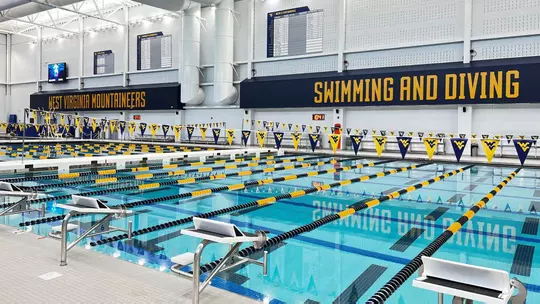
Swimming and diving, which once called the dilapidated and decrepit Mountainlair Pool its home, moved to the WVU Natatorium next the WVU Coliseum in the mid-1970s and is now competing in a beautiful, new $48 million facility at Mylan Park.
Many years after Bette swam at WVU, when Gilson coached the men’s and women’s teams, he would sometimes take his best female swimmer Renee Ricco and put her in the fast lane with the men. He did this to send his guys a little message to pick it up because Renee was good enough to beat them if they didn’t. He had remembered how hard the guys used to train whenever Bette was in the pool.
Yes, even decades later Bette Hushla’s presence was still being felt around here, in a silent way, of course!
This is the final installment in our three-part series celebrating the 50th anniversary of Title IX at West Virginia University.
The age I am now, all of the history I read and the things I get involved in with regards to Southern history, the Civil War and all that stuff – and now you are asking me to think about Bette – it’s amazing how much of an influence she really was to us all in such a silent way. She was years ahead of the (Women’s Liberation) movement and therefore, she had the weight of the world on her shoulders when you really think about what we’re talking about. She was trying to do something that had never been done before.-- Teammate Gene Reiff