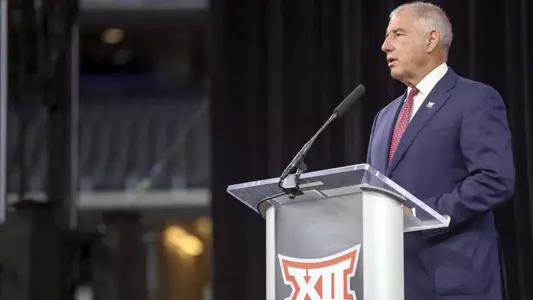
Photo by: Big 12 Conference
Big 12 Boss Bowlsby in Favor of 12-Team College Football Playoff
July 14, 2021 03:06 PM | Football, Blog
ARLINGTON, Texas – College football is inching closer toward an expanded, 12-team college football playoff.
Big 12 commissioner Bob Bowlsby said today he is hopeful a decision can be made during the next College Football Playoff Committee board meeting in September.
Bowlsby is part of the College Football Playoff Board of Managers, chaired by Mississippi State president Mark Keenum, that also includes West Virginia University president Gordon Gee.
"If we're unable to come to some closure on it, either in September or some period of time afterward, I guess that we'll likely wait until the end of the 12-year agreement and implement it at that time," Bowlsby said before an assemblage of reporters at AT&T Stadium in Arlington, Texas, where the Big 12 is holding its annual two-day football media event.
Bowlsby indicated the biggest feedback he received was surprise that the committee suggested an expansion from its present four-team field to 12. He indicated an eight-team playoff that included the highest-ranked six conference champions limited the opportunities for at-large participation.
"That was one of the gating issues," he said.
Bowlsby said the Big 12 has not had a football champion during the playoff era that would have finished outside the top-six highest rated conference champions, so he is reasonably confident the conference will always have at least one school in the mix in an expanded playoff.
The chances of having more than one is also pretty good.
"It is a certainty? No. But it's a risk that I think is an enhancement for us," he said.
Bowlsby cited the Big 12's current 10-team configuration as potentially an easier pathway to get to the playoffs, as opposed to some of the larger conferences.
"You've only got to beat nine others in order to get to the championship. That's easier said than done, but it's also easier than going through 14 or 15 to get there," he pointed out. "So, I like our dog in the fight, but it wasn't about what's going to benefit the Big 12.
"I certainly took my own temperature on that during the course of the hundreds of hours of conversation, but I was proud of the three colleagues that were in the room with me. I think everybody did a good job of checking their hat at the door."
Oklahoma has made the playoffs four times since it was introduced for the 2014-15 season. The Sooners are the only Big 12 program to qualify for the playoffs since its inception.
"You've got to start somewhere and I think their proposal was really good in a lot of ways," Oklahoma coach Lincoln Riley said. "I think it addressed maintaining bowls, which are so important to the history of our game that I hope we never turn our back on.
"I think it addressed getting the conference champions in the playoff, which has needed to happen. I think it addressed a pathway for a Group of 5 member to be able to get into the playoffs, which honestly hasn't been realistic under the current system," he said. "There's still work to be done and questions to be answered. The obvious one is how many games do you want to play in a season? Is 12 too many? Those things are up for debate, but I think it was a great proposal and something we can all work off of to make the system better."
Bowlsby doesn't anticipate an expanded College Football Playoff impacting the lucrative conference football championship games typically played during the first week of December.
"One of the things we looked at was moving the season a week earlier," Bowlsby said. "Then you'd have your conference championship games the week before Thanksgiving.
"Ultimately, we didn't do that, but it probably isn't completely off the table. But expect those (playoff) games to be played the second or third week in December, so it won't impact the conference championship games."
He added, "But as it has always been, it's up to the leagues to decide if they play a conference championship game. It isn't a requirement, but there is the determination that the conference champion, however designated, is going to be the representative."
Bowlsby mentioned the primary motivation for expanding the playoff from four to 12 teams was driven by the desire to include more teams in the playoff process and keep more college football fanbases engaged throughout the season.
In its present format, a September or October loss means most teams are eliminated from playoff consideration.
"I think the 12-team playoff, if adopted, will be a tremendous asset for the regular season," he explained. "There will be 40 schools that have a legitimate claim to a path to the playoff in mid-October, and by early November, there will still be 25, and we're not going to be in a situation where who is in and who is out starts taking place the first week of November. It's gotten fairly predictable, and that's going to be a good thing for college football."
In the same vein, Bowlsby doesn't foresee an expanded college playoff really doing much to alter the landscape of college sports. Conferences are not going to expand or contract based on an expanded college football playoff field.
"Conference alignment is always at the discretion of the conference, but you have to remember, the last time around the last round of conference realignment was all driven by cable households, and we find ourselves now in a rapidly shrinking cable environment," he said.
"It's much less driven by capturing a particular cable market because if it's an in-market fee, you get a lot more money for it than if it's an out-of-market fee. So the more you can include those things, the more revenue you're going to derive from it.
"The motivation (to expand) is essentially gone," Bowlsby continued. "The cable universe has shrunk 20 million households already, and it's going to continue to shrink as we migrate to digital consumption and streaming."
Which means the motivation for conferences to expand to increase its television imprint is no longer there.
"Is that to say it couldn't happen? No, it could possibly happen for other reasons, but it doesn't appear to me that the motivation is there at this point in time. It's not one of the things that keeps me up at night," he concluded.
Big 12 commissioner Bob Bowlsby said today he is hopeful a decision can be made during the next College Football Playoff Committee board meeting in September.
Bowlsby is part of the College Football Playoff Board of Managers, chaired by Mississippi State president Mark Keenum, that also includes West Virginia University president Gordon Gee.
"If we're unable to come to some closure on it, either in September or some period of time afterward, I guess that we'll likely wait until the end of the 12-year agreement and implement it at that time," Bowlsby said before an assemblage of reporters at AT&T Stadium in Arlington, Texas, where the Big 12 is holding its annual two-day football media event.
Bowlsby indicated the biggest feedback he received was surprise that the committee suggested an expansion from its present four-team field to 12. He indicated an eight-team playoff that included the highest-ranked six conference champions limited the opportunities for at-large participation.
"That was one of the gating issues," he said.
Bowlsby said the Big 12 has not had a football champion during the playoff era that would have finished outside the top-six highest rated conference champions, so he is reasonably confident the conference will always have at least one school in the mix in an expanded playoff.
The chances of having more than one is also pretty good.
"It is a certainty? No. But it's a risk that I think is an enhancement for us," he said.
Bowlsby cited the Big 12's current 10-team configuration as potentially an easier pathway to get to the playoffs, as opposed to some of the larger conferences.
"You've only got to beat nine others in order to get to the championship. That's easier said than done, but it's also easier than going through 14 or 15 to get there," he pointed out. "So, I like our dog in the fight, but it wasn't about what's going to benefit the Big 12.
"I certainly took my own temperature on that during the course of the hundreds of hours of conversation, but I was proud of the three colleagues that were in the room with me. I think everybody did a good job of checking their hat at the door."
Oklahoma has made the playoffs four times since it was introduced for the 2014-15 season. The Sooners are the only Big 12 program to qualify for the playoffs since its inception.
"You've got to start somewhere and I think their proposal was really good in a lot of ways," Oklahoma coach Lincoln Riley said. "I think it addressed maintaining bowls, which are so important to the history of our game that I hope we never turn our back on.
"I think it addressed getting the conference champions in the playoff, which has needed to happen. I think it addressed a pathway for a Group of 5 member to be able to get into the playoffs, which honestly hasn't been realistic under the current system," he said. "There's still work to be done and questions to be answered. The obvious one is how many games do you want to play in a season? Is 12 too many? Those things are up for debate, but I think it was a great proposal and something we can all work off of to make the system better."
Bowlsby doesn't anticipate an expanded College Football Playoff impacting the lucrative conference football championship games typically played during the first week of December.
"One of the things we looked at was moving the season a week earlier," Bowlsby said. "Then you'd have your conference championship games the week before Thanksgiving.
"Ultimately, we didn't do that, but it probably isn't completely off the table. But expect those (playoff) games to be played the second or third week in December, so it won't impact the conference championship games."
He added, "But as it has always been, it's up to the leagues to decide if they play a conference championship game. It isn't a requirement, but there is the determination that the conference champion, however designated, is going to be the representative."
Bowlsby mentioned the primary motivation for expanding the playoff from four to 12 teams was driven by the desire to include more teams in the playoff process and keep more college football fanbases engaged throughout the season.
In its present format, a September or October loss means most teams are eliminated from playoff consideration.
"I think the 12-team playoff, if adopted, will be a tremendous asset for the regular season," he explained. "There will be 40 schools that have a legitimate claim to a path to the playoff in mid-October, and by early November, there will still be 25, and we're not going to be in a situation where who is in and who is out starts taking place the first week of November. It's gotten fairly predictable, and that's going to be a good thing for college football."
In the same vein, Bowlsby doesn't foresee an expanded college playoff really doing much to alter the landscape of college sports. Conferences are not going to expand or contract based on an expanded college football playoff field.
"Conference alignment is always at the discretion of the conference, but you have to remember, the last time around the last round of conference realignment was all driven by cable households, and we find ourselves now in a rapidly shrinking cable environment," he said.
"It's much less driven by capturing a particular cable market because if it's an in-market fee, you get a lot more money for it than if it's an out-of-market fee. So the more you can include those things, the more revenue you're going to derive from it.
"The motivation (to expand) is essentially gone," Bowlsby continued. "The cable universe has shrunk 20 million households already, and it's going to continue to shrink as we migrate to digital consumption and streaming."
Which means the motivation for conferences to expand to increase its television imprint is no longer there.
"Is that to say it couldn't happen? No, it could possibly happen for other reasons, but it doesn't appear to me that the motivation is there at this point in time. It's not one of the things that keeps me up at night," he concluded.



WRES: Athletics Performance Center Tour
Wednesday, June 10
TV Highlights: Morgantown Super Regional Game 2
Saturday, June 06
NCAA Super Regional (Steve Sabins) - WVU Baseball | June 4
Saturday, June 06
A Special Announcement for No. 5 Pat White
Saturday, June 06