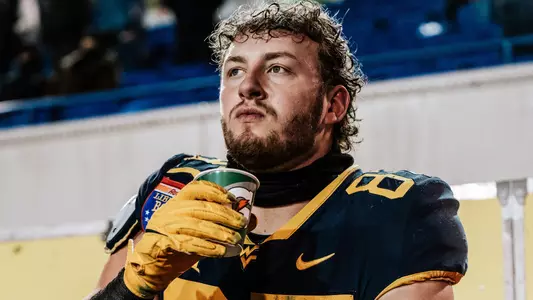
Photo by: WVU Athletic Communications
Mountaineers Positioning Themselves To Take Advantage of Tight End Rebirth
May 19, 2021 05:30 PM | Football, Blog
MORGANTOWN, W.Va. – Could Kolar, Allen and Soehner be changing college football as we've known it?
No, Kolar, Allen and Soehner is not a law firm and this is not an essay about Name, Image and Likeness (NIL), but rather it's Iowa State's trio of outstanding tight ends who helped the Cyclones have a breakout campaign in 2020 under sixth-year coach Matt Campbell.
All three are large human beings who also happen to be nimble enough to take advantage of some more average-sized guys on the other side of the line of scrimmage trying to defend them.
Who wouldn't want that on your football team? And, why did it take five years for Iowa State to come up with this?
Well, as the story goes out in Ames, Iowa State offensive coordinator Tom Manning once coached the tight ends for the Indianapolis Colts, and he realized that Campbell had recruited three very good ones at Iowa State. So, instead of playing one and having the other two standing on the sidelines, he devised ways to use all three of them at the same time in certain situations.
What came of it was an immediate problem for modern defenses now geared toward using smaller, more agile and versatile players to try and slow down explosive playmakers out in space.
All three tight ends can play attached, giving Iowa State a 13-personnel look, which means more gaps for All-American running back Breece Hall of which to take advantage. Or, two of them can move out to wide receiver to become an 11-personel look (one tight end, three wide receivers and one running back) without having to come out of the game.
Who takes the 260-pounder now lined up in the slot, and who covers the 250-pounder split out wide? When you are giving up 4 or 5 inches and 50 or 60 pounds, that can be a problem.
Or, when two tight ends are lined up next to each other attached, creating a D- and an E-gap, that can also be a problem.
Naturally, the tradeoff is using more tight ends means fewer explosive playmakers on the field, which can make scoring quickly a little more difficult. It also means playing mistake-free football in order to complete sustained scoring drives.
But that hasn't been too much of an issue for Iowa State when it's faced Oklahoma in recent years.
"They're creative," OU coach Lincoln Riley said last year. Riley's Sooners have lost twice to Iowa State since Campbell has been at the helm. "They have a couple of guys there that really have outstanding skill sets. They do a good job trying to create matchups, whether it's in their blocking schemes or trying to get those guys out in route combinations."
We saw first-hand in Ames last year what having three big tight ends can accomplish patrolling the middle of the field or creating more running space for Hall.
Of course, Neal Brown saw it, too.
Remember, it was Brown calling the plays at Texas Tech in 2012 when Red Raider tight end Jace Amaro went through West Virginia's secondary like a hot knife through butter. Brown understands as well as anybody the value versatile and athletic tight ends can bring to the table in today's football.
In fact, we saw some of it from the Mountaineers last season.
 Who can forget Mike O'Laughlin's fourth-down catch in overtime that helped West Virginia upset Baylor? Or, O'Laughlin's third-quarter touchdown grab (also on fourth down) that propelled the Mountaineers' to their 24-21 comeback victory over Army in the Liberty Bowl?
A couple of years ago, you couldn't find more than one tight end anywhere near the Milan Puskar Center. Having a bunch of tight ends in an Air Raid offense was about as useful as owning a snowblower in Hawaii.
But that began to change when Jake Spavital returned to run Dana Holgorsen's attack in 2017-18 and brought in O'Laughlin and T.J. Banks. Now, Brown is taking the position to another level. As of mid-May, tight ends coach Travis Trickett has six players to work with, five of whom are on scholarship.
A few years ago, when Trevon Westco came out of the game, he was either replaced by a fullback or an offensive tackle. Furthermore, it's probably been more than 20 years since West Virginia has had this many tight ends on scholarship at one time - going back to when Don Nehlen was coaching and Anthony Becht was starring for the Mountaineers.
O'Laughlin suspects Iowa State could be one of the reasons why tight ends are getting more opportunities in college football today.
"I think people are seeing the value in three tight ends, and obviously, (Iowa State) invested a lot in them," he said last month. "That's not always easy to do because you don't know what the outcome will be.
"When you have three bigger guys, they're not going to blow by people," O'Laughlin explained. "I don't know if it was an experimental thing and it just kind of worked out or they had a plan, but I think a lot of people are paying attention to that, and I think a lot of people are trying to find and develop tight ends right now to play that role."
The key word is "develop" because tight ends are not born. The storks just aren't dropping them off at the doorstep.
O'Laughlin should know. He came here four years ago as a 210-pound wide receiver.
"After that first year I gained some weight," he recalled. "It was difficult, but I kind of got past that stage. As you get older, you want to kind of develop the mental side as well, and the past two years working with coach Trickett, coach (Gerad) Parker and coach Brown, I'm kind of taking it to that next level of thinking."
In all honestly, Iowa State shouldn't get all of the credit for the rebirth of the tight end position in football today. For years, people at all levels were paying close attention to what Rob Gronkowski did with the New England Patriots and what he continues to do today with the Tampa Bay Buccaneers.
Gronkowski was the reason Spavital changed course at West Virginia in 2017, and a lot of young coaches today continue to see the value in having a 6-foot-5, 260-pound guy who can block on one play and catch a 20-yard seam pass the next.
It just may be that the guy who ends up doing it is 6-foot-5, 210 pounds and never once got down into a three-point stance like O'Laughlin was to start out. The Glen Ellyn, Illinois, resident admits Gronkowski has had a big influence on his young football career.
"If you look at Gronk, the guy was dunking basketballs in high school, and he's just a big, athletic guy who turned out to be a football player," he said. "He's a guy who is a little bit crazy, and I feel like at this position you've got to have a little bit of crazy because you are doing all sorts of things.
"You're blocking big people and trying to run by little people," O'Laughlin said. "(Gronkowski) was an idol growing up and when I was learning the position, I used to watch him, and he played so hard.
"If you play hard, good things are going to happen," he concluded.
Look for more good things to happen to Mike O'Laughlin, too, as well as West Virginia's other tight ends.
Perhaps we could see O'Laughlin, Banks and Davis running around out there this fall. Or, possibly O'Laughlin, Banks and Wikstrom, or maybe even O'Laughlin, Banks and Finley.
Who and how many remains a question for another day, but there are strong indications that the tight end position could become an even bigger part of West Virginia's offense this fall.
Stay tuned.
Season tickets for the 2021 campaign are on now sale through the Mountaineer Ticket Office by calling toll-free 1-800-WVU GAME or by logging on to WVUGAME.com.
No, Kolar, Allen and Soehner is not a law firm and this is not an essay about Name, Image and Likeness (NIL), but rather it's Iowa State's trio of outstanding tight ends who helped the Cyclones have a breakout campaign in 2020 under sixth-year coach Matt Campbell.
All three are large human beings who also happen to be nimble enough to take advantage of some more average-sized guys on the other side of the line of scrimmage trying to defend them.
Who wouldn't want that on your football team? And, why did it take five years for Iowa State to come up with this?
Well, as the story goes out in Ames, Iowa State offensive coordinator Tom Manning once coached the tight ends for the Indianapolis Colts, and he realized that Campbell had recruited three very good ones at Iowa State. So, instead of playing one and having the other two standing on the sidelines, he devised ways to use all three of them at the same time in certain situations.
What came of it was an immediate problem for modern defenses now geared toward using smaller, more agile and versatile players to try and slow down explosive playmakers out in space.
All three tight ends can play attached, giving Iowa State a 13-personnel look, which means more gaps for All-American running back Breece Hall of which to take advantage. Or, two of them can move out to wide receiver to become an 11-personel look (one tight end, three wide receivers and one running back) without having to come out of the game.
Who takes the 260-pounder now lined up in the slot, and who covers the 250-pounder split out wide? When you are giving up 4 or 5 inches and 50 or 60 pounds, that can be a problem.
Or, when two tight ends are lined up next to each other attached, creating a D- and an E-gap, that can also be a problem.
Naturally, the tradeoff is using more tight ends means fewer explosive playmakers on the field, which can make scoring quickly a little more difficult. It also means playing mistake-free football in order to complete sustained scoring drives.
But that hasn't been too much of an issue for Iowa State when it's faced Oklahoma in recent years.
"They're creative," OU coach Lincoln Riley said last year. Riley's Sooners have lost twice to Iowa State since Campbell has been at the helm. "They have a couple of guys there that really have outstanding skill sets. They do a good job trying to create matchups, whether it's in their blocking schemes or trying to get those guys out in route combinations."
We saw first-hand in Ames last year what having three big tight ends can accomplish patrolling the middle of the field or creating more running space for Hall.
Of course, Neal Brown saw it, too.
Remember, it was Brown calling the plays at Texas Tech in 2012 when Red Raider tight end Jace Amaro went through West Virginia's secondary like a hot knife through butter. Brown understands as well as anybody the value versatile and athletic tight ends can bring to the table in today's football.
In fact, we saw some of it from the Mountaineers last season.
Who can forget Mike O'Laughlin's fourth-down catch in overtime that helped West Virginia upset Baylor? Or, O'Laughlin's third-quarter touchdown grab (also on fourth down) that propelled the Mountaineers' to their 24-21 comeback victory over Army in the Liberty Bowl?A couple of years ago, you couldn't find more than one tight end anywhere near the Milan Puskar Center. Having a bunch of tight ends in an Air Raid offense was about as useful as owning a snowblower in Hawaii.
But that began to change when Jake Spavital returned to run Dana Holgorsen's attack in 2017-18 and brought in O'Laughlin and T.J. Banks. Now, Brown is taking the position to another level. As of mid-May, tight ends coach Travis Trickett has six players to work with, five of whom are on scholarship.
A few years ago, when Trevon Westco came out of the game, he was either replaced by a fullback or an offensive tackle. Furthermore, it's probably been more than 20 years since West Virginia has had this many tight ends on scholarship at one time - going back to when Don Nehlen was coaching and Anthony Becht was starring for the Mountaineers.
O'Laughlin suspects Iowa State could be one of the reasons why tight ends are getting more opportunities in college football today.
"I think people are seeing the value in three tight ends, and obviously, (Iowa State) invested a lot in them," he said last month. "That's not always easy to do because you don't know what the outcome will be.
"When you have three bigger guys, they're not going to blow by people," O'Laughlin explained. "I don't know if it was an experimental thing and it just kind of worked out or they had a plan, but I think a lot of people are paying attention to that, and I think a lot of people are trying to find and develop tight ends right now to play that role."
The key word is "develop" because tight ends are not born. The storks just aren't dropping them off at the doorstep.
O'Laughlin should know. He came here four years ago as a 210-pound wide receiver.
"After that first year I gained some weight," he recalled. "It was difficult, but I kind of got past that stage. As you get older, you want to kind of develop the mental side as well, and the past two years working with coach Trickett, coach (Gerad) Parker and coach Brown, I'm kind of taking it to that next level of thinking."
In all honestly, Iowa State shouldn't get all of the credit for the rebirth of the tight end position in football today. For years, people at all levels were paying close attention to what Rob Gronkowski did with the New England Patriots and what he continues to do today with the Tampa Bay Buccaneers.
Gronkowski was the reason Spavital changed course at West Virginia in 2017, and a lot of young coaches today continue to see the value in having a 6-foot-5, 260-pound guy who can block on one play and catch a 20-yard seam pass the next.
It just may be that the guy who ends up doing it is 6-foot-5, 210 pounds and never once got down into a three-point stance like O'Laughlin was to start out. The Glen Ellyn, Illinois, resident admits Gronkowski has had a big influence on his young football career.
"If you look at Gronk, the guy was dunking basketballs in high school, and he's just a big, athletic guy who turned out to be a football player," he said. "He's a guy who is a little bit crazy, and I feel like at this position you've got to have a little bit of crazy because you are doing all sorts of things.
"You're blocking big people and trying to run by little people," O'Laughlin said. "(Gronkowski) was an idol growing up and when I was learning the position, I used to watch him, and he played so hard.
"If you play hard, good things are going to happen," he concluded.
Look for more good things to happen to Mike O'Laughlin, too, as well as West Virginia's other tight ends.
Perhaps we could see O'Laughlin, Banks and Davis running around out there this fall. Or, possibly O'Laughlin, Banks and Wikstrom, or maybe even O'Laughlin, Banks and Finley.
Who and how many remains a question for another day, but there are strong indications that the tight end position could become an even bigger part of West Virginia's offense this fall.
Stay tuned.
Season tickets for the 2021 campaign are on now sale through the Mountaineer Ticket Office by calling toll-free 1-800-WVU GAME or by logging on to WVUGAME.com.

Players Mentioned

TE
/ FootballRoss Hodge | Utah Postgame
Thursday, February 19
Honor Huff & Chance Moore | Utah Postgame
Thursday, February 19
Riley Makalusky | Feb. 18
Wednesday, February 18
Mark Kellogg | Feb. 18
Wednesday, February 18