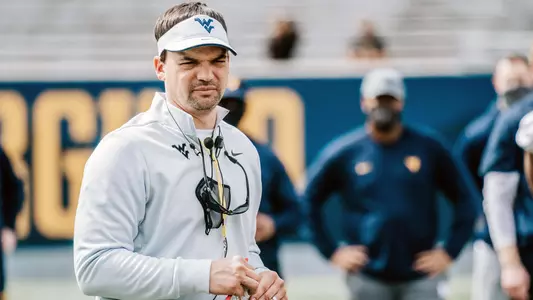
Photo by: Caleb Saunders
Teaching a Big Part of Spring Football Practice for WVU’s Brown
March 30, 2021 04:00 PM | Football, Blog
MORGANTOWN, W.Va. – West Virginia once had a mad scientist for a football coach - a guy who was so brilliant in the theories and schemes of the game that he often got lost in the complicated diagrams he was drawing on the grease board.
And not only did he get lost in those diagrams he was constructing, but he also frequently lost those trying to follow his Albert Einstein-like creations.
Head coach Don Nehlen, once sitting in the back of the room watching what looked to him like a formula for the H-bomb, nervously exchanged glances with his other assistant coaches while this was going on in front of them.
When it was over, Nehlen nudged one of the older coaches sitting next to him and whispered, "Make sure you dumb all of this down to our guys because if I can't understand what he's drawing up there, I damned well know our players aren't going to understand it either!"
On the other hand, there was a coach many, many years ago who put up a diagram of a common running play on the chalkboard and quickly got confused trying to figure out how to defend it. Each time he moved the Xs around to match the Os, there was always an extra O unaccounted for until one player pointed out that he had one too many Os on the chalk board.
Yes, it can be rather difficult coming up with a way for 11 Xs to defend 12 Os!
Art Lewis once recruited a player from Western Pennsylvania whose father was a lay minister. Lewis and the father began talking about religion, which was something a little beyond Pappy's expertise, and the two eventually retired to a work shed where the father had diagrammed on a chalkboard his interpretation of the Book of Revelation.
When Pappy finally got out of that shed and into his car with the assistant coach he took with him, Lewis swore what he saw on that chalkboard was an exact replica of Bud Wilkinson's Oklahoma split-T offense!
I bring this up because the astute Kevin Kinder of Blue and Gold News asked Neal Brown a question the other day about teaching during spring football practice. It was a question Brown, the son of an educator, clearly appreciated.
You see, teaching is a huge part of what Neal Brown does during the spring. He admits it's a time of the year he really enjoys.
"I've got kind of a sketch of a plan for 15 practices," Brown said.
His sketch includes five practices before giving the players a little break for the Easter holiday. Brown will take the time during the break to dissect those five practices and then come up with a plan for the remaining 10 practices to conclude the spring.
It's a time of learning for the coaches as well.
Brown gave an example of the tweaking that he will sometimes do from one practice to the next, based on what he's seeing.
Yesterday's practice plan didn't include a segment on two-point plays, but because Brown didn't see what he wanted from his guys during Saturday's practice, he added a two-point play period to the Monday workout.
"I didn't think we played those particularly well on either side, so we'll add those back in and do some kind of competition two-point play period to kind of teach off (Saturday's) practice," he explained.
 Offensive coordinator Gerad Parker got his degree in teaching, and he says many of the guys on Brown's staff have backgrounds in education as former high school coaches.
Basically, they're teachers first and college football coaches second.
"It's a huge, huge progression, and that's why I think it's one of the best professions in the world to have a teaching background," Parker admitted. "A lot of our guys here were all ball coaches that didn't know whether they were going to coach in high school or college, so you got a teaching degree and, hopefully, we all have a bunch of different ways to teach it well."
Parker said he will use just about any means available to make sure his players understand what they're being taught. That could even include the players themselves going up to the grease board and diagramming plays.
"We'll use magnets and different modes of learning to make sure we're hitting all spots and then, of course, you check their notes. Then, you have to inspect what you've taught and make sure that they know and are retaining it through tests and quizzes," he said.
"Then, we take them out on the field and walk them through it. This is daily," Parker explained. "Then, we get to do it fast, and we go back to the film room and say, 'Okay, now you did it fast and here is how we improve it.' Then, it all starts all over again."
The objective, of course, is to make sure the players fully understand it. It does no good for only the coaches to understand what's going on.
"Coach Brown has made a big emphasis with us on teaching – and not only us teaching but hopefully some of our players learning how to teach the material as well," Parker said.
"Just hearing our guys on staff teach … I think any way you can get a guy to be able to retain it is crucial. So how do we retain information? You've got to hit all modes of learning because we've got all kinds of different teachers and learners," Parker added.
Parker said the lockdown from the pandemic last spring forced them to dramatically improve their teaching skills. Getting 100-plus 18-, 19-, 20- and 21-year-olds to pay attention on a Zoom call is by no means an easy task.
"COVID has made us better teachers because we have to do all of this over Zoom, and you've got to find ways to reach guys when you're staring at them on a screen and making sure they're retaining it," Parker concluded.
And yes, those diagrams they're drawing for the players on the grease board only have 11 Xs and 11 Os.
And not only did he get lost in those diagrams he was constructing, but he also frequently lost those trying to follow his Albert Einstein-like creations.
Head coach Don Nehlen, once sitting in the back of the room watching what looked to him like a formula for the H-bomb, nervously exchanged glances with his other assistant coaches while this was going on in front of them.
When it was over, Nehlen nudged one of the older coaches sitting next to him and whispered, "Make sure you dumb all of this down to our guys because if I can't understand what he's drawing up there, I damned well know our players aren't going to understand it either!"
On the other hand, there was a coach many, many years ago who put up a diagram of a common running play on the chalkboard and quickly got confused trying to figure out how to defend it. Each time he moved the Xs around to match the Os, there was always an extra O unaccounted for until one player pointed out that he had one too many Os on the chalk board.
Yes, it can be rather difficult coming up with a way for 11 Xs to defend 12 Os!
Art Lewis once recruited a player from Western Pennsylvania whose father was a lay minister. Lewis and the father began talking about religion, which was something a little beyond Pappy's expertise, and the two eventually retired to a work shed where the father had diagrammed on a chalkboard his interpretation of the Book of Revelation.
When Pappy finally got out of that shed and into his car with the assistant coach he took with him, Lewis swore what he saw on that chalkboard was an exact replica of Bud Wilkinson's Oklahoma split-T offense!
I bring this up because the astute Kevin Kinder of Blue and Gold News asked Neal Brown a question the other day about teaching during spring football practice. It was a question Brown, the son of an educator, clearly appreciated.
You see, teaching is a huge part of what Neal Brown does during the spring. He admits it's a time of the year he really enjoys.
"I've got kind of a sketch of a plan for 15 practices," Brown said.
His sketch includes five practices before giving the players a little break for the Easter holiday. Brown will take the time during the break to dissect those five practices and then come up with a plan for the remaining 10 practices to conclude the spring.
It's a time of learning for the coaches as well.
Brown gave an example of the tweaking that he will sometimes do from one practice to the next, based on what he's seeing.
Yesterday's practice plan didn't include a segment on two-point plays, but because Brown didn't see what he wanted from his guys during Saturday's practice, he added a two-point play period to the Monday workout.
"I didn't think we played those particularly well on either side, so we'll add those back in and do some kind of competition two-point play period to kind of teach off (Saturday's) practice," he explained.
Offensive coordinator Gerad Parker got his degree in teaching, and he says many of the guys on Brown's staff have backgrounds in education as former high school coaches.Basically, they're teachers first and college football coaches second.
"It's a huge, huge progression, and that's why I think it's one of the best professions in the world to have a teaching background," Parker admitted. "A lot of our guys here were all ball coaches that didn't know whether they were going to coach in high school or college, so you got a teaching degree and, hopefully, we all have a bunch of different ways to teach it well."
Parker said he will use just about any means available to make sure his players understand what they're being taught. That could even include the players themselves going up to the grease board and diagramming plays.
"We'll use magnets and different modes of learning to make sure we're hitting all spots and then, of course, you check their notes. Then, you have to inspect what you've taught and make sure that they know and are retaining it through tests and quizzes," he said.
"Then, we take them out on the field and walk them through it. This is daily," Parker explained. "Then, we get to do it fast, and we go back to the film room and say, 'Okay, now you did it fast and here is how we improve it.' Then, it all starts all over again."
The objective, of course, is to make sure the players fully understand it. It does no good for only the coaches to understand what's going on.
"Coach Brown has made a big emphasis with us on teaching – and not only us teaching but hopefully some of our players learning how to teach the material as well," Parker said.
"Just hearing our guys on staff teach … I think any way you can get a guy to be able to retain it is crucial. So how do we retain information? You've got to hit all modes of learning because we've got all kinds of different teachers and learners," Parker added.
Parker said the lockdown from the pandemic last spring forced them to dramatically improve their teaching skills. Getting 100-plus 18-, 19-, 20- and 21-year-olds to pay attention on a Zoom call is by no means an easy task.
"COVID has made us better teachers because we have to do all of this over Zoom, and you've got to find ways to reach guys when you're staring at them on a screen and making sure they're retaining it," Parker concluded.
And yes, those diagrams they're drawing for the players on the grease board only have 11 Xs and 11 Os.

Gold-Blue Spring Festival Fan Recap
Sunday, April 19
John Neider | April 18
Saturday, April 18
Coach Zac Alley | April 18
Saturday, April 18
Coach Rich Rodriguez | April 18
Saturday, April 18