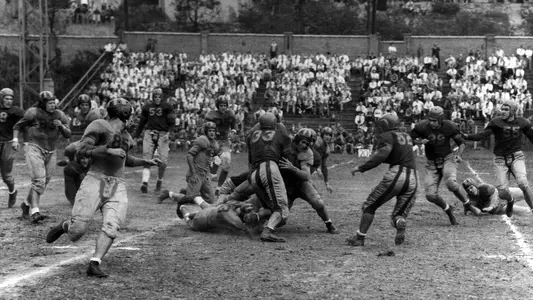
Photo by: WVU Athletic Communications
Unique Grid Season in ‘43 Could Provide Guidance For Football’s Future
June 02, 2020 04:00 PM | Football, Blog
MORGANTOWN, W.Va. – There is nothing in Football for Dummies about COVID-19. I know because I'm a dummy and I checked.
But there was an instance from the past that could be useful in helping us navigate what could possibly an unusual college football season this fall.
Seventy-seven years ago in 1943, less than two years after the Japanese bombed Pearl Harbor, college football was in jeopardy of closing up shop until the conclusion of World War II.
Coaches and players had gone off to war and inexperienced freshmen were utilized to help fortify depleted rosters while transportation issues and gasoline rationing limited the number of games teams were able to play.
Some schools suspended play for the entire season while others carried on as best they could.
For those playing football, such as West Virginia University, wartime restrictions required games to take place close to campuses and team travel to be severely limited. As a result, college football experienced a 19 percent drop in overall attendance, according to Allison Danzig his 1956 book The History of American Football: Great Teams, Players and Coaches.
 For financial reasons, WVU athletic director Roy "Legs" Hawley (pictured to the right shaking hands with Maryland coach Jim Tatum with WVU coach Dud DeGroot looking off into the distance) was adamant that the Mountaineers play football games in 1943 despite losing their coach, Bill Kern, and most of their top players to Uncle Sam.
Other sports such as baseball were discontinued until the conclusion of the war.
"We intend to field a team and play out a schedule because we feel we have everything to gain and nothing to lose by continuing football," Hawley declared. "The brand of play may not be up to par because our squad naturally will be composed of young, inexperienced boys, but since most of our opponents will be in the same position the competition should be more or less even."
In 1940, Hawley hired Kern, the national coach of the year after leading Carnegie Tech to the 1939 Sugar Bowl, with the hopes of him turning the Mountaineers into a national football power.
The schedule certainly reflected Hawley's desire of bringing big-time college football to Morgantown. Fordham, Penn State, Kentucky and Michigan State were on the docket Hawley had arranged for 1940.
In 1941, the AD had the Mountaineers playing Navy, Fordham, Kentucky, Kansas, Penn State, Army and Michigan State – all formidable opponents - and in 1942 Hawley's grid slate included Boston College, South Carolina, Fordham, Penn State, Kentucky, Michigan State and Miami, Florida.
Kern managed to win five and lose four versus Hawley's 1942 schedule before reporting to active duty on July 1, 1943.
As a result, the AD picked former coach and Mountaineer great Ira Errett Rodgers to lead the grid program until Kern's return, and the material he had to work consisted primarily of freshmen and 4Fs - those unfit for military service.
Unfortunately, some of them were unfit for football service as well.
Hawley's first crack at a schedule he released on Aug. 8, 1943 featured games against rival Pitt, Geneva, Virginia Tech, Ohio University, Syracuse and Michigan State.
The Pitt contest raised many eyebrows locally because the Panthers had been off the slate for four years because they were pursuing membership in the Big Ten.
At least that was Pitt's public explanation.
The private reason the series was canceled was because the Panthers were upset that West Virginia had failed to pay them guarantee money for games played in Morgantown in the early 1930s during the Great Depression when the WVU athletic department was virtually bankrupt.
Nevertheless, Hawley's first schedule didn't hold up for very long.
Virginia Tech chose not to field a team in '43 so Virginia was contracted as a replacement for the Gobblers in a contest to be played at Charleston's Laidley Field to open the season.
Syracuse and Michigan State were the next two to give up football for '43 so Penn State and Lehigh were added. Bethany replaced Geneva, and a mid-October contest against Maryland featuring the return of WVU coaching legend Clarence "Doc" Spears and a home date against Carnegie Tech were the remaining two pieces to the puzzle.
The '43 slate featured five games in October - Virginia, Pitt, Maryland, Carnegie Tech and Penn State – and two in November, Lehigh and Bethany.
The Mountaineers' longest trip of the season was a 297-mile train ride over to Bethlehem, Pennsylvania, to play Leigh with the Engineers returning the game in Morgantown in 1944.
At the time, the service academies and schools with special military programs fielded the strongest football squads while the rest made do with mostly players who likely would not have made college rosters when the top players were still stateside.
In some instances, it was also common for guys to switch teams during the season as eligibility standards were relaxed or servicemen transferred to other schools to continue their military training.
Such was the case with fullback Bill Abromitis, who began the year at Pitt before transferring to Penn State. Huntington's Chasey Wilson also started the season at West Virginia before ending it at Bethany.
A WVU roster of 39 players in early September dwindled to just 22 by late October, requiring Rodgers to juggle his lineup throughout the season.
Rodgers' best players were 1942 holdovers Kenny Fryer, John Lucente, Bob Dutton and Charles Helinski, basketball All-American Scotty Hamilton and freshmen Russ Lopez, Raymond Queen and Buddy Pike.
It was Pike who scooped up a Maryland fumble in the mud to score the game's only touchdown in a 6-2 victory over the Terps, and Hamilton's open-field running that led to a 53-6 win at Lehigh.
A year later, Pike wound up at Tennessee where he played on the Vols' 1945 Rose and 1947 Orange Bowl teams.
Mid-season transfers wrecked some teams, such as Southern California, and weakened many others. Ohio State was college football's top squad in 1942 before absorbing repeated beatings in 1943 with only civilians on its roster.
Wisconsin and Minnesota, two other top programs in '42, saw their best players scoring touchdowns for other teams in '43.
The final Associated Press Top 10 that year featured Navy, Army, military teams Iowa Pre-Flight, Great Lakes Navy, Del Monte Pre-Flight and March Field, with Notre Dame holding down the top spot.
No West Virginia opponents finished in the Top 20.
 The Mountaineers concluded the 1943 campaign with a 4-3 record. Rodgers coached the team again in 1944 and 1945 before Kern returned in 1946 following the conclusion of the war.
It was immediately after the war when college football experienced one of its greatest growth periods as players returned to campus on G.I. bills and the general public had more money to spend as a result of an improving economy.
This also occurred in the early 1920s following World I War and a great worldwide flu pandemic that infected more than 500 million people, causing the cancellation of football for WVU and many other schools in 1918.
West Virginia rebounded in the mid-1920s to field some of its greatest football teams under Spears, and it also recovered very nicely in the early 1950s when Art Lewis took over the coaching reins.
Perhaps history will repeat itself yet again with Neal Brown.
Stay tuned!
But there was an instance from the past that could be useful in helping us navigate what could possibly an unusual college football season this fall.
Seventy-seven years ago in 1943, less than two years after the Japanese bombed Pearl Harbor, college football was in jeopardy of closing up shop until the conclusion of World War II.
Coaches and players had gone off to war and inexperienced freshmen were utilized to help fortify depleted rosters while transportation issues and gasoline rationing limited the number of games teams were able to play.
Some schools suspended play for the entire season while others carried on as best they could.
For those playing football, such as West Virginia University, wartime restrictions required games to take place close to campuses and team travel to be severely limited. As a result, college football experienced a 19 percent drop in overall attendance, according to Allison Danzig his 1956 book The History of American Football: Great Teams, Players and Coaches.
For financial reasons, WVU athletic director Roy "Legs" Hawley (pictured to the right shaking hands with Maryland coach Jim Tatum with WVU coach Dud DeGroot looking off into the distance) was adamant that the Mountaineers play football games in 1943 despite losing their coach, Bill Kern, and most of their top players to Uncle Sam.Other sports such as baseball were discontinued until the conclusion of the war.
"We intend to field a team and play out a schedule because we feel we have everything to gain and nothing to lose by continuing football," Hawley declared. "The brand of play may not be up to par because our squad naturally will be composed of young, inexperienced boys, but since most of our opponents will be in the same position the competition should be more or less even."
In 1940, Hawley hired Kern, the national coach of the year after leading Carnegie Tech to the 1939 Sugar Bowl, with the hopes of him turning the Mountaineers into a national football power.
The schedule certainly reflected Hawley's desire of bringing big-time college football to Morgantown. Fordham, Penn State, Kentucky and Michigan State were on the docket Hawley had arranged for 1940.
In 1941, the AD had the Mountaineers playing Navy, Fordham, Kentucky, Kansas, Penn State, Army and Michigan State – all formidable opponents - and in 1942 Hawley's grid slate included Boston College, South Carolina, Fordham, Penn State, Kentucky, Michigan State and Miami, Florida.
Kern managed to win five and lose four versus Hawley's 1942 schedule before reporting to active duty on July 1, 1943.
As a result, the AD picked former coach and Mountaineer great Ira Errett Rodgers to lead the grid program until Kern's return, and the material he had to work consisted primarily of freshmen and 4Fs - those unfit for military service.
Unfortunately, some of them were unfit for football service as well.
Hawley's first crack at a schedule he released on Aug. 8, 1943 featured games against rival Pitt, Geneva, Virginia Tech, Ohio University, Syracuse and Michigan State.
The Pitt contest raised many eyebrows locally because the Panthers had been off the slate for four years because they were pursuing membership in the Big Ten.
At least that was Pitt's public explanation.
The private reason the series was canceled was because the Panthers were upset that West Virginia had failed to pay them guarantee money for games played in Morgantown in the early 1930s during the Great Depression when the WVU athletic department was virtually bankrupt.
Nevertheless, Hawley's first schedule didn't hold up for very long.
Virginia Tech chose not to field a team in '43 so Virginia was contracted as a replacement for the Gobblers in a contest to be played at Charleston's Laidley Field to open the season.
Syracuse and Michigan State were the next two to give up football for '43 so Penn State and Lehigh were added. Bethany replaced Geneva, and a mid-October contest against Maryland featuring the return of WVU coaching legend Clarence "Doc" Spears and a home date against Carnegie Tech were the remaining two pieces to the puzzle.
The '43 slate featured five games in October - Virginia, Pitt, Maryland, Carnegie Tech and Penn State – and two in November, Lehigh and Bethany.
The Mountaineers' longest trip of the season was a 297-mile train ride over to Bethlehem, Pennsylvania, to play Leigh with the Engineers returning the game in Morgantown in 1944.
At the time, the service academies and schools with special military programs fielded the strongest football squads while the rest made do with mostly players who likely would not have made college rosters when the top players were still stateside.
In some instances, it was also common for guys to switch teams during the season as eligibility standards were relaxed or servicemen transferred to other schools to continue their military training.
Such was the case with fullback Bill Abromitis, who began the year at Pitt before transferring to Penn State. Huntington's Chasey Wilson also started the season at West Virginia before ending it at Bethany.
A WVU roster of 39 players in early September dwindled to just 22 by late October, requiring Rodgers to juggle his lineup throughout the season.
Rodgers' best players were 1942 holdovers Kenny Fryer, John Lucente, Bob Dutton and Charles Helinski, basketball All-American Scotty Hamilton and freshmen Russ Lopez, Raymond Queen and Buddy Pike.
It was Pike who scooped up a Maryland fumble in the mud to score the game's only touchdown in a 6-2 victory over the Terps, and Hamilton's open-field running that led to a 53-6 win at Lehigh.
A year later, Pike wound up at Tennessee where he played on the Vols' 1945 Rose and 1947 Orange Bowl teams.
Mid-season transfers wrecked some teams, such as Southern California, and weakened many others. Ohio State was college football's top squad in 1942 before absorbing repeated beatings in 1943 with only civilians on its roster.
Wisconsin and Minnesota, two other top programs in '42, saw their best players scoring touchdowns for other teams in '43.
The final Associated Press Top 10 that year featured Navy, Army, military teams Iowa Pre-Flight, Great Lakes Navy, Del Monte Pre-Flight and March Field, with Notre Dame holding down the top spot.
No West Virginia opponents finished in the Top 20.
The Mountaineers concluded the 1943 campaign with a 4-3 record. Rodgers coached the team again in 1944 and 1945 before Kern returned in 1946 following the conclusion of the war.It was immediately after the war when college football experienced one of its greatest growth periods as players returned to campus on G.I. bills and the general public had more money to spend as a result of an improving economy.
This also occurred in the early 1920s following World I War and a great worldwide flu pandemic that infected more than 500 million people, causing the cancellation of football for WVU and many other schools in 1918.
West Virginia rebounded in the mid-1920s to field some of its greatest football teams under Spears, and it also recovered very nicely in the early 1950s when Art Lewis took over the coaching reins.
Perhaps history will repeat itself yet again with Neal Brown.
Stay tuned!
WRES: Brody Conley
Friday, June 19
WRES: Brody Conley
Friday, June 19
Steve Sabins, Armani Guzman, Maxx Yehl | College World Series | June 14
Wednesday, June 17
Steve Sabins, Gavin Kelly, Dawson Montesa, Reese Bassinger | College World Series | June 16
Wednesday, June 17