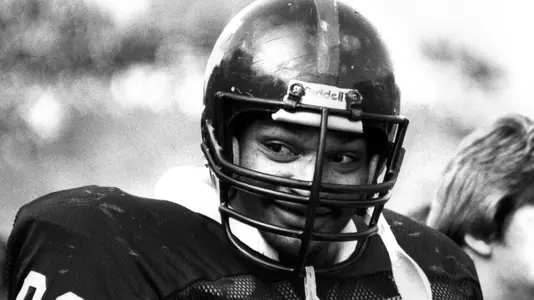
Photo by: WVU Athletic Communications
Talley Sets The Standard For Mountaineer Football Players The Past 50 Years
June 11, 2020 01:02 PM | Football, Blog
MORGANTOWN, W.Va. – Social media never ceases to amaze me.
The other day I tweeted out what I thought was a universally accepted opinion among Mountaineer football fans:
Then, as I began reading some of the responses it dawned on me that perhaps it is not universally accepted that Darryl Talley is the most successful West Virginia football player of the last 50 years.
So I called up an old ball coach to get his thoughts on Mr. Talley.
This gray beard is now retired, spending the cold months in Florida and the warmer months back in West Virginia in his favorite place on the other side of Cheat Lake. His time these days is mostly occupied by playing, in his words, "@#$% golf!"
 His name is Bill Kirelawich, but those who know him best simply call him Kirlav.
No assistant coach in Mountaineer football history can match the success that Kirlav enjoyed during his 32-year run with the Mountaineers from 1980 until 2012.
He saw West Virginia go from being a bottom-tier football program in 1979 to a brink of winning a national championship just nine years later.
He was involved in the three greatest bowl wins in school history against Georgia in the Sugar Bowl, against Oklahoma in the Fiesta Bowl, and against Clemson in the Orange Bowl.
He was there to see WVU upset Florida in the 1981 Peach Bowl, and nine months later, stun Oklahoma in the 1982 season opener out in Norman.
He had a hand in ending Penn State's nearly three-decade-long winning streak over West Virginia in 1984.
He saw quarterbacks Doug Flutie and Boomer Esiason go 0 for 3 against West Virginia, and observe the Backyard Brawl flip in favor of Pitt to West Virginia.
The Mountaineer football we know and love today was certainly not the Mountaineer football some of us were raised on back in 1979 when Kirelawich first came here and a young linebacker from East Cleveland, Ohio, named Darryl Talley was just coming of age.
Talley was one of those extremely rare football players who could line up anywhere on the field and excel – which he actually once did in a 16-13 loss up at Pitt in 1982.
For anyone younger than 40, back then Pitt was it - as they used to like to say in Pittsburgh.
These Panthers were much different than the win-six, lose-six Pitt teams we've become familiar with over the last 20 to 25 years or so. In 1982, Pitt was loaded, on par talent-wise with Alabama and Clemson today – perhaps even more talented.
And Darryl Talley nearly beat those talented Panthers all by himself!
"The problem with that game was we had one Darryl Talley and they had about six or seven," Kirelawich said.
It was said that Talley lined up at every defensive position on the field except nose tackle that afternoon. His normal spot was outside linebacker, but at times he played with his hand on the ground at defensive line because he was such a great pass rusher.
Other times, he lined up out in the slot to cover wide receivers. He made tackles and sacks. He broke up and intercepted passes.
He forced fumbles and he even blocked a punt.
On one play, he chased down Pitt running back Bryan Thomas from the other side of the field to prevent a long touchdown run, keeping it instead to a harmless 22-yard gainer.
Every single stat a defensive player was capable of recording, Talley registered that afternoon. What he did was absolutely mind boggling against such a talented football team!
"In my career in coaching it's the best game any one player ever played," Kirelawich said. "From blocking punts to intercepting passes to making tackles … the defense we played then would put him on a wide receiver because he was fast enough to cover wideouts.
"He did it all," Kirelawich added. "It was absolutely a game when you ask a football player to lay it on the line, that was the definition of laying it on the line – not that the rest of them didn't because they all did – he just did his with a little more moxie!"
The problem for West Virginia, as Kirelawich indicated, was that Pitt was simply a far more talented football program at the time.
Effort and enthusiasm can only take you so far.
"Those guys didn't just go to Pitt because they liked (coach Foge Fazio's) open-collared shirts," Kirelawich said. "Now, I'm not going to get into all of that, but they were loaded and the thing was they coached them well and they had tough kids. Danny Marino was a great player; Jimbo Covert, Dwight Collins, Julius Dawkins … they had an all-star at every position."
Heading into the fourth quarter, West Virginia was leading those all-stars 13-0.
Then Marino got hot, as he later did regularly in the NFL with the Miami Dolphins, and Pitt scored a couple of fourth-quarter touchdowns once the Mountaineers ran out of gas.
"The lesson that game taught me was when a game is over, win or lose, let it go," Kirelawich said. "Typically, I could do that. Win or lose, forget about it and get on to the next game. That was one loss that stuck in your craw for a long time. It was hard as hell to get over that game. You go to bed thinking about it at night and you wake up thinking about the same thing.
"To lead the No. 1 team in the country 13-0 with Danny Marino involved on the other side, common sense will tell you it's only a matter of time before this guy was going to do something. He's no hack," Kirlav noted.
That was one of the few West Virginia football games televised at the time, although the other half of the country watched Georgia Tech play North Carolina that afternoon.
It was only the third time Talley had ever played a game on TV, and those from the rest of the country who finally got to see him in living color were amazed by what they saw!
On the basis of that performance and his total body of work, Talley was named consensus All-America in 1982 – only the school's third consensus All-American football player at the time and the first in nearly 30 years.
With such limited national attention, that demonstrates what a truly dominant college football player Darryl Talley was.
"Every weekend wasn't New Year's Day like it is today," Kirelawich explained. "For Talley to do what he did with limited exposure … it was a remarkable thing.
"West Virginia today? You can go north and south, east and west, and everywhere you go they know who West Virginia is," he said.
But sadly, time has a way of fading people's memories.
It takes a little bit of research to understand that Talley was an All-Pro and Pro Bowl performer for the Buffalo Bills, or that he started on four consecutive AFC championship teams in the early 1990s.
Today, Talley is one of just 27 Bills players on their wall of fame.
He is also one of only six Mountaineer football players in the College Football Hall of Fame. Of those six just two in my opinion – Ira Errett Rodgers and Darryl Talley – were physically capable of playing all of the positions on the football field.
Chuck Howley, who is not in the College Football Hall of Fame, is perhaps another.
 Rodgers did it in 1919 because most players back then were expected to do it; Talley almost did it 63 years later in 1982 because the coaching staff believed that gave them the best opportunity to win a big football game against their oldest rival.
So when you start thinking about the most successful Mountaineer football players of the last 50 years, keep that little tidbit in the back of your mind.
Or this from Mr. Kirelawich: "Talley was a phenomenal player and obviously we're going to say that because he played for us, but we saw things he did daily that made you shake your head. There were only a few guys who could make the plays he made or do the things that he did."
And those guys just happen to be in the College Football Hall of Fame!
The other day I tweeted out what I thought was a universally accepted opinion among Mountaineer football fans:
The most successful @WVUfootball player of the last 50 years is Ohio native Darryl Talley ...
— John Antonik (@JohnAntonik) June 9, 2020
Then, as I began reading some of the responses it dawned on me that perhaps it is not universally accepted that Darryl Talley is the most successful West Virginia football player of the last 50 years.
So I called up an old ball coach to get his thoughts on Mr. Talley.
This gray beard is now retired, spending the cold months in Florida and the warmer months back in West Virginia in his favorite place on the other side of Cheat Lake. His time these days is mostly occupied by playing, in his words, "@#$% golf!"
His name is Bill Kirelawich, but those who know him best simply call him Kirlav.No assistant coach in Mountaineer football history can match the success that Kirlav enjoyed during his 32-year run with the Mountaineers from 1980 until 2012.
He saw West Virginia go from being a bottom-tier football program in 1979 to a brink of winning a national championship just nine years later.
He was involved in the three greatest bowl wins in school history against Georgia in the Sugar Bowl, against Oklahoma in the Fiesta Bowl, and against Clemson in the Orange Bowl.
He was there to see WVU upset Florida in the 1981 Peach Bowl, and nine months later, stun Oklahoma in the 1982 season opener out in Norman.
He had a hand in ending Penn State's nearly three-decade-long winning streak over West Virginia in 1984.
He saw quarterbacks Doug Flutie and Boomer Esiason go 0 for 3 against West Virginia, and observe the Backyard Brawl flip in favor of Pitt to West Virginia.
The Mountaineer football we know and love today was certainly not the Mountaineer football some of us were raised on back in 1979 when Kirelawich first came here and a young linebacker from East Cleveland, Ohio, named Darryl Talley was just coming of age.
Talley was one of those extremely rare football players who could line up anywhere on the field and excel – which he actually once did in a 16-13 loss up at Pitt in 1982.
For anyone younger than 40, back then Pitt was it - as they used to like to say in Pittsburgh.
These Panthers were much different than the win-six, lose-six Pitt teams we've become familiar with over the last 20 to 25 years or so. In 1982, Pitt was loaded, on par talent-wise with Alabama and Clemson today – perhaps even more talented.
And Darryl Talley nearly beat those talented Panthers all by himself!
"The problem with that game was we had one Darryl Talley and they had about six or seven," Kirelawich said.
It was said that Talley lined up at every defensive position on the field except nose tackle that afternoon. His normal spot was outside linebacker, but at times he played with his hand on the ground at defensive line because he was such a great pass rusher.
Other times, he lined up out in the slot to cover wide receivers. He made tackles and sacks. He broke up and intercepted passes.
He forced fumbles and he even blocked a punt.
On one play, he chased down Pitt running back Bryan Thomas from the other side of the field to prevent a long touchdown run, keeping it instead to a harmless 22-yard gainer.
Every single stat a defensive player was capable of recording, Talley registered that afternoon. What he did was absolutely mind boggling against such a talented football team!
"In my career in coaching it's the best game any one player ever played," Kirelawich said. "From blocking punts to intercepting passes to making tackles … the defense we played then would put him on a wide receiver because he was fast enough to cover wideouts.
"He did it all," Kirelawich added. "It was absolutely a game when you ask a football player to lay it on the line, that was the definition of laying it on the line – not that the rest of them didn't because they all did – he just did his with a little more moxie!"
The problem for West Virginia, as Kirelawich indicated, was that Pitt was simply a far more talented football program at the time.
Effort and enthusiasm can only take you so far.
"Those guys didn't just go to Pitt because they liked (coach Foge Fazio's) open-collared shirts," Kirelawich said. "Now, I'm not going to get into all of that, but they were loaded and the thing was they coached them well and they had tough kids. Danny Marino was a great player; Jimbo Covert, Dwight Collins, Julius Dawkins … they had an all-star at every position."
Heading into the fourth quarter, West Virginia was leading those all-stars 13-0.
Then Marino got hot, as he later did regularly in the NFL with the Miami Dolphins, and Pitt scored a couple of fourth-quarter touchdowns once the Mountaineers ran out of gas.
"The lesson that game taught me was when a game is over, win or lose, let it go," Kirelawich said. "Typically, I could do that. Win or lose, forget about it and get on to the next game. That was one loss that stuck in your craw for a long time. It was hard as hell to get over that game. You go to bed thinking about it at night and you wake up thinking about the same thing.
"To lead the No. 1 team in the country 13-0 with Danny Marino involved on the other side, common sense will tell you it's only a matter of time before this guy was going to do something. He's no hack," Kirlav noted.
That was one of the few West Virginia football games televised at the time, although the other half of the country watched Georgia Tech play North Carolina that afternoon.
It was only the third time Talley had ever played a game on TV, and those from the rest of the country who finally got to see him in living color were amazed by what they saw!
On the basis of that performance and his total body of work, Talley was named consensus All-America in 1982 – only the school's third consensus All-American football player at the time and the first in nearly 30 years.
With such limited national attention, that demonstrates what a truly dominant college football player Darryl Talley was.
"Every weekend wasn't New Year's Day like it is today," Kirelawich explained. "For Talley to do what he did with limited exposure … it was a remarkable thing.
"West Virginia today? You can go north and south, east and west, and everywhere you go they know who West Virginia is," he said.
But sadly, time has a way of fading people's memories.
It takes a little bit of research to understand that Talley was an All-Pro and Pro Bowl performer for the Buffalo Bills, or that he started on four consecutive AFC championship teams in the early 1990s.
Today, Talley is one of just 27 Bills players on their wall of fame.
He is also one of only six Mountaineer football players in the College Football Hall of Fame. Of those six just two in my opinion – Ira Errett Rodgers and Darryl Talley – were physically capable of playing all of the positions on the football field.
Chuck Howley, who is not in the College Football Hall of Fame, is perhaps another.
Rodgers did it in 1919 because most players back then were expected to do it; Talley almost did it 63 years later in 1982 because the coaching staff believed that gave them the best opportunity to win a big football game against their oldest rival.So when you start thinking about the most successful Mountaineer football players of the last 50 years, keep that little tidbit in the back of your mind.
Or this from Mr. Kirelawich: "Talley was a phenomenal player and obviously we're going to say that because he played for us, but we saw things he did daily that made you shake your head. There were only a few guys who could make the plays he made or do the things that he did."
And those guys just happen to be in the College Football Hall of Fame!

TV Highlights: WVU 74, UCF 67
Sunday, February 15
Ross Hodge | UCF Postgame
Sunday, February 15
United Bank Playbook: UCF Preview
Friday, February 13
Ross Hodge | UCF Preview
Thursday, February 12