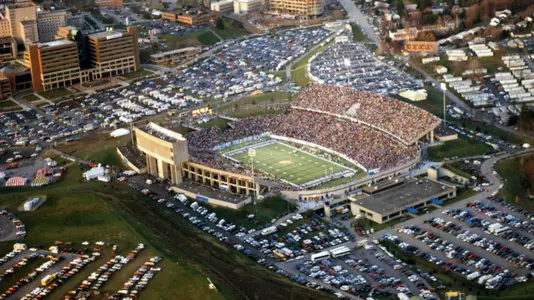
Photo by: WVU Athletic Communications
Mountaineer Memories: WVU’s Braham Recalls Great ’93 Miami Victory
May 11, 2020 06:00 PM | Football, Blog
The Mountaineer Sports Network from Learfield IMG College is pleased to present, in conjunction with corporate partners and radio affiliate partners throughout the state, classic WVU radio broadcasts from recent history made available to fans through a combination of terrestrial radio and on-demand digital platforms.
Today's replay is West Virginia's unforgettable 17-14 victory over fourth-ranked Miami at Mountaineer Field on Nov. 20, 1993.
Presented by Staples
 MORGANTOWN, W.Va. – Tonight is the re-airing of the biggest sports happening this state has ever seen – West Virginia's 17-14 victory over fourth-ranked Miami at Mountaineer Field on Nov. 20, 1993.
The announced attendance for the game was 70,222, but anyone who was there knows far more than that were packed into the stadium that late November afternoon.
Count West Virginia offensive tackle Rich Braham among those believing the official attendance count easily exceeded 75,000.
"People sat in the aisles and also along the hillside outside the stadium," Braham recalled earlier today. "There is no way they know for sure how many people were in that stadium. I think you could have robbed any house you wanted to in Morgantown that day because everybody was at the stadium."
When the game was over, just about everybody there had something from the stadium when they left.
"My mom and dad had a banner they brought to the games for the entire year, and it disappeared and they never saw it again," he chuckled. "And this happened to multiple players – they were all gone.
"There was even a piece of turf that somebody had cut up after the game to take with them," Braham said. "It was a good-sized piece that someone had cut out with a knife! And, of course, the goal posts didn't make it either. It was just chaos; crazy."
The victory over Miami was so momentous because of how much ahead of everybody else the Hurricanes were at that time. Oklahoma today is the top dog in the Big 12 - and the Sooners are really good - but they can't compare to the talent Miami was running out there on a yearly basis, especially on defense.
I recall a game West Virginia once played against Miami in the Orange Bowl during Braham's sophomore season in 1991 when the Canes ended up winning the national championship. WVU had come up with a well-conceived misdirection play, blocked it perfectly, and the Mountaineer ball carrier had nothing but daylight ahead of him to the goal line.
But just as quickly as the play opened up it closed because two Miami defenders were fast enough to recover and run him down for only a 10- or 15-yard gain.
The Hurricanes could simply outrun their mistakes back then.
"Being a tackle, I knew exactly what they had playing every year against guys being drafted in the first round, sometimes the first player taken off the board," Braham said. "Their defensive ends could all fly, and it was such a great challenge every year playing a team of that caliber. They just had phenomenal teams."
Braham said it really showed up when the backups got on the field.
"At West Virginia, when we went beyond our first team with an injury, there was a dramatic drop-off," he explained. "You go to Miami and they get an injury the next guy they put in is probably going to be drafted two years later. That's a big difference. Football is a tough sport at times; other people have to come in and play."
Naturally, an error-free game was required to beat the Hurricanes. You had to be sound in all three phases, play physically and take advantage of the weather conditions whenever possible.
All of those areas came into play that day against Miami, including frigid temperatures. One of Miami's biggest concerns heading into that game was making sure they had enough heaters on the sidelines to keep its players warm.
"The cold weather definitely helped, but the biggest thing was we went into it with the mentality that it was our house," Braham recalled. "At the time, I think they were calling themselves 'The U' instead of Miami because they were so good, and we just smacked them in the mouth and did our jobs."
 West Virginia's two best attributes that season were its toughness and togetherness. Braham believes the '93 squad had great chemistry and was full of tough guys across the board right down to its kicker, Todd Sauerburn, who got into as many fist fights as the linebackers and fullbacks.
Quarterbacks Jake Kelchner and Darren Studstill were tough guys, too.
So one of the things veteran coach Don Nehlen wanted to do against Miami was run right at them behind Braham, his best player, and specifically, run right at its small outside linebacker Rohan Marley.
Marley wasn't in the game when Robert Walker scored the game's go-head touchdown late in the fourth quarter, but the play Nehlen called was headed in the direction where Marley would have been - which also happened to be going away from defensive tackle Warren Sapp.
"I remember playing against Sapp and running a trap one time and just blowing him up," Braham recalled. "Well, knowing coach Nehlen, you knew six plays later you were going to run that same play and the next time we ran it, Sapp hit me in the shins so hard I tumbled over and rolled three times.
"When you are dealing with players of that caliber, they are only going to get fooled one time and you had to take advantage of it because they were THAT good," Braham.
West Virginia's big moment to take advantage of Miami came with about six minutes left in the game and the ball resting at the Miami 19 after Mike Baker's big punt return had finally flipped the field.
Nehlen called 43, an I-formation play with tailback Robert Walker taking a deep handoff and following lead blocker Rodney Woodard off left tackle.
It was Braham's job to take care of the end to open up a path for Woodard to take on the outside linebacker. If those two things were done properly, and the strong-side guard got his seal block, Walker could take it to the outside where all he had to do was beat the safety.
Braham got his block, Woodard took out his man and guard Tom Robsock made a great seal block on Sapp to keep him from penetrating and blowing up the play before it got started. Walker got the ball, pressed his block perfectly and used his excellent straight-line speed to take it to the outside to get into the end zone.
Everyone executed perfectly.
"The thing was to keep their speed from penetrating," Braham explained. "If we could stop their penetration, we could run against them and I think of that play we ran with Robert coming off my butt on the left side and scoring the touchdown to take the lead.
"I thought we had a great game plan by our coaches, and the players executed it," Braham added. "We were physical, and they weren't used to seeing the physicality we showed them that day."
Kelchner attempted just 12 passes, completing six, because Nehlen wanted to play things close to the vest and keep from making a big mistake.
"You had to stay in the game to win it," Braham explained. "You make a big turnover and they turn that into points and get two touchdowns up and you aren't going to beat them. Stay in the game, stay in the game, pound it, pound it and try and win it at the end, and that's what we did."
For Braham, one of the best offensive linemen in school history who played 13 seasons in the NFL with the Cincinnati Bengals, the Miami victory and the win at 11th-ranked Boston College six days later comprised the most memorable stretch of games during his college career.
 It was Miami's first-ever Big East loss and Boston College was the hottest team in college football coming off a victory at No. 1 Notre Dame the week prior.
"There is no way we should have beaten Boston College, but we did," Braham said. "That was quite a time to pretty much end up my career with those two big wins."
Today, Braham, now 49, lives in Morgantown with his wife, Connie, and their three children – Noah, Luke and Riley.
His time is now spent enjoying their basketball, baseball and volleyball games.
He said he also spends a lot of time answering questions from Mountaineer fans about that great victory over Miami.
"Beating Miami that year meant a lot to people here and it meant a lot to us – and to the coaches," Braham said. "At the time, Miami was the program to beat. They were phenomenal."
So was that 1993 game.
We hope you enjoy this latest version of Mountaineer Memories, presented today by Staples.
Today's replay is West Virginia's unforgettable 17-14 victory over fourth-ranked Miami at Mountaineer Field on Nov. 20, 1993.
Presented by Staples
MORGANTOWN, W.Va. – Tonight is the re-airing of the biggest sports happening this state has ever seen – West Virginia's 17-14 victory over fourth-ranked Miami at Mountaineer Field on Nov. 20, 1993.The announced attendance for the game was 70,222, but anyone who was there knows far more than that were packed into the stadium that late November afternoon.
Count West Virginia offensive tackle Rich Braham among those believing the official attendance count easily exceeded 75,000.
"People sat in the aisles and also along the hillside outside the stadium," Braham recalled earlier today. "There is no way they know for sure how many people were in that stadium. I think you could have robbed any house you wanted to in Morgantown that day because everybody was at the stadium."
When the game was over, just about everybody there had something from the stadium when they left.
"My mom and dad had a banner they brought to the games for the entire year, and it disappeared and they never saw it again," he chuckled. "And this happened to multiple players – they were all gone.
"There was even a piece of turf that somebody had cut up after the game to take with them," Braham said. "It was a good-sized piece that someone had cut out with a knife! And, of course, the goal posts didn't make it either. It was just chaos; crazy."
The victory over Miami was so momentous because of how much ahead of everybody else the Hurricanes were at that time. Oklahoma today is the top dog in the Big 12 - and the Sooners are really good - but they can't compare to the talent Miami was running out there on a yearly basis, especially on defense.
I recall a game West Virginia once played against Miami in the Orange Bowl during Braham's sophomore season in 1991 when the Canes ended up winning the national championship. WVU had come up with a well-conceived misdirection play, blocked it perfectly, and the Mountaineer ball carrier had nothing but daylight ahead of him to the goal line.
But just as quickly as the play opened up it closed because two Miami defenders were fast enough to recover and run him down for only a 10- or 15-yard gain.
The Hurricanes could simply outrun their mistakes back then.
"Being a tackle, I knew exactly what they had playing every year against guys being drafted in the first round, sometimes the first player taken off the board," Braham said. "Their defensive ends could all fly, and it was such a great challenge every year playing a team of that caliber. They just had phenomenal teams."
Braham said it really showed up when the backups got on the field.
"At West Virginia, when we went beyond our first team with an injury, there was a dramatic drop-off," he explained. "You go to Miami and they get an injury the next guy they put in is probably going to be drafted two years later. That's a big difference. Football is a tough sport at times; other people have to come in and play."
Naturally, an error-free game was required to beat the Hurricanes. You had to be sound in all three phases, play physically and take advantage of the weather conditions whenever possible.
All of those areas came into play that day against Miami, including frigid temperatures. One of Miami's biggest concerns heading into that game was making sure they had enough heaters on the sidelines to keep its players warm.
"The cold weather definitely helped, but the biggest thing was we went into it with the mentality that it was our house," Braham recalled. "At the time, I think they were calling themselves 'The U' instead of Miami because they were so good, and we just smacked them in the mouth and did our jobs."
West Virginia's two best attributes that season were its toughness and togetherness. Braham believes the '93 squad had great chemistry and was full of tough guys across the board right down to its kicker, Todd Sauerburn, who got into as many fist fights as the linebackers and fullbacks.Quarterbacks Jake Kelchner and Darren Studstill were tough guys, too.
So one of the things veteran coach Don Nehlen wanted to do against Miami was run right at them behind Braham, his best player, and specifically, run right at its small outside linebacker Rohan Marley.
Marley wasn't in the game when Robert Walker scored the game's go-head touchdown late in the fourth quarter, but the play Nehlen called was headed in the direction where Marley would have been - which also happened to be going away from defensive tackle Warren Sapp.
"I remember playing against Sapp and running a trap one time and just blowing him up," Braham recalled. "Well, knowing coach Nehlen, you knew six plays later you were going to run that same play and the next time we ran it, Sapp hit me in the shins so hard I tumbled over and rolled three times.
"When you are dealing with players of that caliber, they are only going to get fooled one time and you had to take advantage of it because they were THAT good," Braham.
West Virginia's big moment to take advantage of Miami came with about six minutes left in the game and the ball resting at the Miami 19 after Mike Baker's big punt return had finally flipped the field.
Nehlen called 43, an I-formation play with tailback Robert Walker taking a deep handoff and following lead blocker Rodney Woodard off left tackle.
It was Braham's job to take care of the end to open up a path for Woodard to take on the outside linebacker. If those two things were done properly, and the strong-side guard got his seal block, Walker could take it to the outside where all he had to do was beat the safety.
Braham got his block, Woodard took out his man and guard Tom Robsock made a great seal block on Sapp to keep him from penetrating and blowing up the play before it got started. Walker got the ball, pressed his block perfectly and used his excellent straight-line speed to take it to the outside to get into the end zone.
Everyone executed perfectly.
"The thing was to keep their speed from penetrating," Braham explained. "If we could stop their penetration, we could run against them and I think of that play we ran with Robert coming off my butt on the left side and scoring the touchdown to take the lead.
"I thought we had a great game plan by our coaches, and the players executed it," Braham added. "We were physical, and they weren't used to seeing the physicality we showed them that day."
Kelchner attempted just 12 passes, completing six, because Nehlen wanted to play things close to the vest and keep from making a big mistake.
"You had to stay in the game to win it," Braham explained. "You make a big turnover and they turn that into points and get two touchdowns up and you aren't going to beat them. Stay in the game, stay in the game, pound it, pound it and try and win it at the end, and that's what we did."
For Braham, one of the best offensive linemen in school history who played 13 seasons in the NFL with the Cincinnati Bengals, the Miami victory and the win at 11th-ranked Boston College six days later comprised the most memorable stretch of games during his college career.
It was Miami's first-ever Big East loss and Boston College was the hottest team in college football coming off a victory at No. 1 Notre Dame the week prior."There is no way we should have beaten Boston College, but we did," Braham said. "That was quite a time to pretty much end up my career with those two big wins."
Today, Braham, now 49, lives in Morgantown with his wife, Connie, and their three children – Noah, Luke and Riley.
His time is now spent enjoying their basketball, baseball and volleyball games.
He said he also spends a lot of time answering questions from Mountaineer fans about that great victory over Miami.
"Beating Miami that year meant a lot to people here and it meant a lot to us – and to the coaches," Braham said. "At the time, Miami was the program to beat. They were phenomenal."
So was that 1993 game.
We hope you enjoy this latest version of Mountaineer Memories, presented today by Staples.

TV Highlights: MCWS vs. Troy
Friday, June 12
BSB: College World Series Trailer
Friday, June 12
BSB: Morgantown Super Regional Recap
Friday, June 12
WRES: Athletics Performance Center Tour
Wednesday, June 10