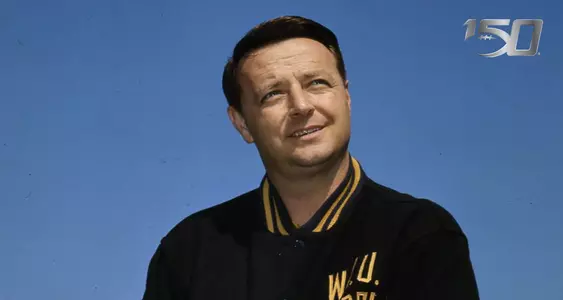
CFB150: Eastern Independence
July 12, 2019 09:00 AM | Football, Blog
Editor's note: Each Friday throughout the remainder of July, West Virginia University is celebrating the 150th anniversary of college football. WVU has been playing the sport since 1891 and is currently the 14th winningest program in NCAA history. This week, we examine West Virginia's quest to join an all-sports conference and how that led the Mountaineers to different parts of the country.
As it once did in the 1920s and 1930s when Harry Stansbury was athletics director, West Virginia in 1968 cast its eyes eastward when it ended its 18-year affiliation with the Southern Conference. Nineteen years prior, in early December 1949, WVU athletics director Legs Hawley finally found a suitable conference for the Mountaineers to play in.
The Southern Conference then had an impressive array of schools such as North Carolina, Duke, North Carolina State, Maryland, Clemson and South Carolina, which gave West Virginia the regional all-sports conference pedigree it had always been seeking.
Since the mid-1920s, when Stansbury successfully fought a movement within the state to force West Virginia University into the West Virginia Conference, WVU had sought an eastern athletic presence by scheduling schools located in the major Northeast media markets such as New York City, Boston, Philadelphia and Washington, D.C. Stansbury was also one of the driving forces behind the establishment of the Eastern Conference in basketball and boxing in 1931 that first consisted of Pitt, Carnegie Tech, Temple, Georgetown and West Virginia before later adding Bucknell and Penn State before it disbanded in 1939.
Hawley continued Stansbury's desire to have an eastern athletic presence by scheduling such teams as Manhattan, Navy, Army, Boston College and Syracuse in the 1930s and 1940s. But Hawley grew impatient of the northeast's inability to support an all-sports conference, and a discrepancy in how WVU had counted the eligibility of some of its pre-World War II football players led to a dispute with some of the schools competing in the ECAC.
At the time, Hawley was seeking to find an all-sports affiliation that could protect West Virginia's entire athletics department, specifically the nationally ranked basketball program.
The basketball team, led by coaches Dyke Raese and Lee Patton, had developed into a national power and its annual trips to New York City had significantly raised the program's visibility. Yet the Southern Conference West Virginia had joined for the 1950 season was not a rock-solid association and a couple of years later, the Southern Conference's two most successful football programs, Maryland and Clemson, wanted to break away because of the conference's anti-bowl game stance.
Those two joined forces with North Carolina, Duke, North Carolina State and Wake Forest to form the Atlantic Coast Conference in 1953.
Hawley sought membership in the ACC twice, when it was first formed and again a few months later when the conference considered adding West Virginia and Virginia Tech to make 10 institutions, but on both occasions West Virginia did not get the necessary support required to get into the conference.
So, WVU continued its relationship with a severely watered-down Southern Conference until the late 1960s when Jim Carlen finally convinced WVU athletics director Red Brown to get out. In the meantime, West Virginia had developed deeper ties with Pitt, Penn State and Syracuse through what those schools began referencing as the "Big Four," which was formed in the early 1960s to regulate such minor things as roster sizes, officiating and other athletic issues.
 "It was like a gentlemen's agreement," Bobby Bowden recalled in 2014. "It was no conference, but we all agreed on things."
The Big Four's first major agreement made in 1962 was the prohibition of redshirting strictly for developmental purposes. Eventually, this turned into a significant bone of contention among the four football playing schools because by the mid-1960s Penn State and Syracuse had vastly superior rosters, and Pitt and West Virginia believed the redshirting rule and roster restrictions had helped maintain a status quo favoring Penn State and Syracuse.
Carlen hated the redshirt rule and roster restrictions because he wanted to do at West Virginia what Bear Bryant did at Alabama by signing large recruiting classes and weeding out the bad players from the good ones, or, using a redshirt year to develop the ones that were not quite ready to play.
"Georgia Tech, where I had been, was an engineering school,and it was high up on the mathematical scale," Carlen recalled in 2009. "We could take very few players that were marginal. Well, coach (Bobby) Dodd and coach Bryant were inseparable, and the biggest argument they ever had (was over scholarships).
"(Dodd) said, 'Paul, I want you to get your pencil out because I want you to put these numbers down. You're signing 55 players a year and I'm signing 32 players a year on average, and then you redshirt your eight to 10 players like we redshirt our eight to 10 players - not necessarily because they are going to be good players but because our academics are so tough - and we're never over our total of 120 and we're on the cusp all the time. You start writing those numbers down and you tell me what the difference is going to be.' You take the difference of 32 from 55 and then multiply that by four,and we're over and they're not over."
According to Carlen, that was a big reason why Georgia Tech left the Southeastern Conference in 1964 and that was one of the contributing factors in why Carlen left West Virginia for Texas Tech in 1969. He wanted to redshirt players and do what the successful programs in the south were doing that the Big Four prohibited.
When Carlen pressed WVU on these issues in the fall of 1969, West Virginia's athletics council, fearing a damaging of relations with Pitt, Penn State and Syracuse, pushed back by citing the Big Four's gentlemen's agreement on redshirting and roster limitations.
These issues came up again three years later at Pitt after it had hired Iowa State's Johnny Majors following another losing season in 1972. The Panthers blamed the Big Four for a lot of their gridiron woes and after Majors came on board the first thing he did was get out of the Big Four and sign a massive 75-player recruiting class that included Tony Dorsett.
Before leaving, Pitt argued that the other schools were doing things to get around the Big Four's redshirting and roster stipulations. It complained that West Virginia had used questionable practices to secure a retroactive redshirt for quarterback Bernie Galiffa, and that Penn State had regularly ignored travel roster limitations or sometimes gave full scholarships to football walk-ons in other sports to skirt the rules.
"I remember that we couldn't sign but 25 players. Well, if we're only going to sign 25 and (Pitt) was going to sign 75 that's a tremendous advantage because football is a game of numbers," Bowden said. "So, Johnny kind of got that thing going, and we all went in different directions since then."
"I wasn't surprised when Pitt pulled out of the Big Four because we could see it coming," Leland Byrd, West Virginia's athletics director in 1972, recalled in 2016. "I talked to (outgoing athletics director) Red Brown about it when I took the West Virginia job, and Red was very much in favor of the Big Four agreement, but the problem was Pitt was already beginning to get around some of the Big Four stipulations and we were concerned about that."
Byrd added, "Syracuse and ourselves, we really felt it helped us because it limited the scholarships Pitt and Penn State could give out. It really helped with our recruiting, at least we thought so, because Pitt and Penn State could only take so many and that left the other available players for us to recruit so we were able to recruit some more in Pennsylvania at that particular time."
Byrd thought Pitt's departure from the Big Four really exacerbated the seeds of mistrust between the four schools that ultimately led to Penn State leaving for the Big Ten in the early 1990s, and then the other schools departing to the ACC two decades later.
"That was probably the start of it because Penn State really never got over the fact that Pitt violated the agreement and they had to change their ideas about recruiting as well," Byrd said. "After that, Pitt and Penn State could never agree on anything. It was amazing that we were able to get them together for a while in the Eastern 8, but of course, that just involved basketball at that particular time and it didn't have anything to do with football."
Byrd spearheaded some informal discussions to form an eastern all-sports conference that included football, but he said Penn State and Pitt were always difficult mating partners.
"In the beginning, Pitt was in favor of it and Penn State was against it, but later on when the Atlantic 10 was formed when Pitt dropped out of the Eastern 8, then Penn State was in favor of having an all-sports conference and Pitt was not," Byrd said.
"There was always that animosity between Pitt and Penn State that negated any thoughts of coming to any agreement of having an eastern all-sports conference," Byrd concluded.
Additionally, Penn State coach Joe Paterno was not eager to develop deeper ties with West Virginia University, which he considered beneath Penn State both academically and culturally. This was brought to light during a Nittany Lion Club meeting in 1972 when Paterno openly contradicted Penn State president John Oswald's support of the Big Four.
Paterno told the group that Penn State should not be comparing itself to schools like West Virginia and should have higher national aspirations, according to Ronald Smith in his book Wounded Lions: Joe Paterno, Jerry Sandusky, and the Crises in Penn State Athletics.
During the 1970s, despite the discontinuation of the Big Four, West Virginia, Pitt, Penn State and Syracuse continued to play each other as football independents.
Once again, West Virginia had considered itself an eastern school with its old Southern Conference opponents being replaced by schools such as Boston College, Temple and Maryland.
By the late 1970s, however, the only regular Southern Conference foe left was Richmond as the Mountaineers fully embraced their eastern football independence.
As it once did in the 1920s and 1930s when Harry Stansbury was athletics director, West Virginia in 1968 cast its eyes eastward when it ended its 18-year affiliation with the Southern Conference. Nineteen years prior, in early December 1949, WVU athletics director Legs Hawley finally found a suitable conference for the Mountaineers to play in.
The Southern Conference then had an impressive array of schools such as North Carolina, Duke, North Carolina State, Maryland, Clemson and South Carolina, which gave West Virginia the regional all-sports conference pedigree it had always been seeking.
Since the mid-1920s, when Stansbury successfully fought a movement within the state to force West Virginia University into the West Virginia Conference, WVU had sought an eastern athletic presence by scheduling schools located in the major Northeast media markets such as New York City, Boston, Philadelphia and Washington, D.C. Stansbury was also one of the driving forces behind the establishment of the Eastern Conference in basketball and boxing in 1931 that first consisted of Pitt, Carnegie Tech, Temple, Georgetown and West Virginia before later adding Bucknell and Penn State before it disbanded in 1939.
Hawley continued Stansbury's desire to have an eastern athletic presence by scheduling such teams as Manhattan, Navy, Army, Boston College and Syracuse in the 1930s and 1940s. But Hawley grew impatient of the northeast's inability to support an all-sports conference, and a discrepancy in how WVU had counted the eligibility of some of its pre-World War II football players led to a dispute with some of the schools competing in the ECAC.
At the time, Hawley was seeking to find an all-sports affiliation that could protect West Virginia's entire athletics department, specifically the nationally ranked basketball program.
The basketball team, led by coaches Dyke Raese and Lee Patton, had developed into a national power and its annual trips to New York City had significantly raised the program's visibility. Yet the Southern Conference West Virginia had joined for the 1950 season was not a rock-solid association and a couple of years later, the Southern Conference's two most successful football programs, Maryland and Clemson, wanted to break away because of the conference's anti-bowl game stance.
Those two joined forces with North Carolina, Duke, North Carolina State and Wake Forest to form the Atlantic Coast Conference in 1953.
Hawley sought membership in the ACC twice, when it was first formed and again a few months later when the conference considered adding West Virginia and Virginia Tech to make 10 institutions, but on both occasions West Virginia did not get the necessary support required to get into the conference.
So, WVU continued its relationship with a severely watered-down Southern Conference until the late 1960s when Jim Carlen finally convinced WVU athletics director Red Brown to get out. In the meantime, West Virginia had developed deeper ties with Pitt, Penn State and Syracuse through what those schools began referencing as the "Big Four," which was formed in the early 1960s to regulate such minor things as roster sizes, officiating and other athletic issues.
"It was like a gentlemen's agreement," Bobby Bowden recalled in 2014. "It was no conference, but we all agreed on things."The Big Four's first major agreement made in 1962 was the prohibition of redshirting strictly for developmental purposes. Eventually, this turned into a significant bone of contention among the four football playing schools because by the mid-1960s Penn State and Syracuse had vastly superior rosters, and Pitt and West Virginia believed the redshirting rule and roster restrictions had helped maintain a status quo favoring Penn State and Syracuse.
Carlen hated the redshirt rule and roster restrictions because he wanted to do at West Virginia what Bear Bryant did at Alabama by signing large recruiting classes and weeding out the bad players from the good ones, or, using a redshirt year to develop the ones that were not quite ready to play.
"Georgia Tech, where I had been, was an engineering school,and it was high up on the mathematical scale," Carlen recalled in 2009. "We could take very few players that were marginal. Well, coach (Bobby) Dodd and coach Bryant were inseparable, and the biggest argument they ever had (was over scholarships).
"(Dodd) said, 'Paul, I want you to get your pencil out because I want you to put these numbers down. You're signing 55 players a year and I'm signing 32 players a year on average, and then you redshirt your eight to 10 players like we redshirt our eight to 10 players - not necessarily because they are going to be good players but because our academics are so tough - and we're never over our total of 120 and we're on the cusp all the time. You start writing those numbers down and you tell me what the difference is going to be.' You take the difference of 32 from 55 and then multiply that by four,and we're over and they're not over."
According to Carlen, that was a big reason why Georgia Tech left the Southeastern Conference in 1964 and that was one of the contributing factors in why Carlen left West Virginia for Texas Tech in 1969. He wanted to redshirt players and do what the successful programs in the south were doing that the Big Four prohibited.
When Carlen pressed WVU on these issues in the fall of 1969, West Virginia's athletics council, fearing a damaging of relations with Pitt, Penn State and Syracuse, pushed back by citing the Big Four's gentlemen's agreement on redshirting and roster limitations.
These issues came up again three years later at Pitt after it had hired Iowa State's Johnny Majors following another losing season in 1972. The Panthers blamed the Big Four for a lot of their gridiron woes and after Majors came on board the first thing he did was get out of the Big Four and sign a massive 75-player recruiting class that included Tony Dorsett.
Before leaving, Pitt argued that the other schools were doing things to get around the Big Four's redshirting and roster stipulations. It complained that West Virginia had used questionable practices to secure a retroactive redshirt for quarterback Bernie Galiffa, and that Penn State had regularly ignored travel roster limitations or sometimes gave full scholarships to football walk-ons in other sports to skirt the rules.
"I remember that we couldn't sign but 25 players. Well, if we're only going to sign 25 and (Pitt) was going to sign 75 that's a tremendous advantage because football is a game of numbers," Bowden said. "So, Johnny kind of got that thing going, and we all went in different directions since then."
"I wasn't surprised when Pitt pulled out of the Big Four because we could see it coming," Leland Byrd, West Virginia's athletics director in 1972, recalled in 2016. "I talked to (outgoing athletics director) Red Brown about it when I took the West Virginia job, and Red was very much in favor of the Big Four agreement, but the problem was Pitt was already beginning to get around some of the Big Four stipulations and we were concerned about that."
Byrd added, "Syracuse and ourselves, we really felt it helped us because it limited the scholarships Pitt and Penn State could give out. It really helped with our recruiting, at least we thought so, because Pitt and Penn State could only take so many and that left the other available players for us to recruit so we were able to recruit some more in Pennsylvania at that particular time."
Byrd thought Pitt's departure from the Big Four really exacerbated the seeds of mistrust between the four schools that ultimately led to Penn State leaving for the Big Ten in the early 1990s, and then the other schools departing to the ACC two decades later.
"That was probably the start of it because Penn State really never got over the fact that Pitt violated the agreement and they had to change their ideas about recruiting as well," Byrd said. "After that, Pitt and Penn State could never agree on anything. It was amazing that we were able to get them together for a while in the Eastern 8, but of course, that just involved basketball at that particular time and it didn't have anything to do with football."
Byrd spearheaded some informal discussions to form an eastern all-sports conference that included football, but he said Penn State and Pitt were always difficult mating partners.
"In the beginning, Pitt was in favor of it and Penn State was against it, but later on when the Atlantic 10 was formed when Pitt dropped out of the Eastern 8, then Penn State was in favor of having an all-sports conference and Pitt was not," Byrd said.
"There was always that animosity between Pitt and Penn State that negated any thoughts of coming to any agreement of having an eastern all-sports conference," Byrd concluded.
Additionally, Penn State coach Joe Paterno was not eager to develop deeper ties with West Virginia University, which he considered beneath Penn State both academically and culturally. This was brought to light during a Nittany Lion Club meeting in 1972 when Paterno openly contradicted Penn State president John Oswald's support of the Big Four.
Paterno told the group that Penn State should not be comparing itself to schools like West Virginia and should have higher national aspirations, according to Ronald Smith in his book Wounded Lions: Joe Paterno, Jerry Sandusky, and the Crises in Penn State Athletics.
During the 1970s, despite the discontinuation of the Big Four, West Virginia, Pitt, Penn State and Syracuse continued to play each other as football independents.
Once again, West Virginia had considered itself an eastern school with its old Southern Conference opponents being replaced by schools such as Boston College, Temple and Maryland.
By the late 1970s, however, the only regular Southern Conference foe left was Richmond as the Mountaineers fully embraced their eastern football independence.
A Conversation with Wren Baker | Big 12 Football Media Days
Wednesday, July 08
Coach Rich Rodriguez Press Conference | Big 12 Football Media Days
Wednesday, July 08
Steve Sabins, Gavin Kelly, Armani Guzman, Matthew Graveline | College World Series | June 17
Tuesday, July 07
WRES: Gunner Andrick
Tuesday, July 07