Photo by: Brian Persinger / WVU Photograph
In His Own Words
February 14, 2019 04:53 PM | Rifle
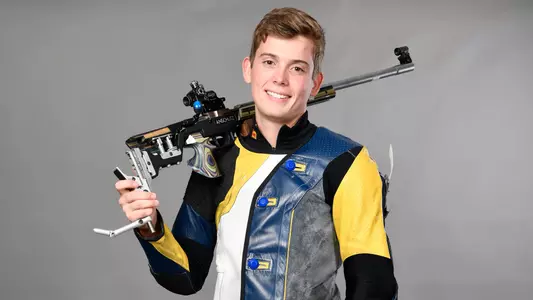
MORGANTOWN, W.Va. – The No. 1-ranked West Virginia University rifle team features a pair of seniors in Will Anti and Ginny Thrasher. Though both student-athletes have experienced vastly different careers as Mountaineers, the duo has achieved one feat together – they have never lost a regular-season match in their four years at WVU.
With their collegiate careers coming to a close, both student-athletes have started to reflect on their time as Mountaineers.
Anti, a native of Fort Benning, Georgia, boasts a recognizable name, as his father, Mike, is a member of the Mountaineer Legends Society. A finance major, Will's path at WVU has featured a few twists and turns, but along the way, he has developed into one of the program's greatest leaders.
Below, Will, the 2018-19 team captain, explains how his years at WVU have shaped him into a young adult ready to tackle the future.
Anti Bio
You're a Mountaineer Legacy, as your father, Mike Anti, was an eight-time All-American at WVU (1984-87) and helped the Mountaineers capture two NCAA National Championships, as well as claim the 1986 NCAA smallbore title. Did his time at WVU influence your decision to attend WVU, and with four years of perspective, are you happy with your decision?
I thought about going to other schools, but looking back, this was the right choice. I've had some incredible experiences at WVU and met incredible people. This was the right choice. I didn't attend WVU because of my dad, but I've enjoyed having that connection.
Every day for the last four years, you've walked passed a photo of your father that is a part of the team's Olympic Wall (Mike Anti won a Silver medal at the 2004 Summer Olympic Games). Was that ever weird?
(laughs) I love it. We look similar – at least that's what people say. It's nice! We're all really proud of his Olympic accomplishments.
Initially, I didn't love to talk about this because people would try to draw comparisons. Now, I really appreciate it.
Do you feel you've carved out your own legacy at WVU?
Yes, and I feel like it's a lot different than my dad's. It's unique and different. My dad was a phenomenal shooter and one of the first eight-time All-Americans. He earned a lot of accolades. My legacy is more about my leadership and reworking the culture of the team. That's been a big push for me this season. I think our culture became stale, and we needed to jumpstart it. We used to have an advantage over other teams in a lot of areas, and those teams caught up to us. We needed to figure out a way to get out in front of the curve again.
Hopefully, that's the legacy I leave – a leader who saw the need to make changes, was ready to make changes and then initiated a lot of change.
What is an example of one of the changes you initiated?
For a long time, we talked about the team we wanted to be, but there wasn't a lot of follow through with our actions. I wanted our team to move forward – say what we want to do, list ways to do them and then hold each other accountable.
Our mission statement this season took a new shape; we focused more on questions to ask ourselves daily instead of statements. An example is, 'Are you living by our culture?' Really, we just needed to change our mindsets.
This has been a huge group effort, and everyone had to buy-in. I'm pretty proud of the change.
What's your favorite moment from your WVU career?
I have so many memories with my old teammates. The trip we took to South Africa was a great experience; a lot of great bonds were formed on that trip. I have a lot of great memories of getting together with my teammates at my house. I've really enjoyed being around a group of like-minded, nice people. We genuinely enjoy being together as teammates. We are an eclectic group of people with a lot of personalities; it's interesting.
What's something you've learned from this program that you know you will take with you and will impact you daily?
I think my ability to communicate with others and to perceive others' needs – that's been my biggest growth in four years. I think I always had a little social awareness, but I feel now I can look at a teammate and assess his or her day and communicate better with the individual. It's been a growth process. I always thought I'd be set in my ways as a leader, but over the course of this season, I've learned that I have to be a different leader for different people. My teammates each need different leadership. I think being a leader involves recognizing what type of leadership is needed in specific moments rather than just sticking to my guns.
What is one lesson that coach Jon Hammond has imparted on you that will stick with you?
Jon has really shown me how to communicate with others to get the best out of them. It's something he does very well. He's a calm, level-headed person; that's not my personality! I think I've taken on a little of his personality, and I think we feed off each other.
Your dad is currently the head coach at Navy. Do you think coaching is in your future?
Actually, my grandfather was a coach, too – he was a coach at the Naval Academy in the 1990s. I have a lot of love for the sport, so if an opportunity presents itself, I would love to stay in it. I don't think I would coach for 40 years, but if something came up, I would seriously look at it.
Over the last year, I've realized that I have a strong ability to work with others. I have a lot of knowledge of the sport. I've worked a lot with (senior) Ginny (Thrasher) over the last few months, and I've realized this is something I'm good at and enjoy. I enjoy talking and learning about the sport. I like to take what others know and combine it with my own knowledge. I'm not ruling coaching out.
Once you graduate in May, what are you hoping to do next?
I have a desire to go to law school. I think I may take a small gap and work for a little, either in the shooting industry or the financial industry. Eventually, I will get to law school.
How would you summarize your four years at WVU?
Unexpected. I wrote my personal statement for law school the other day. In the statement, I discussed how I arrived at WVU with the expectation of being a phenomenal shooter. I was a highly ranked recruit, and I certainly knew a lot about the sport, especially at the collegiate level.
I didn't get that. I've had some struggles along the way and some performances I didn't like. Instead, I gained a different opportunity – the chance to impact change on the team. This isn't what I was looking for when I arrived at WVU, but I'm very thankful it's what happened. I think I've gained a lot of self-confidence. Things work out in unexpected ways, but I think you end up where you're meant to be.
How do you want to see your senior season end?
My goal for this season is once we arrive at its end, we can say that nobody worked harder than us in all facets of the sport – physically, mentally, on the range, off the range and building bonds. If we can get to the end of the season and know we did everything better than everyone else, we have succeeded. If that results in a National Championship – great! If it results in us not even qualifying for the NCAA Championships – fine.
For the remainder of the season, we're in a great, laser-focused mindset, and that's where I want us to stay. Every day, we need to work so when we're at the end, we can look back and know we gave it our all. I never want to feel like we could have done more.
The Mountaineers will shoot an NCAA Qualifying Match on Saturday, Feb. 16, at 10 a.m., at the Bill McKenzie Rifle Range inside the WVU Shell Building. Admission is free and open to the public.
With their collegiate careers coming to a close, both student-athletes have started to reflect on their time as Mountaineers.
Anti, a native of Fort Benning, Georgia, boasts a recognizable name, as his father, Mike, is a member of the Mountaineer Legends Society. A finance major, Will's path at WVU has featured a few twists and turns, but along the way, he has developed into one of the program's greatest leaders.
Below, Will, the 2018-19 team captain, explains how his years at WVU have shaped him into a young adult ready to tackle the future.
Anti Bio
You're a Mountaineer Legacy, as your father, Mike Anti, was an eight-time All-American at WVU (1984-87) and helped the Mountaineers capture two NCAA National Championships, as well as claim the 1986 NCAA smallbore title. Did his time at WVU influence your decision to attend WVU, and with four years of perspective, are you happy with your decision?
I thought about going to other schools, but looking back, this was the right choice. I've had some incredible experiences at WVU and met incredible people. This was the right choice. I didn't attend WVU because of my dad, but I've enjoyed having that connection.
Every day for the last four years, you've walked passed a photo of your father that is a part of the team's Olympic Wall (Mike Anti won a Silver medal at the 2004 Summer Olympic Games). Was that ever weird?
(laughs) I love it. We look similar – at least that's what people say. It's nice! We're all really proud of his Olympic accomplishments.
Initially, I didn't love to talk about this because people would try to draw comparisons. Now, I really appreciate it.
Do you feel you've carved out your own legacy at WVU?
Yes, and I feel like it's a lot different than my dad's. It's unique and different. My dad was a phenomenal shooter and one of the first eight-time All-Americans. He earned a lot of accolades. My legacy is more about my leadership and reworking the culture of the team. That's been a big push for me this season. I think our culture became stale, and we needed to jumpstart it. We used to have an advantage over other teams in a lot of areas, and those teams caught up to us. We needed to figure out a way to get out in front of the curve again.
Hopefully, that's the legacy I leave – a leader who saw the need to make changes, was ready to make changes and then initiated a lot of change.
What is an example of one of the changes you initiated?
For a long time, we talked about the team we wanted to be, but there wasn't a lot of follow through with our actions. I wanted our team to move forward – say what we want to do, list ways to do them and then hold each other accountable.
Our mission statement this season took a new shape; we focused more on questions to ask ourselves daily instead of statements. An example is, 'Are you living by our culture?' Really, we just needed to change our mindsets.
This has been a huge group effort, and everyone had to buy-in. I'm pretty proud of the change.
What's your favorite moment from your WVU career?
I have so many memories with my old teammates. The trip we took to South Africa was a great experience; a lot of great bonds were formed on that trip. I have a lot of great memories of getting together with my teammates at my house. I've really enjoyed being around a group of like-minded, nice people. We genuinely enjoy being together as teammates. We are an eclectic group of people with a lot of personalities; it's interesting.
What's something you've learned from this program that you know you will take with you and will impact you daily?
I think my ability to communicate with others and to perceive others' needs – that's been my biggest growth in four years. I think I always had a little social awareness, but I feel now I can look at a teammate and assess his or her day and communicate better with the individual. It's been a growth process. I always thought I'd be set in my ways as a leader, but over the course of this season, I've learned that I have to be a different leader for different people. My teammates each need different leadership. I think being a leader involves recognizing what type of leadership is needed in specific moments rather than just sticking to my guns.
What is one lesson that coach Jon Hammond has imparted on you that will stick with you?
Jon has really shown me how to communicate with others to get the best out of them. It's something he does very well. He's a calm, level-headed person; that's not my personality! I think I've taken on a little of his personality, and I think we feed off each other.
Your dad is currently the head coach at Navy. Do you think coaching is in your future?
Actually, my grandfather was a coach, too – he was a coach at the Naval Academy in the 1990s. I have a lot of love for the sport, so if an opportunity presents itself, I would love to stay in it. I don't think I would coach for 40 years, but if something came up, I would seriously look at it.
Over the last year, I've realized that I have a strong ability to work with others. I have a lot of knowledge of the sport. I've worked a lot with (senior) Ginny (Thrasher) over the last few months, and I've realized this is something I'm good at and enjoy. I enjoy talking and learning about the sport. I like to take what others know and combine it with my own knowledge. I'm not ruling coaching out.
Once you graduate in May, what are you hoping to do next?
I have a desire to go to law school. I think I may take a small gap and work for a little, either in the shooting industry or the financial industry. Eventually, I will get to law school.
How would you summarize your four years at WVU?
Unexpected. I wrote my personal statement for law school the other day. In the statement, I discussed how I arrived at WVU with the expectation of being a phenomenal shooter. I was a highly ranked recruit, and I certainly knew a lot about the sport, especially at the collegiate level.
I didn't get that. I've had some struggles along the way and some performances I didn't like. Instead, I gained a different opportunity – the chance to impact change on the team. This isn't what I was looking for when I arrived at WVU, but I'm very thankful it's what happened. I think I've gained a lot of self-confidence. Things work out in unexpected ways, but I think you end up where you're meant to be.
How do you want to see your senior season end?
My goal for this season is once we arrive at its end, we can say that nobody worked harder than us in all facets of the sport – physically, mentally, on the range, off the range and building bonds. If we can get to the end of the season and know we did everything better than everyone else, we have succeeded. If that results in a National Championship – great! If it results in us not even qualifying for the NCAA Championships – fine.
For the remainder of the season, we're in a great, laser-focused mindset, and that's where I want us to stay. Every day, we need to work so when we're at the end, we can look back and know we gave it our all. I never want to feel like we could have done more.
The Mountaineers will shoot an NCAA Qualifying Match on Saturday, Feb. 16, at 10 a.m., at the Bill McKenzie Rifle Range inside the WVU Shell Building. Admission is free and open to the public.
Players Mentioned
/ Rifle

/ Rifle
Jon Hammond NCAA Championship | March 18
Wednesday, March 18
A Conversation with Wren Baker
Monday, December 05
Jon Hammond | Thursday
Thursday, September 30
Life as a Mountaineer - Jared Eddy
Wednesday, March 24