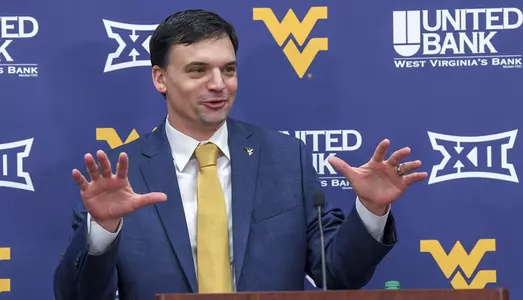
Photo by: All Pro Photography/Dale Sparks
Hot Reads: Don't Blink
January 24, 2019 10:06 AM | Football, Blog
Radio sideline reporter Jed Drenning provides periodic commentary on the Mountaineer football program for WVUsports.com. Be sure to follow him on Twitter @TheSignalCaller.
Every story has a beginning. But where do you start with Neal Brown?
As Brown was in the process of being hired as the 35th head football coach at WVU -- the flagship University of, as chance would have it, the 35th state admitted to the Union -- I got busy digging into his gridiron past.
I watched all the Troy cut ups I could get my mitts on, and I ran the numbers on all 51 of Brown's games with the Trojans. I pulled all the pre- and post-game pressers I could find to shed light on the most meaningful narratives behind those games (as Brown himself saw them).
After all, from the outside looking in, what did I know (for example) about Troy's 31-21 win over Georgia State in 2016 – or most other games Brown coached with the Trojans? Not much. When I began, I had little insight into those matchups (with a couple obvious exceptions), or how each might've figured into his overall tenure at Troy.
Watching Brown's press conferences before and after such contests armed me with a perspective that a box score, a game capsule or even game film itself simply couldn't. Those weekly Q&As with a head coach can serve as the miner's light that guides your descent into seasons past, illuminating the storylines that you'll want to be mindful of as you study each game.
For example, as a byproduct of Brown's press conference, I knew it was Homecoming weekend in Troy and, because Auburn was off and Alabama was on the road, he was hoping some of those War Eagle and Crimson Tide fans would swing down to Pike County and check out the Trojans. Some apparently did because the matchup produced the largest crowd ever to watch a Sun Belt Conference game in Troy.
Because of Brown's remarks, I knew GSU was led by Trent Miles, who was coming off a 2015 season that saw him win Sun Belt Coach of the Year honors and that, a month earlier, the Panthers had marched into Camp-Randall Stadium and pushed a top-10 Wisconsin squad against the ropes in a 23-17 loss. I knew Georgia State featured an NFL talent at receiver in Robert Davis (currently with the Washington Redskins). I knew GSU returned 10 starters from the defense Troy had faced in 2015. I also knew Georgia State deployed primarily a three-man front that controlled the trenches against Wisconsin.
Suddenly, as a result of that press conference, an otherwise nondescript Trojans victory over a conference opponent took on meaning and had a story behind it. Brown's other 50 games at Troy did too, I realized, as I watched all the pressers I could track down from 2015-18.
In addition to the game film, the analytics and the press conferences, I also studied as many hours of Brown's clinic lectures through the years as possible. Some I simply read about, some I discovered online and some were sent my way from the video library of generous high school coaches who had attended such clinics (a shout out, in particular, goes to coach Donnie Mays of South Charleston).
I scrutinized the concepts and coaching points Brown shared with those audiences. He discussed countless topics, including the importance of matchups and why that was one of the first things he investigated when watching an opponent on tape. Who do they have that we can't block? Do they have someone we need to chip or double-team? Who can we exploit on the backend? How do they adjust to tempo?
With so much material to draw from with Brown, who -- in 11 seasons as a play caller (seven as a coordinator and four as a head coach) -- has never been shut out, where do you begin telling his story?
We could start with his introduction at WVU on Jan. 10. If truly there is such a thing as "winning" a press conference, what Brown did would have to qualify. He was pitch perfect at the podium, hitting all the Old Gold and Blue buttons. Brown shared his earnest appreciation of the program's rich history and its stature in college football. He invited back Mountaineers of the past and paid homage to the Flying WV and Country Roads. The only thing missing was a hologram of Ira Errett Rodgers nodding in approval.
The best part? It was easy to discern this wasn't showmanship. Brown wasn't simply playing to the crowd. Instead, this was sincerity from a man familiar with the hardships of Appalachia, a man delighted to land a job of such magnitude that will place him among hiskind of folks, a man who genuinely values where he's been and is uniquely excited about where he's going.
"I think about the 14th-winningest program in college football. Wow. I think about 15 conference championships. I think about the Flying WV and the hard-working, blue-collar people of West Virginia that the WV represents," Brown said, regarding his new home. "I think about Country Roads, and I think about one of the best environments in all of college football. West Virginia is culture. It is vision and it is passion. It was a great fit; it fits my DNA."
We could start Brown's story with his heartfelt goodbye at a Troy basketball game he attended after accepting the job at West Virginia. The emotional aftermath of bidding farewell to a place that's been such an instrumental part of the lives of the Brown family is easy for an outsider to overlook, but this touching tribute spoke volumes about Neal Brown andabout the people of Trojan Nation.
We could start with Brown's third bowl triumph in as many tries, a 42-32 victory over a 10-win Buffalo team in the Dollar General Bowl on Dec. 22. It was a night that saw Troy play the most incredible 15-minute game of keep away you'll likely ever see – not allowing Buffalo to run a single offensive play in the entire third quarter. Sure, that was made possible in part by an onside kick recovery by Troy and a defensive touchdown by the Bulls, but it was remarkable nevertheless.
 We could start with the fact that Brown's Troy squad finished last season ranked No. 1 in the country in ESPN's Special Teams Efficiency ratings. Those special teams showed up big in the win at Nebraska last September as the Trojans returned a punt for a 58-yard touchdown in the second quarter and averaged 54 yards on five punts (including a field-flipping 79-yarder).
In a game in which they were paid $1.15 million to make the trip, the Trojans managed just 253 yards of offense but edged the Cornhuskers 24-19 and sent 89,360 fans home angry by playing complementary football --- a hallmark of Neal Brown-coached teams. Troy forced three turnovers, controlled field position through the kicking game and overcame mismatches presented by the Huskers sizeable front seven with the creative use of various motions to help create seams in the running game (one of which QB Sawyer Smith shot through on a 57-yard run).
We could of course start Brown's story with Troy's 2017 victory over LSU in Baton Rouge, Louisiana, the signature win of his young career, when the Trojans ended the Bayou Bengals non-conference home winning streak of 49 games, the second longest streak of the AP era.
This storied win showcased what makes Neal Brown a success on the field and off it, including a family that doesn't let anything – not even the trappings of a Saturday night in Baton Rouge – tilt their priorities. As Troy was making history by snapping LSU's streak, you might think Brown's family was at Tiger Stadium with him, perhaps enjoying the game from a posh box seat somewhere high above Death Valley.
But they weren't.
They were watching from an Applebee's in Alabama. Not because there's no place like the neighborhood, but because one of Brown's daughters had a gymnastics meet that weekend. Instead of the family traveling to the game, they stayed behind and took in one of the biggest upsets of 2017 at dinner following the meet.
In some ways, it was a Trojan victory nine years in the making. In 2008, during Brown's first season as a play caller, Troy visited Baton Rouge to tangle with an LSU team still reeling from an overtime gut punch against top-ranked Alabama, the Tigers' first loss to the Tide in six seasons. The Trojans came to play, dominating the first half. By the time DuJuan Harris' touchdown catch midway through the third quarter extended Troy's lead to 31-3, the stunned crowd was flooding out the exits.
From that point forward, however, the Trojans couldn't get out of their own way, managing nothing more than an ugly assortment of three-and-outs, punts, turnovers on downs and interceptions. What that crowd missed was the biggest comeback in LSU history as the Tigers scored 37 unanswered points to claim a 40-31 victory.
Troy lost the balance it had enjoyed in the first half, struggling in the final 25 minutes to help its defense stay off the field as the Tigers clawed their way back into the game. All told, the Trojans threw the football 72 times in that 2008 loss – including 20 pass attempts in their final 21 offensive snaps.
Nine years later, as Brown prepared for his return to LSU, he was asked about Troy blowing that 28-point lead.
"Quite honestly," Brown responded, "I've matured so much as a coach and a play caller since 2008."
Indeed he had.
Brown's offensive pedigree is no state secret. He came up as an Air Raid wide receiver – a disciple of Hal Mumme, his head coach at Kentucky – and he spent time, among other stops, running a jet-fueled offense at Texas Tech. It's a path to Morgantown that should sound familiar to Mountaineer fans.
Brown's a guy who's coached QBs to multiple 4,000-yard seasons and rushers to several 1,000-yard campaigns -- but he won't hesitate to leave his high-octane lineage at the door and wade waist-deep into the ugly side of football to win a game. He's just as happy with a slobber knocker as he is with a masterpiece so long as there's a 'W' attached to it.
This is a coach, after all, who won a Sun Belt Conference matchup last season (vs Texas State) with just 12 points and 220 yards of offense. Brown was groomed on the offensive side of the football, yes – but his appreciation for the other phases of the game, and how they can be weaponized to help him win, couldn't be more manifest.
All week -- as the Trojans prepared for LSU -- Brown reminded his team of the many times in recent history that Troy, the second smallest college town in FBS football (larger only than West Point), had punched well above its weight, but never claimed a knockout. The list was painfully long.
There was the 30-24 heartbreaker to eventual national champion Clemson in the shadow of Howard's Rock in 2016. There was a 38-31 loss in 2013 to what turned out to be a 10-win Duke team that won the ACC's Coastal Division. There was a blown lead against Tennessee in the final 174 seconds at Neyland Stadium in 2012; a 41-38 defeat at Oklahoma State in 2010; the exasperating loss at LSU in 2008 (and another in 2004); a fourth-quarter meltdown in the Horseshoe at Ohio State in 2008; and a squandered lead in the final six minutes against Bobby Bowden's Florida State Seminoles in 2006.
Brown asked if this team could be different than its predecessors. Instead of just scaring Goliath, could they finish the job and topple him?
The key to doing so?
Don't blink.
That was his advice to the Trojans, and they heeded it. Troy didn't quite walk through the valley of the shadow of death – but it did march eyes-wide-open into Death Valley. After all, their challenge came from Neal Brown, not the Book of Psalms. But for three glorious hours in the most hostile venue in college football, they certainly feared no evil.
Bracing for LSU, Brown knew it would be a low-possession game. As such, he conditioned himself through the week to avoid using tempo. His plan was to wait until 15 or 20 seconds had ticked off the play clock before signaling anything into his quarterback.
The strategy was effective. The Trojans leaned on a workhorse effort by running back Jordan Chunn (30 totes for 191 yards), running the football 42 times as a team and controlling the clock for nearly 35 minutes. With 5:26 left in the game, the LSU offense had run just 46 plays – giving the Troy defense the fresh legs it would need for a strong finish. The Trojans forced four turnovers on the night and chased Tigers QB Danny Etling all over the field on those final possessions. Moreover, when Etling did get the ball out, Troy defenders were in position downfield.
Complementary football had struck again.
But you don't have to start the Neal Brown story there. You could just as easily begin on Oct. 13, 2012, in the south plains of Texas. That was the day a surgical game plan by Brown – then the offensive coordinator at Texas Tech – helped the Red Raiders ambush No. 5 West Virginia 49-14, handing the 5-0 Mountaineers their first loss as a member of the Big 12 Conference. When the dust settled, Tech had gashed WVU for 676 yards – the highest total Brown would produce against a league opponent in his three years in Lubbock.
As a guy who was on the sidelines watching this unfold first-hand, it was impossible to not be impressed, particularly with how creatively Brown utilized the Red Raiders' big-bodied, athletic slot/tight end hybrid Jace Amaro. Amaro ended the day with 156 yards on five grabs – including catches of 61 and 39 yards -- despite playing the second half with a lacerated spleen and fractured ribs after a second quarter shot to the midsection from WVU's Terence Garvin.
Brown consistently got Amaro into open turf against West Virginia's overmatched linebackers, stretching the seams and working crossing routes to exploit the soft spots in the Mountaineers' zones. When WVU responded by dropping numbers into coverage -- softening the box up with just four defenders -- Brown went for the jugular with power plays in the run game, including one that Sadale Foster busted for a 53-yard score that extended Tech's lead to 35-7 at the intermission and, in effect, put the game on ice.
 As we made our way back up the tunnel after the final gun, I remember what was on my mind – and it wasn't just that the visitors' locker room at Jones AT&T Stadium had the allure of a División del Norteprison camp circa 1910.I was thinking how sharp that dude calling the shots for the bad guys' offense was that day.
But we don't have to start Brown's story there either. Instead, we could begin on Oct. 22, 2011, with another of his shining moments at Texas Tech. As four-touchdown underdogs, the Red Raiders rolled into Norman, Oklahoma, with nothing to lose as a lightning storm swept across the prairie and delayed the opening kickoff for an hour-and-a-half.
Oklahoma owned a 39-game home winning streak at Owen Field. Just as LSU would discover six years later, however, the Sooners were about to learn that Neal Brown doesn't blink -- and he's not very impressed by big-time home winning streaks either.
Brown devised a versatile plan that put the Sooners' defense on its heels. Tech ripped off an efficient 96 snaps without suffering a single turnover. Red Raiders QB Seth Doege spread his 34 completions to 11 different targets (and even caught a pass himself on a gadget play). TTU took a 31-7 lead and held on for a shocking, 41-38 upset. Entering the game, Bob Stoops was 75-2 at home. When it ended, he was 75-3.
But maybe we shouldn't start Brown's story there either. Why not glide deeper into his past to find him as a young, walk-on wide receiver at Kentucky playing for an eccentric position coach named Mike Leach?
Brown, a note-taking, coach's son who was a favorite among the UK staff, would spend three years in Lexington (1998-2000) before transferring to Massachusetts where he would catch 58 passes in two seasons (2001-02) under coach Mark Whipple (a journeyman NFL and college coach hired in recent weeks as Pitt's offensive coordinator). But Brown's first grab in the college ranks came at Kentucky -- as did his first touchdown.
Brown managed 10 receptions as a Wildcat, but it was his lone scoring catch that made the biggest impression on at least one member of the Kentucky staff – Tony Franklin (currently the offensive coordinator at Middle Tennessee), a coach who's had a tremendous influence on Brown's career.
According to Franklin, even two decades ago, Brown's football intuition was obvious to the trained eye.
"We were on the 5-yard line," Franklin recalled for SB Nation in 2017. "And it was a typical zone-beater route that a smart guy fits into the hole and scores, and a guy who is less intelligent doesn't. He scored."
Of course he did.
And something tells me he didn't blink either.
I'll see you at the 50.
Every story has a beginning. But where do you start with Neal Brown?
As Brown was in the process of being hired as the 35th head football coach at WVU -- the flagship University of, as chance would have it, the 35th state admitted to the Union -- I got busy digging into his gridiron past.
I watched all the Troy cut ups I could get my mitts on, and I ran the numbers on all 51 of Brown's games with the Trojans. I pulled all the pre- and post-game pressers I could find to shed light on the most meaningful narratives behind those games (as Brown himself saw them).
After all, from the outside looking in, what did I know (for example) about Troy's 31-21 win over Georgia State in 2016 – or most other games Brown coached with the Trojans? Not much. When I began, I had little insight into those matchups (with a couple obvious exceptions), or how each might've figured into his overall tenure at Troy.
Watching Brown's press conferences before and after such contests armed me with a perspective that a box score, a game capsule or even game film itself simply couldn't. Those weekly Q&As with a head coach can serve as the miner's light that guides your descent into seasons past, illuminating the storylines that you'll want to be mindful of as you study each game.
For example, as a byproduct of Brown's press conference, I knew it was Homecoming weekend in Troy and, because Auburn was off and Alabama was on the road, he was hoping some of those War Eagle and Crimson Tide fans would swing down to Pike County and check out the Trojans. Some apparently did because the matchup produced the largest crowd ever to watch a Sun Belt Conference game in Troy.
Because of Brown's remarks, I knew GSU was led by Trent Miles, who was coming off a 2015 season that saw him win Sun Belt Coach of the Year honors and that, a month earlier, the Panthers had marched into Camp-Randall Stadium and pushed a top-10 Wisconsin squad against the ropes in a 23-17 loss. I knew Georgia State featured an NFL talent at receiver in Robert Davis (currently with the Washington Redskins). I knew GSU returned 10 starters from the defense Troy had faced in 2015. I also knew Georgia State deployed primarily a three-man front that controlled the trenches against Wisconsin.
Suddenly, as a result of that press conference, an otherwise nondescript Trojans victory over a conference opponent took on meaning and had a story behind it. Brown's other 50 games at Troy did too, I realized, as I watched all the pressers I could track down from 2015-18.
In addition to the game film, the analytics and the press conferences, I also studied as many hours of Brown's clinic lectures through the years as possible. Some I simply read about, some I discovered online and some were sent my way from the video library of generous high school coaches who had attended such clinics (a shout out, in particular, goes to coach Donnie Mays of South Charleston).
I scrutinized the concepts and coaching points Brown shared with those audiences. He discussed countless topics, including the importance of matchups and why that was one of the first things he investigated when watching an opponent on tape. Who do they have that we can't block? Do they have someone we need to chip or double-team? Who can we exploit on the backend? How do they adjust to tempo?
With so much material to draw from with Brown, who -- in 11 seasons as a play caller (seven as a coordinator and four as a head coach) -- has never been shut out, where do you begin telling his story?
We could start with his introduction at WVU on Jan. 10. If truly there is such a thing as "winning" a press conference, what Brown did would have to qualify. He was pitch perfect at the podium, hitting all the Old Gold and Blue buttons. Brown shared his earnest appreciation of the program's rich history and its stature in college football. He invited back Mountaineers of the past and paid homage to the Flying WV and Country Roads. The only thing missing was a hologram of Ira Errett Rodgers nodding in approval.
The best part? It was easy to discern this wasn't showmanship. Brown wasn't simply playing to the crowd. Instead, this was sincerity from a man familiar with the hardships of Appalachia, a man delighted to land a job of such magnitude that will place him among hiskind of folks, a man who genuinely values where he's been and is uniquely excited about where he's going.
"I think about the 14th-winningest program in college football. Wow. I think about 15 conference championships. I think about the Flying WV and the hard-working, blue-collar people of West Virginia that the WV represents," Brown said, regarding his new home. "I think about Country Roads, and I think about one of the best environments in all of college football. West Virginia is culture. It is vision and it is passion. It was a great fit; it fits my DNA."
We could start Brown's story with his heartfelt goodbye at a Troy basketball game he attended after accepting the job at West Virginia. The emotional aftermath of bidding farewell to a place that's been such an instrumental part of the lives of the Brown family is easy for an outsider to overlook, but this touching tribute spoke volumes about Neal Brown andabout the people of Trojan Nation.
We could start with Brown's third bowl triumph in as many tries, a 42-32 victory over a 10-win Buffalo team in the Dollar General Bowl on Dec. 22. It was a night that saw Troy play the most incredible 15-minute game of keep away you'll likely ever see – not allowing Buffalo to run a single offensive play in the entire third quarter. Sure, that was made possible in part by an onside kick recovery by Troy and a defensive touchdown by the Bulls, but it was remarkable nevertheless.
We could start with the fact that Brown's Troy squad finished last season ranked No. 1 in the country in ESPN's Special Teams Efficiency ratings. Those special teams showed up big in the win at Nebraska last September as the Trojans returned a punt for a 58-yard touchdown in the second quarter and averaged 54 yards on five punts (including a field-flipping 79-yarder). In a game in which they were paid $1.15 million to make the trip, the Trojans managed just 253 yards of offense but edged the Cornhuskers 24-19 and sent 89,360 fans home angry by playing complementary football --- a hallmark of Neal Brown-coached teams. Troy forced three turnovers, controlled field position through the kicking game and overcame mismatches presented by the Huskers sizeable front seven with the creative use of various motions to help create seams in the running game (one of which QB Sawyer Smith shot through on a 57-yard run).
We could of course start Brown's story with Troy's 2017 victory over LSU in Baton Rouge, Louisiana, the signature win of his young career, when the Trojans ended the Bayou Bengals non-conference home winning streak of 49 games, the second longest streak of the AP era.
This storied win showcased what makes Neal Brown a success on the field and off it, including a family that doesn't let anything – not even the trappings of a Saturday night in Baton Rouge – tilt their priorities. As Troy was making history by snapping LSU's streak, you might think Brown's family was at Tiger Stadium with him, perhaps enjoying the game from a posh box seat somewhere high above Death Valley.
But they weren't.
They were watching from an Applebee's in Alabama. Not because there's no place like the neighborhood, but because one of Brown's daughters had a gymnastics meet that weekend. Instead of the family traveling to the game, they stayed behind and took in one of the biggest upsets of 2017 at dinner following the meet.
In some ways, it was a Trojan victory nine years in the making. In 2008, during Brown's first season as a play caller, Troy visited Baton Rouge to tangle with an LSU team still reeling from an overtime gut punch against top-ranked Alabama, the Tigers' first loss to the Tide in six seasons. The Trojans came to play, dominating the first half. By the time DuJuan Harris' touchdown catch midway through the third quarter extended Troy's lead to 31-3, the stunned crowd was flooding out the exits.
From that point forward, however, the Trojans couldn't get out of their own way, managing nothing more than an ugly assortment of three-and-outs, punts, turnovers on downs and interceptions. What that crowd missed was the biggest comeback in LSU history as the Tigers scored 37 unanswered points to claim a 40-31 victory.
Troy lost the balance it had enjoyed in the first half, struggling in the final 25 minutes to help its defense stay off the field as the Tigers clawed their way back into the game. All told, the Trojans threw the football 72 times in that 2008 loss – including 20 pass attempts in their final 21 offensive snaps.
Nine years later, as Brown prepared for his return to LSU, he was asked about Troy blowing that 28-point lead.
"Quite honestly," Brown responded, "I've matured so much as a coach and a play caller since 2008."
Indeed he had.
Brown's offensive pedigree is no state secret. He came up as an Air Raid wide receiver – a disciple of Hal Mumme, his head coach at Kentucky – and he spent time, among other stops, running a jet-fueled offense at Texas Tech. It's a path to Morgantown that should sound familiar to Mountaineer fans.
Brown's a guy who's coached QBs to multiple 4,000-yard seasons and rushers to several 1,000-yard campaigns -- but he won't hesitate to leave his high-octane lineage at the door and wade waist-deep into the ugly side of football to win a game. He's just as happy with a slobber knocker as he is with a masterpiece so long as there's a 'W' attached to it.
This is a coach, after all, who won a Sun Belt Conference matchup last season (vs Texas State) with just 12 points and 220 yards of offense. Brown was groomed on the offensive side of the football, yes – but his appreciation for the other phases of the game, and how they can be weaponized to help him win, couldn't be more manifest.
All week -- as the Trojans prepared for LSU -- Brown reminded his team of the many times in recent history that Troy, the second smallest college town in FBS football (larger only than West Point), had punched well above its weight, but never claimed a knockout. The list was painfully long.
There was the 30-24 heartbreaker to eventual national champion Clemson in the shadow of Howard's Rock in 2016. There was a 38-31 loss in 2013 to what turned out to be a 10-win Duke team that won the ACC's Coastal Division. There was a blown lead against Tennessee in the final 174 seconds at Neyland Stadium in 2012; a 41-38 defeat at Oklahoma State in 2010; the exasperating loss at LSU in 2008 (and another in 2004); a fourth-quarter meltdown in the Horseshoe at Ohio State in 2008; and a squandered lead in the final six minutes against Bobby Bowden's Florida State Seminoles in 2006.
Brown asked if this team could be different than its predecessors. Instead of just scaring Goliath, could they finish the job and topple him?
The key to doing so?
Don't blink.
That was his advice to the Trojans, and they heeded it. Troy didn't quite walk through the valley of the shadow of death – but it did march eyes-wide-open into Death Valley. After all, their challenge came from Neal Brown, not the Book of Psalms. But for three glorious hours in the most hostile venue in college football, they certainly feared no evil.
Bracing for LSU, Brown knew it would be a low-possession game. As such, he conditioned himself through the week to avoid using tempo. His plan was to wait until 15 or 20 seconds had ticked off the play clock before signaling anything into his quarterback.
The strategy was effective. The Trojans leaned on a workhorse effort by running back Jordan Chunn (30 totes for 191 yards), running the football 42 times as a team and controlling the clock for nearly 35 minutes. With 5:26 left in the game, the LSU offense had run just 46 plays – giving the Troy defense the fresh legs it would need for a strong finish. The Trojans forced four turnovers on the night and chased Tigers QB Danny Etling all over the field on those final possessions. Moreover, when Etling did get the ball out, Troy defenders were in position downfield.
Complementary football had struck again.
But you don't have to start the Neal Brown story there. You could just as easily begin on Oct. 13, 2012, in the south plains of Texas. That was the day a surgical game plan by Brown – then the offensive coordinator at Texas Tech – helped the Red Raiders ambush No. 5 West Virginia 49-14, handing the 5-0 Mountaineers their first loss as a member of the Big 12 Conference. When the dust settled, Tech had gashed WVU for 676 yards – the highest total Brown would produce against a league opponent in his three years in Lubbock.
As a guy who was on the sidelines watching this unfold first-hand, it was impossible to not be impressed, particularly with how creatively Brown utilized the Red Raiders' big-bodied, athletic slot/tight end hybrid Jace Amaro. Amaro ended the day with 156 yards on five grabs – including catches of 61 and 39 yards -- despite playing the second half with a lacerated spleen and fractured ribs after a second quarter shot to the midsection from WVU's Terence Garvin.
Brown consistently got Amaro into open turf against West Virginia's overmatched linebackers, stretching the seams and working crossing routes to exploit the soft spots in the Mountaineers' zones. When WVU responded by dropping numbers into coverage -- softening the box up with just four defenders -- Brown went for the jugular with power plays in the run game, including one that Sadale Foster busted for a 53-yard score that extended Tech's lead to 35-7 at the intermission and, in effect, put the game on ice.
As we made our way back up the tunnel after the final gun, I remember what was on my mind – and it wasn't just that the visitors' locker room at Jones AT&T Stadium had the allure of a División del Norteprison camp circa 1910.I was thinking how sharp that dude calling the shots for the bad guys' offense was that day. But we don't have to start Brown's story there either. Instead, we could begin on Oct. 22, 2011, with another of his shining moments at Texas Tech. As four-touchdown underdogs, the Red Raiders rolled into Norman, Oklahoma, with nothing to lose as a lightning storm swept across the prairie and delayed the opening kickoff for an hour-and-a-half.
Oklahoma owned a 39-game home winning streak at Owen Field. Just as LSU would discover six years later, however, the Sooners were about to learn that Neal Brown doesn't blink -- and he's not very impressed by big-time home winning streaks either.
Brown devised a versatile plan that put the Sooners' defense on its heels. Tech ripped off an efficient 96 snaps without suffering a single turnover. Red Raiders QB Seth Doege spread his 34 completions to 11 different targets (and even caught a pass himself on a gadget play). TTU took a 31-7 lead and held on for a shocking, 41-38 upset. Entering the game, Bob Stoops was 75-2 at home. When it ended, he was 75-3.
But maybe we shouldn't start Brown's story there either. Why not glide deeper into his past to find him as a young, walk-on wide receiver at Kentucky playing for an eccentric position coach named Mike Leach?
Brown, a note-taking, coach's son who was a favorite among the UK staff, would spend three years in Lexington (1998-2000) before transferring to Massachusetts where he would catch 58 passes in two seasons (2001-02) under coach Mark Whipple (a journeyman NFL and college coach hired in recent weeks as Pitt's offensive coordinator). But Brown's first grab in the college ranks came at Kentucky -- as did his first touchdown.
Brown managed 10 receptions as a Wildcat, but it was his lone scoring catch that made the biggest impression on at least one member of the Kentucky staff – Tony Franklin (currently the offensive coordinator at Middle Tennessee), a coach who's had a tremendous influence on Brown's career.
According to Franklin, even two decades ago, Brown's football intuition was obvious to the trained eye.
"We were on the 5-yard line," Franklin recalled for SB Nation in 2017. "And it was a typical zone-beater route that a smart guy fits into the hole and scores, and a guy who is less intelligent doesn't. He scored."
Of course he did.
And something tells me he didn't blink either.
I'll see you at the 50.

United Bank Playbook: UCF Preview
Friday, February 13
Ross Hodge | UCF Preview
Thursday, February 12
Mark Kellogg, Meme Wheeler & Riley Makalusky | UCF
Thursday, February 12
SWIM: Paper Airplane Competition
Wednesday, February 11