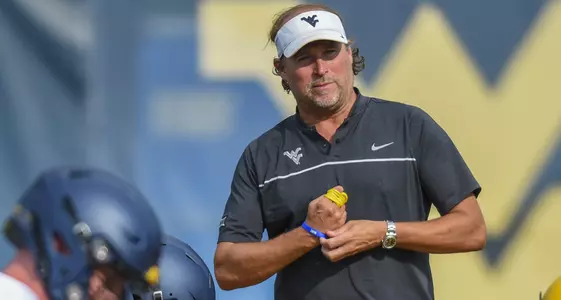
Photo by: All Pro Photography/Dale Sparks
Some Food For Thought
August 10, 2018 10:33 AM | Football, Blog
MORGANTOWN, W.Va. - Who knew Dana Holgorsen was a foodie?
We knew West Virginia's veteran football coach likes to keep up on his health as much as possible as Suncrest's most famous noon-time power walker.
Holgorsen is part of a long line of physically fit Mountaineer football coaches dating back to at least chain-smoking Art Lewis, who was several biscuits north of 300 pounds when he was coaching the Mountaineers in the late 1950s.
The great Ira Errett Rodgers also let his waist line sag a little when he coached the Mountaineers in the late 1920s and then later when he was pressed into duty again in the 1940s after Bill Kern was called into action during World War II.
Mont McIntyre was known to be a little hefty when he coached West Virginia in the late teens as well.
The portliest of West Virginia football coaches was Clarence Spears, whose nickname was the not-so politically correct "Fats."
In news accounts from his time coaching the Mountaineers there was nary an instance when the adjective "cherub" wasn't inserted someplace near his name.
But since Lewis, WVU's football coaches have been relatively svelte, even a young Jim Carlen in the late 1960s before he started getting those fat paychecks when he later coached at South Carolina.
Bobby Bowden liked to eat, but he kept himself in pretty good shape. Tall and slender Frank Cignetti was an avid jogger, and Don Nehlen also liked to work out, despite loading up his training table dinner plates like some of his offensive linemen.
Nehlen kept himself fit by playing racquetball every morning. His favorite playing partner was football recruiting coordinator Donnie Young, who the assistant coaches used to tease purposely lost his racquetball games against Nehlen to remain in his good favor.
After all, you don't work someplace for more than 45 years straight by beating the head football coach's ass in racquetball every morning!
Rich Rodriguez spent lots of time on the Stairmaster in the weight room trying to remain near his college playing weight of 200 pounds.
The late Bill Stewart was once an avid weightlifter, and he was known to pick up a barbell or two during his spare time coaching the Mountaineers.
And then there is Holgorsen, whose "broken down" football body can't handle those rigorous workouts he used to do when he was younger, but he still keeps in good shape with his 2 ½-mile power walks with top football administrators Alex Hammond and Ryan Dorchester.
He does them as a way to clear his head to get him ready to attack the remainder of the day. It's also a way for him to clear his digestive system to attack the dinner plate later that evening.
"We like to eat," Holgorsen said Thursday afternoon after beginning his meeting with the media describing his anticipation for the arrival of the watermelon truck to the Milan Puskar Center that afternoon. "Most of us are foodies."
Holgorsen said his late Wednesday evening was spent in front of a stove, preparing a multi-course menu for his family.
"Steaks, chicken, cornbread, corn on the cob, fresh green beans, cauliflower mixed in with olive oil and bacon, onions, baked potatoes, bacon, butter and sour cream on the outside … it was really good," he said.
 Holgorsen tied in his evening meal with the newly renovated training table area that has become a big hit with the players. Player meals are prepared by Sodexo each day under the close supervision of football nutritionist Taylor Lile.
"The presentation is obviously better in the back," Holgorsen explained. "They're back there, and they sit down there for about an hour and they eat. The end game is you want that food to go into their system. Eating and sleeping are the keys to recovering and getting back on the field as healthy as you can possibly get."
Speaking about nutrition to perhaps the unhealthiest segment of the population – sportswriters – can sometimes be futile. But on this afternoon a couple of them were game and dived in with forks in both hands.
One asked Holgorsen if it's important for his players to avoid many of the foods sportswriters love to eat – junk food.
"We'd like them to," he answered. "This time of year, as much as we feed them, we can prevent it because we're giving them four meals a day, really. When you get into a routine of us giving them one meal a day, then what are they going to do? They're going to do that. We try to educate them to the point of what's good and what's bad."
Another asked Holgorsen if he could measure the benefits of the nutritional system he has in place.
This one caught the coach off guard a little bit.
"I don't know how you can measure it," he finally answered. "It's just one of those things where if it's working and there are no issues, then it's thumbs up. (Strength coach) Mike Joseph weighs them in and out like twice a day. So if a guy is dropping weight then we're going to catch it pretty quickly.
"What's the No. 1 reason they drop weight? It's intake," Holgorsen continued. "We measure how much energy they are exerting with the GPS and how much they are running. We can measure if they're working hard or if they're not working hard."
Not really nutritional metrics, but a fairly scientific enough answer from the coach.
Another coach - coach Greg Hunter – growing tired of all the food talk, quickly steered the conversation back to football.
After all, it was already past lunchtime and Coach Hunter likes to eat, too!
We knew West Virginia's veteran football coach likes to keep up on his health as much as possible as Suncrest's most famous noon-time power walker.
Holgorsen is part of a long line of physically fit Mountaineer football coaches dating back to at least chain-smoking Art Lewis, who was several biscuits north of 300 pounds when he was coaching the Mountaineers in the late 1950s.
The great Ira Errett Rodgers also let his waist line sag a little when he coached the Mountaineers in the late 1920s and then later when he was pressed into duty again in the 1940s after Bill Kern was called into action during World War II.
Mont McIntyre was known to be a little hefty when he coached West Virginia in the late teens as well.
The portliest of West Virginia football coaches was Clarence Spears, whose nickname was the not-so politically correct "Fats."
In news accounts from his time coaching the Mountaineers there was nary an instance when the adjective "cherub" wasn't inserted someplace near his name.
But since Lewis, WVU's football coaches have been relatively svelte, even a young Jim Carlen in the late 1960s before he started getting those fat paychecks when he later coached at South Carolina.
Bobby Bowden liked to eat, but he kept himself in pretty good shape. Tall and slender Frank Cignetti was an avid jogger, and Don Nehlen also liked to work out, despite loading up his training table dinner plates like some of his offensive linemen.
Nehlen kept himself fit by playing racquetball every morning. His favorite playing partner was football recruiting coordinator Donnie Young, who the assistant coaches used to tease purposely lost his racquetball games against Nehlen to remain in his good favor.
After all, you don't work someplace for more than 45 years straight by beating the head football coach's ass in racquetball every morning!
Rich Rodriguez spent lots of time on the Stairmaster in the weight room trying to remain near his college playing weight of 200 pounds.
The late Bill Stewart was once an avid weightlifter, and he was known to pick up a barbell or two during his spare time coaching the Mountaineers.
And then there is Holgorsen, whose "broken down" football body can't handle those rigorous workouts he used to do when he was younger, but he still keeps in good shape with his 2 ½-mile power walks with top football administrators Alex Hammond and Ryan Dorchester.
He does them as a way to clear his head to get him ready to attack the remainder of the day. It's also a way for him to clear his digestive system to attack the dinner plate later that evening.
"We like to eat," Holgorsen said Thursday afternoon after beginning his meeting with the media describing his anticipation for the arrival of the watermelon truck to the Milan Puskar Center that afternoon. "Most of us are foodies."
Holgorsen said his late Wednesday evening was spent in front of a stove, preparing a multi-course menu for his family.
"Steaks, chicken, cornbread, corn on the cob, fresh green beans, cauliflower mixed in with olive oil and bacon, onions, baked potatoes, bacon, butter and sour cream on the outside … it was really good," he said.
Holgorsen tied in his evening meal with the newly renovated training table area that has become a big hit with the players. Player meals are prepared by Sodexo each day under the close supervision of football nutritionist Taylor Lile."The presentation is obviously better in the back," Holgorsen explained. "They're back there, and they sit down there for about an hour and they eat. The end game is you want that food to go into their system. Eating and sleeping are the keys to recovering and getting back on the field as healthy as you can possibly get."
Speaking about nutrition to perhaps the unhealthiest segment of the population – sportswriters – can sometimes be futile. But on this afternoon a couple of them were game and dived in with forks in both hands.
One asked Holgorsen if it's important for his players to avoid many of the foods sportswriters love to eat – junk food.
"We'd like them to," he answered. "This time of year, as much as we feed them, we can prevent it because we're giving them four meals a day, really. When you get into a routine of us giving them one meal a day, then what are they going to do? They're going to do that. We try to educate them to the point of what's good and what's bad."
Another asked Holgorsen if he could measure the benefits of the nutritional system he has in place.
This one caught the coach off guard a little bit.
"I don't know how you can measure it," he finally answered. "It's just one of those things where if it's working and there are no issues, then it's thumbs up. (Strength coach) Mike Joseph weighs them in and out like twice a day. So if a guy is dropping weight then we're going to catch it pretty quickly.
"What's the No. 1 reason they drop weight? It's intake," Holgorsen continued. "We measure how much energy they are exerting with the GPS and how much they are running. We can measure if they're working hard or if they're not working hard."
Not really nutritional metrics, but a fairly scientific enough answer from the coach.
Another coach - coach Greg Hunter – growing tired of all the food talk, quickly steered the conversation back to football.
After all, it was already past lunchtime and Coach Hunter likes to eat, too!
Gold-Blue Spring Festival Fan Recap
Sunday, April 19
John Neider | April 18
Saturday, April 18
Coach Zac Alley | April 18
Saturday, April 18
Coach Rich Rodriguez | April 18
Saturday, April 18