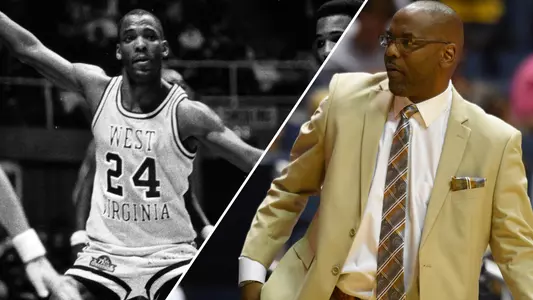
Country Roads: Lester Rowe
June 21, 2018 02:40 PM | Women's Basketball
Our coaching staff has a special connection to West Virginia University. Assistant coaches Lester Rowe and Christal Caldwell, along with assistant director of operations Ayana Dunning, represented the Mountaineers on the court as student-athletes, while assistant coach Chester Nichols started his Division I coaching career on the sidelines in the WVU Coliseum. As the song goes, country roads took them all home to coach Mike Carey's staff.
This week, Olivia VanHorn takes us through Lester Rowe's journey from men's basketball Hall of Famer to women's basketball assistant coach.
"Lester Rowe from Buffalo" has experienced Mountaineer basketball from all different sides of the court. Rowe got his first taste of the West Virginia University basketball program as a star member of coach Gale Catlett's men's basketball team in the 1980s. After playing professionally overseas for a few years, Rowe returned to Morgantown as one of Catlett's assistants. After a little more than a decade away, Rowe is back as an assistant coach for Mike Carey and the WVU women's basketball team.
Rowe first came to Morgantown from Buffalo, New York, in 1981. He thrilled the crowds in the WVU Coliseum and helped lead the Mountaineers to three conference championships and a record of 90-23 in his four years as a starter at WVU. Rowe ranks No. 17 in all-time scoring with 1,524 points and was named the Atlantic 10 Tournament Most Valuable Player in 1984.
Rowe was a beloved member of the WVU basketball team. As soon as the ball got in his hands, fans knew that something special was about to happen. After finishing his collegiate career and earning a degree in physical education, Rowe travelled the world playing professional basketball for eight years.
The Mountaineer alum made his first return to the WVU basketball program in 1997 when he was hired as an assistant coach on Catlett's staff. He was an integral part of the program until 2002, assisting in on-campus recruiting and scouting. After leaving the squad, Rowe remained in Morgantown as a real estate agent. He was asked to return to his alma mater once again as an assistant coach in 2011, but this time it was Carey making the call.
"Had it been any place else, I probably would have turned the job down because I raised my kids here and this became my home," said Rowe of the coaching job. "But by it being WVU, it made the decision really easy."
In his time as a player and a coach, the two-time team captain has had the chance to decipher the biggest differences between the two aspects of the game. He says that the preparation for practices and games differs the most. As a coach, he has to dissect film of opposing teams, create scouting reports and prepare practice plans. As a player, he just had to show up.
"As a player, all you have to do is come to practice, put your two and a half hours in and then you don't have to worry about the other stuff," said Rowe. "As a coach, you have to make sure you're getting done what your head coach needs done so we can keep moving forward and getting better."
Since becoming a coach, Rowe has recognized what he could have done to make himself a better athlete when he played in the 1980s. He notices how dedication directly correlates with success on the court. If he could go back, Rowe wishes he would have studied film and spent more time in the gym. While he had a successful career as a Mountaineer, Rowe now knows that these aspects could have helped him take his career further.
The WVU Sports Hall of Fame honoree says that one of his favorite parts of coaching is that no two days are the same. The athletes are smart so they are able to pick up what the coaching staff is teaching, allowing them to move on to the next drill. The team's intuition and drive is what makes coming to work every day so enjoyable. In fact, Rowe hardly considers coaching a job.
"This is not a job for me," he said. "I've never had something that I considered a job. I enjoy doing this; it's fun for me to do this."
This week, Olivia VanHorn takes us through Lester Rowe's journey from men's basketball Hall of Famer to women's basketball assistant coach.
"Lester Rowe from Buffalo" has experienced Mountaineer basketball from all different sides of the court. Rowe got his first taste of the West Virginia University basketball program as a star member of coach Gale Catlett's men's basketball team in the 1980s. After playing professionally overseas for a few years, Rowe returned to Morgantown as one of Catlett's assistants. After a little more than a decade away, Rowe is back as an assistant coach for Mike Carey and the WVU women's basketball team.
Rowe first came to Morgantown from Buffalo, New York, in 1981. He thrilled the crowds in the WVU Coliseum and helped lead the Mountaineers to three conference championships and a record of 90-23 in his four years as a starter at WVU. Rowe ranks No. 17 in all-time scoring with 1,524 points and was named the Atlantic 10 Tournament Most Valuable Player in 1984.
Rowe was a beloved member of the WVU basketball team. As soon as the ball got in his hands, fans knew that something special was about to happen. After finishing his collegiate career and earning a degree in physical education, Rowe travelled the world playing professional basketball for eight years.
The Mountaineer alum made his first return to the WVU basketball program in 1997 when he was hired as an assistant coach on Catlett's staff. He was an integral part of the program until 2002, assisting in on-campus recruiting and scouting. After leaving the squad, Rowe remained in Morgantown as a real estate agent. He was asked to return to his alma mater once again as an assistant coach in 2011, but this time it was Carey making the call.
"Had it been any place else, I probably would have turned the job down because I raised my kids here and this became my home," said Rowe of the coaching job. "But by it being WVU, it made the decision really easy."
In his time as a player and a coach, the two-time team captain has had the chance to decipher the biggest differences between the two aspects of the game. He says that the preparation for practices and games differs the most. As a coach, he has to dissect film of opposing teams, create scouting reports and prepare practice plans. As a player, he just had to show up.
"As a player, all you have to do is come to practice, put your two and a half hours in and then you don't have to worry about the other stuff," said Rowe. "As a coach, you have to make sure you're getting done what your head coach needs done so we can keep moving forward and getting better."
Since becoming a coach, Rowe has recognized what he could have done to make himself a better athlete when he played in the 1980s. He notices how dedication directly correlates with success on the court. If he could go back, Rowe wishes he would have studied film and spent more time in the gym. While he had a successful career as a Mountaineer, Rowe now knows that these aspects could have helped him take his career further.
The WVU Sports Hall of Fame honoree says that one of his favorite parts of coaching is that no two days are the same. The athletes are smart so they are able to pick up what the coaching staff is teaching, allowing them to move on to the next drill. The team's intuition and drive is what makes coming to work every day so enjoyable. In fact, Rowe hardly considers coaching a job.
"This is not a job for me," he said. "I've never had something that I considered a job. I enjoy doing this; it's fun for me to do this."

NCAA Second Round Press Conference | Kellogg, Harrison, Shaw
Monday, March 23
NCAA First Round Recap
Sunday, March 22
Mark Kellogg, Meme Wheeler & Jordan Harrison | NCAA First Round vs. Miami (OH)
Saturday, March 21
NCAA Tournament Trailer
Friday, March 20