Mozes-Main-61915.jpg
2006 Sugar Bowl: Dan Mozes
June 19, 2015 08:31 AM | General
 |
|
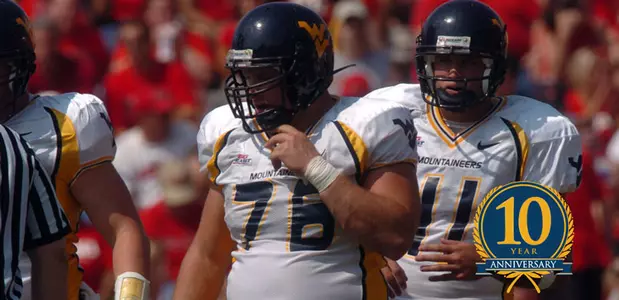
| Dan Mozes earned his first career start at center during this 2005 game at Maryland. He won the Rimington Trophy as college football's top center a year later in 2006. | |
| All-Pro Photography/Dale Sparks photo | |
|
More Stories
Sweet Memories: 2006 Sugar Bowl
2006 Sugar Bowl: Steve Slaton
|
In 2006, Mozes won the Rimington Trophy, presented annually to college football’s top center. He was a unanimous choice for the award after helping the Mountaineers to an 11-2 record and a victory over Georgia Tech in the 2007 Toyota Gator Bowl. West Virginia that season finished second in the country in rushing (303 ypg.), third in scoring (38.9 ppg.) and fifth in total offense (461.4 ypg.).
“People ask me, ‘How did you win the Rimington?’” Mozes, now living in Plymouth, Michigan, and running one of Mike Barwis’ training centers, said earlier this spring. “I say I had three great things in my favor: I had Mike Barwis as a strength coach, I had Rick Trickett as an offensive line coach and I had (sports information director) Shelly Poe getting my name out there. If it wasn’t for those three people nobody would ever know who Dan Mozes was.”
Those three played a role, for sure, but Mozes also had a lot to do with his great honor as well.
Mozes came to WVU from nearby Washington, Pennslyvania, with a chip on his shoulder because Pitt didn’t offer him a scholarship. In hindsight, Mozes’ decision to come to West Virginia perfectly suited his talents because of Rich Rodriguez’s spread offensive attack and offensive line coach Rick Trickett’s hard-nosed mentality.
Mozes began his career at offensive guard before switching to center the week before a road game at Maryland early in the 2005 season, which turned out being one of the key games that year.
However, Mozes’ first couple snaps of the game were less than stellar and Rodriguez wanted Trickett to move Mozes back to offensive guard.
“That was the running joke among the guys that Rich Rod was like, ‘Take him out and put him back at guard right now!’ Trickett was like, ‘Give him one more series to let him cool down.’ I don’t know if I ever cooled down because the velocity of my snaps continued to get faster and faster, but thankfully (quarterbacks) Pat (White) and Adam (Bednarik) were such good athletes that they were able to keep those snaps on their chests,” Mozes recalled.
Who knows, if Trickett doesn’t stick with Mozes at center West Virginia may still be seeking its first major award winner (Tavon Austin did win the Paul Hornung Award in 2012, but that decoration is still relatively new and is still not a part of the College Football Awards Show).
At any rate, the emergence of White and running back Steve Slaton during the Louisville game was certainly a big moment during the 2005 season, but Mozes’ move from guard to center to anchor the offensive line before the game in College Park was probably equally as important.
The victory over the Terrapins was also a watershed moment during that season.
“The thing about the Maryland win was the way we beat them,” said Mozes. “We whipped their ass and the defense … we had highlight hit after highlight hit on them.”
West Virginia lost just once in 2005, at home against Virginia Tech, a game Mozes believes was a lot closer than the 34-17 score might indicate.
“Two or three plays in that game and it would have been a totally different ballgame,” he said.
Mozes teamed with guards Jeremy Sheffey and Ryan Stanchek and tackles Garin Justice and Travis Garrett to give the Mountaineers a physical, relentless group of warriors up front. This was the offensive line that really established the tradition of West Virginia’s power ground game that finished ranked among the nation’s top 15 in rushing offense for seven consecutive years from 2002-08.
None of the guys who played on those West Virginia offensive lines were prototypical linemen coveted by the pros – they were short and light with small wingspans – but they all possessed huge hearts, none bigger than Mozes’.
“How many times did we run the ball?” asked Mozes. “We weren’t a Power-I offense with a bunch of 350-pound linemen, but we were guys who took one step and then we went right down your throat. There was nothing about us that was finesse. Yeah, we threw some screens but guess what? We were out there trying to hit you in the mouth or take you out.”

#76 | Dan Mozes | C
Height: 6-4
Weight: 290
Home: Washington, Pa.
Seasons: 2002-06
HONORS
Consensus All-American (2006) | Rimington Trophy (2006) |
All-Big East First Team (2004, 2005, 2006)
Most recall Steve Slaton’s performance in the 2006 Sugar Bowl, or the plays Pat White, Darius Reynaud, Brandon Myles and punter Phil Brady made that unforgettable evening, but there was a block Mozes somehow made during a key drive late in that game that probably ended up winning it for the Mountaineers.
West Virginia, leading just 31-28 at the time, was backed up deep in its own territory and Georgia was gaining momentum after falling behind 28-0 to start the game.
The Mountaineers faced a third and 10 inside their own 10-yard line and the play Rodriguez called was Quarterback Power. Considering the circumstances and the field position, the hope was to get a few positive yards to give Phil Brady more room to punt out of his own end zone.
On the play it was Mozes’ job to get a piece of the defensive tackle engaged with the guard and then peel off to the second level to block the middle linebacker. As the play developed, Mozes stumbled and lost his balance as the linebacker he was supposed to block shot past him to his backside right.
Somehow, Mozes planted both feet, lunged backward almost as if he was going to do a backflip and got enough of the linebacker to give White the room he needed to run for a critical first down. If Mozes doesn’t make that block White is thrown for a two-yard loss and West Virginia is punting the football back to Georgia from deep in its own territory.
“That play kind of summed up the game,” said teammate Garin Justice, now head coach at Division II Concord. “If we’re going to win this game then we’re going to have to do whatever it takes.”
West Virginia eventually scored on that drive when Slaton broke free (sprung by another Mozes block) for a 52-yard touchdown.
The Mountaineers’ 38-35 victory over Georgia in the Nokia Sugar Bowl was a watershed moment for West Virginia’s football program. Beating the SEC champion in its own backyard has a way of getting people’s attention.
A year later, during Mozes’ senior season, he helped West Virginia to another Top-10 finish when the Mountaineers came from 18 points down to beat Calvin Johnson and Georgia Tech in the Gator Bowl. It was the first time in school history West Virginia produced back-to-back seasons in the Top 10.
“We kept on going after (the Sugar Bowl victory) and I pray to God we can get it back so I can have my Saturdays sitting down, drinking a bottle of beer and hanging my Mountaineer flag and enjoying some more Mountaineer wins,” he concluded.
NCAA Selection Show
Wednesday, May 13
WVU Baseball Defensive Highlights
Tuesday, May 12
Kansas Recap
Tuesday, May 12
Kansas State Recap
Tuesday, May 12