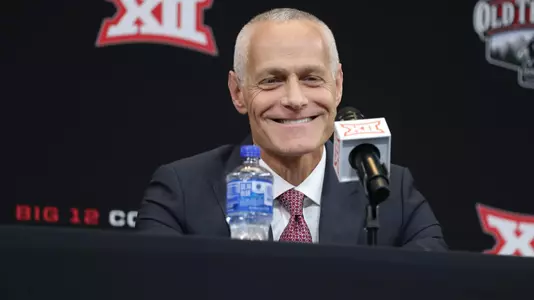
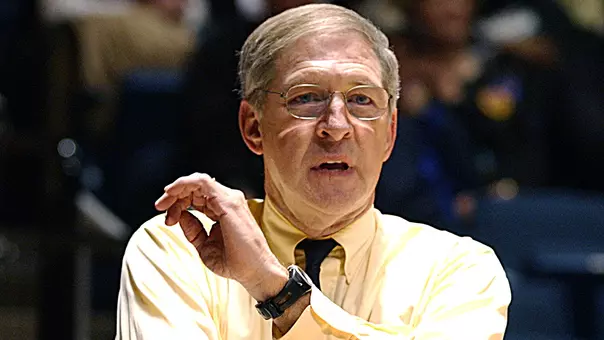
Photo by: Liz Parke
Commissioner Brett Yormark’s First Year Overseeing the Big 12 Was Big and Bold
June 07, 2023 02:39 PM | Blog
MORGANTOWN, W.Va. – Believe it or not, Brett Yormark is still a couple of weeks shy of celebrating his one-year anniversary as the Big 12 Conference's commissioner.
And, although the official announcement of his hiring was June 29, 2022, he didn't actually begin duties with the conference until Aug. 1. Since then, the Big 12 has gone from a collection of schools uncertain of its place at the table within the Power 5 to a position of strength, today arguably the third-most stable league in the country behind the SEC and Big Ten.
How did it happen so quickly?
Yormark, who has more than two decade's-worth of experience in sports but none in collegiate athletics prior to his current stint with the Big 12, did it by renegotiating the conference's media rights deal last October, guaranteeing each member an average of $31.6 million per year through 2031 when the new contract begins in 2025. Including College Football Playoff and NCAA men's basketball tournament revenue, the per-school yearly outlay could approach $50 million per year.
Amazingly, Yormark was able to stabilize the Big 12's financial outlook despite losing Oklahoma and Texas to the SEC. He wisely understood that there is only so much linear TV money to go around, and after the SEC and Big Ten secured its lucrative deals, he took most of what was left.
 "When you look at the work that has been done by commissioner Yormark and even before him commissioner (Bob) Bowlsby to position the league after the shockwaves of Oklahoma and Texas announcing their departures … you went from a league that a lot of people thought was going to collapse to a league that not only has survived, but I think most people would say is the third-most stable league in the country," WVU director of athletics Wren Baker said last month. "That's really saying something. I give commissioner Yormark a lot of credit, as well as the presidents and the ADs before I arrived, for stabilizing the league and coming up with a solid plan."
With the Atlantic Coast Conference's Grant of Rights effectively taking it out of play until 2036, the only other significant media rights suitor is the Pac-12, so by doing a deal early and jumping ahead of the Pac-12, Yormark managed to stabilize the Big 12.
The Pac-12, which will be losing USC and UCLA to the Big Ten Conference next year, is now in the same position the Big 12 was in three summers ago when it became known that Texas and Oklahoma were leaving for the SEC.
"I have never felt stronger about the fabric of the Big 12," Iowa State athletic director Jamie Pollard told a group of Iowa State supporters in Kansas City last month. "I've done this for 18 years and quite frankly, for 16 ½ years, I still have the scars, the scabs and the bruises from the Big 12 being the conference that was ready to implode."
Tim Fitzgerald, who covers Kansas State for GoPowercat.com, pointed out recently that with Texas no longer an obstacle to expansion, Bowlsby was able to secure the commitments of BYU, Central Florida, Cincinnati and Houston to join the league as replacements. Now, Yormark is eager to build on this new climate by wanting to expand the Big 12's footprint to all four time zones, and money is going to be the determining factor in any future additions.
These days, conference commissioners not named Greg Sankey or Tony Petitti better figure out how to rub two pennies together to make a quarter. For potential suitors out there sitting on the fence and weighing their options, it's becoming clear that Brett Yormark knows how to make money.
Earlier this year, Yormark's premium seating tweaks to the Big 12 men's basketball tournament in Kansas City contributed to a 37% increase in year-after-year revenue. The women's basketball tournament boosted its revenue by 20%.
Yormark believes Big 12 men's basketball media rights are severely undervalued as the No. 1 conference in the country, and he has talked about separating it from football in the future. His idea of hosting boys' and girls' basketball camps in New York City this summer is a creative way of expanding the Big 12 brand into the Big Apple.
Yormark also wants to expand the Big 12's brand in Mexico with football and men's basketball games being played across the border, with Monterey and Mexico City being identified as two potential host cities. Inspiration for this comes from the NFL's, MLB's and the NBA's prior international successes.
"Commissioner Yormark does a great job of challenging us to think differently," Baker admitted. "You've seen things leak out about potentially playing games in Mexico to extend our brand and reach in other countries. He created some premium areas at the Big 12 men's basketball tournament that brought a new revenue stream to the conference.
"He's taken the media rights and was able to extend those in terms of what is coming in, so he thinks differently. He brings that professional and business-like mentality to the conference, and I think it meshes well with the ADs and CEOs on each campus to put us on a path toward sustainable success," Baker added.
The conference is also getting into the football pro-day business, previously conducted individually by schools on their campuses. Yormark's idea is to establish something similar to what the NFL does with its Scouting Combine in Indianapolis for the Big 12 schools at the Dallas Cowboys' training complex The Star.
The event will be televised in the spring when sports programming is sparse, and sponsorships will be sold for more monetization.
Earlier this month, Yormark announced that the Big 12 will be creating an internal commercial sales division for the first time in its 27-year history. The conference, in a press release, said this will give it complete control of its commercial business enterprise with its outreach strategy "executed at the local, national and international level."
The objective is to maximize current revenue streams with its championship events while establishing new revenue opportunities.
Since last August, Yormark has created several new positions within the conference office with most of his hires having professional sports backgrounds. These people will be searching for new ways to generate revenue for the Big 12 to help offset the widening gap the SEC and Big Ten has created with its lucrative media rights deals.
"The reality is, to use a biblical term, there is an unquenchable thirst for more," Baker explained. "Our league understands that. We're trying to compete with Big Ten and SEC programs that have at least a 50% higher budget, and some of them a 100% higher budget.
"Everybody talks about a Power 5, but within the Power 5 there are two leagues that would be Superpowers in terms of the resources that they currently have and what they're going to have as you project out future years and TV contracts," Baker said. "We know that our fans expect us to compete, and they really don't care what our budget is compared to, say, Kentucky. Their budget is now almost two times ours. If we play Kentucky in something, people expect that we're going to beat them, and sitting in this chair and knowing this reality, it's imperative that we find ways to increase our revenue because that's a significant part of this job.
"So, I think if you are going to thrive in today's environment, and you are not in the SEC or Big Ten, you are going to have to find a way to make a dollar every time you can make a dollar. That's not meant to sound greedy or to take advantage of anything, that's just to point out that our coaches and staff here at WVU, and our league, have fared very well with less money, and you must do everything you can for that gap not to continue to increase," Baker concluded.
Under Yormark's stewardship, that appears to be happening from the top down right now. His first year leading the Big 12 Conference was big and bold.
What lies ahead could be even bigger and bolder.
And, although the official announcement of his hiring was June 29, 2022, he didn't actually begin duties with the conference until Aug. 1. Since then, the Big 12 has gone from a collection of schools uncertain of its place at the table within the Power 5 to a position of strength, today arguably the third-most stable league in the country behind the SEC and Big Ten.
How did it happen so quickly?
Yormark, who has more than two decade's-worth of experience in sports but none in collegiate athletics prior to his current stint with the Big 12, did it by renegotiating the conference's media rights deal last October, guaranteeing each member an average of $31.6 million per year through 2031 when the new contract begins in 2025. Including College Football Playoff and NCAA men's basketball tournament revenue, the per-school yearly outlay could approach $50 million per year.
Amazingly, Yormark was able to stabilize the Big 12's financial outlook despite losing Oklahoma and Texas to the SEC. He wisely understood that there is only so much linear TV money to go around, and after the SEC and Big Ten secured its lucrative deals, he took most of what was left.
"When you look at the work that has been done by commissioner Yormark and even before him commissioner (Bob) Bowlsby to position the league after the shockwaves of Oklahoma and Texas announcing their departures … you went from a league that a lot of people thought was going to collapse to a league that not only has survived, but I think most people would say is the third-most stable league in the country," WVU director of athletics Wren Baker said last month. "That's really saying something. I give commissioner Yormark a lot of credit, as well as the presidents and the ADs before I arrived, for stabilizing the league and coming up with a solid plan."With the Atlantic Coast Conference's Grant of Rights effectively taking it out of play until 2036, the only other significant media rights suitor is the Pac-12, so by doing a deal early and jumping ahead of the Pac-12, Yormark managed to stabilize the Big 12.
The Pac-12, which will be losing USC and UCLA to the Big Ten Conference next year, is now in the same position the Big 12 was in three summers ago when it became known that Texas and Oklahoma were leaving for the SEC.
"I have never felt stronger about the fabric of the Big 12," Iowa State athletic director Jamie Pollard told a group of Iowa State supporters in Kansas City last month. "I've done this for 18 years and quite frankly, for 16 ½ years, I still have the scars, the scabs and the bruises from the Big 12 being the conference that was ready to implode."
Tim Fitzgerald, who covers Kansas State for GoPowercat.com, pointed out recently that with Texas no longer an obstacle to expansion, Bowlsby was able to secure the commitments of BYU, Central Florida, Cincinnati and Houston to join the league as replacements. Now, Yormark is eager to build on this new climate by wanting to expand the Big 12's footprint to all four time zones, and money is going to be the determining factor in any future additions.
These days, conference commissioners not named Greg Sankey or Tony Petitti better figure out how to rub two pennies together to make a quarter. For potential suitors out there sitting on the fence and weighing their options, it's becoming clear that Brett Yormark knows how to make money.
Earlier this year, Yormark's premium seating tweaks to the Big 12 men's basketball tournament in Kansas City contributed to a 37% increase in year-after-year revenue. The women's basketball tournament boosted its revenue by 20%.
Yormark believes Big 12 men's basketball media rights are severely undervalued as the No. 1 conference in the country, and he has talked about separating it from football in the future. His idea of hosting boys' and girls' basketball camps in New York City this summer is a creative way of expanding the Big 12 brand into the Big Apple.
Yormark also wants to expand the Big 12's brand in Mexico with football and men's basketball games being played across the border, with Monterey and Mexico City being identified as two potential host cities. Inspiration for this comes from the NFL's, MLB's and the NBA's prior international successes.
"Commissioner Yormark does a great job of challenging us to think differently," Baker admitted. "You've seen things leak out about potentially playing games in Mexico to extend our brand and reach in other countries. He created some premium areas at the Big 12 men's basketball tournament that brought a new revenue stream to the conference.
"He's taken the media rights and was able to extend those in terms of what is coming in, so he thinks differently. He brings that professional and business-like mentality to the conference, and I think it meshes well with the ADs and CEOs on each campus to put us on a path toward sustainable success," Baker added.
The conference is also getting into the football pro-day business, previously conducted individually by schools on their campuses. Yormark's idea is to establish something similar to what the NFL does with its Scouting Combine in Indianapolis for the Big 12 schools at the Dallas Cowboys' training complex The Star.
The event will be televised in the spring when sports programming is sparse, and sponsorships will be sold for more monetization.
Earlier this month, Yormark announced that the Big 12 will be creating an internal commercial sales division for the first time in its 27-year history. The conference, in a press release, said this will give it complete control of its commercial business enterprise with its outreach strategy "executed at the local, national and international level."
The objective is to maximize current revenue streams with its championship events while establishing new revenue opportunities.
Since last August, Yormark has created several new positions within the conference office with most of his hires having professional sports backgrounds. These people will be searching for new ways to generate revenue for the Big 12 to help offset the widening gap the SEC and Big Ten has created with its lucrative media rights deals.
"The reality is, to use a biblical term, there is an unquenchable thirst for more," Baker explained. "Our league understands that. We're trying to compete with Big Ten and SEC programs that have at least a 50% higher budget, and some of them a 100% higher budget.
"Everybody talks about a Power 5, but within the Power 5 there are two leagues that would be Superpowers in terms of the resources that they currently have and what they're going to have as you project out future years and TV contracts," Baker said. "We know that our fans expect us to compete, and they really don't care what our budget is compared to, say, Kentucky. Their budget is now almost two times ours. If we play Kentucky in something, people expect that we're going to beat them, and sitting in this chair and knowing this reality, it's imperative that we find ways to increase our revenue because that's a significant part of this job.
"So, I think if you are going to thrive in today's environment, and you are not in the SEC or Big Ten, you are going to have to find a way to make a dollar every time you can make a dollar. That's not meant to sound greedy or to take advantage of anything, that's just to point out that our coaches and staff here at WVU, and our league, have fared very well with less money, and you must do everything you can for that gap not to continue to increase," Baker concluded.
Under Yormark's stewardship, that appears to be happening from the top down right now. His first year leading the Big 12 Conference was big and bold.
What lies ahead could be even bigger and bolder.
SWIM: What it Means to Become a Mountaineer
Wednesday, April 29
Gold-Blue Spring Festival Fan Recap
Sunday, April 19
John Neider | April 18
Saturday, April 18
Coach Zac Alley | April 18
Saturday, April 18