Despite Significant Challenges, Brown Building For Success
May 06, 2022 12:30 PM | Football, Blog
MORGANTOWN, W.Va. – The NFL Draft is over and for the first time since 2007, West Virginia is on the outside looking in.
Really since 2019, when five Mountaineer players’ names were called, the pickings have been pretty slim around here. Offensive tackle Colton McKivitz was the 153rd choice by the San Francisco 49ers in the fifth round of the 2020 draft, and last year, Arizona graduate transfer linebacker Tony Fields II was taken at the exact same spot as McKivitz by the Cleveland Browns.
That’s it.
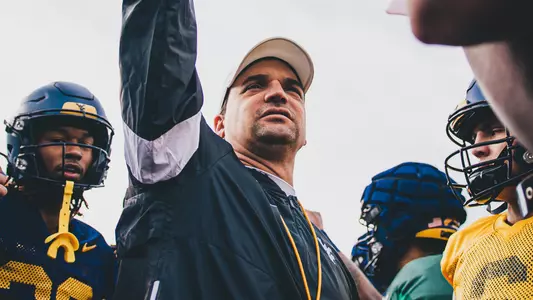
This has been West Virginia’s sparsest pool of NFL-caliber talent since the early 1950s, which is the last time a Mountaineer football coach has been handed a roster as depleted as the one Neal Brown is currently rebuilding. And make no mistake about it, although the R-word hasn’t been used much around here since Brown took over from Dana Holgorsen in 2019, that’s exactly what he’s had to do - rebuild.
One experienced and knowledgable onlooker recently told me that the cupboard wasn’t just bare when Brown took over in 2019, it was barely even attached to the wall!
The last time West Virginia experienced something to this degree was when Mississippi State offensive line coach Pappy Lewis was hired following Dud DeGroot’s two tumultuous seasons in Morgantown in 1948-49.
DeGroot was brought in from the professional ranks to inject some excitement and enthusiasm into a Mountaineer grid program that had seemingly grown stale under Jock Sutherland protégé Bill Kern. DeGroot was a Clark Shaughnessy disciple whose expertise with the popular T-Formation offense made him an attention-grabbing hire.
DeGroot inherited a strong nucleus of players from Kern, including quarterback Jimmy Walthall, the nation’s fourth-leading passer, and the Mountaineers won nine games in 1948, including a 21-12 victory over Texas El Paso in the Sun Bowl. But less than 12 months later, he was run out of town after a 4-6-1 season in 1949 that included embarrassing losses to Ohio University and Boston University.
DeGroot shared equal enjoyment with his critics about his 24-month tenure in Morgantown, once stating, “A person must coach professional football and then come to West Virginia to get a real education. In all my years of coaching, I have never known so many wise guys who know all of the answers as I have met in West Virginia!”
Well, there you go!
What Dud left behind was nothing but duds, Lewis said when he took over in 1950. At the time, West Virginia was entering the Southern Conference, which then was basically the ACC on steroids with college football powers Clemson and Maryland at the top of the league standings.
At the bottom was West Virginia, its two victories that season coming against the pocket-protector-wearing lads of Case Western University and football juggernaut Richmond. Lewis struggled through another difficult year before hitting it big with the best recruiting class in school history in 1952 that included Sam Huff, Bruce Bosley, Joe Marconi, Bobby Moss and option quarterback Freddy Wyant.
The only player Lewis inherited from DeGroot good enough to be considered by the pros was offensive lineman John Bove, who wound up playing in the Canadian League. Consequently, Lewis needed lots of time to get things fixed.
A person must coach professional football and then come to West Virginia to get a real education. In all my years of coaching, I have never known so many wise guys who know all of the answers as I have met in West Virginia!-- Dud DeGroot
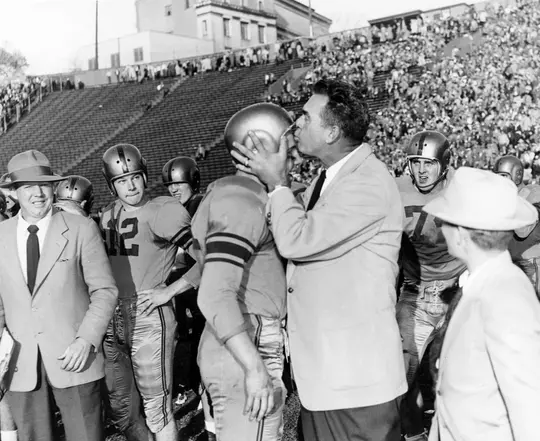
There have been other rebuilds.
Gene Corum endured the only winless season in school history in 1960, partly because he chose to play sophomores that year and partly because West Virginia was severely overscheduled with a slate that included Maryland, Virginia Tech, Illinois, Pitt, Syracuse, Penn State and Oregon.
Unmanageable schedules also contributed to Lewis’ decline in the late 1950s, but he did land an excellent recruiting class in 1959 that included Pennsylvania standouts Tom Woodeshick, Ken Herock and Gene Heeter. Those three formed the nucleus of West Virginia’s 8-2 team in 1962 that won at Syracuse for the first time in school history.
In 1966, Georgia Tech defensive coordinator Jim Carlen had to do lots of heavy lifting when he took over from Corum. WVU had experienced disciplinary problems toward the end of Corum’s tenure that resulted in some of its best players being kicked off the team and requiring Carlen to basically start over from scratch. Carlen said he inherited just two players who were capable of playing at Penn State at the time – running back Garrett Ford and safety John Mallory. Both were eventually taken in the 1968 NFL Draft, as was Wheeling defensive end Danny Williamson.
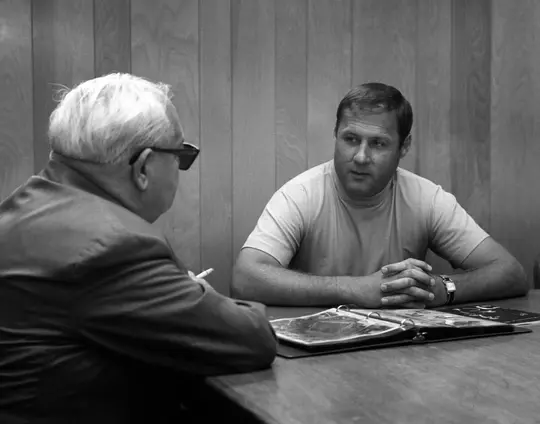
Another rebuild was required in 1976 when offensive coordinator Frank Cignetti replaced Bobby Bowden, who stunned Mountaineer Nation when he accepted the Florida State job just days after upsetting N.C. State in the 1975 Peach Bowl. Nearly all of West Virginia’s top-shelf talent off of Bowden’s 1974-75 squads - players such as Danny Buggs, Jeff Merrow, Marshall Mills, Charlie Miller, Tree Adams, Ron Lee, Artie Owens and Charles Braswell - were taken in the 1975 and 1976 NFL drafts. Cignetti was left with just two players good enough to be drafted, safety Tommy Pridemore and running back Duck Riley in 1978.
Yet, when you factor in some of the existential things that Neal Brown has had to deal with during his three-year WVU tenure, those other rebuilds really pale in comparison.
Yes, Lewis had to deal with the Korean War, which minimally impacted his roster with a couple of his guys being required to fulfill military service commitments. Lewis also had to navigate an upgraded schedule at the outset of his tenure when WVU joined the Southern Conference.
Yes, Corum was dealing with an unrealistic schedule and a roster full of young players at the outset of his coaching career, but those talented young players eventually turned things around in 1962.
Yes, Carlen had to contend with the Vietnam War, campus unrest and the Civil Rights Movement, which proved perilous for a WVU program then considered a “southern” school trying to recruit standout Northeastern players. However, Carlen also had the benefit of coaching in the Southern Conference. Arch-rival Pitt was in the depths of the Dave Hart/Carl DePasqua years and Syracuse was also in decline, which left Penn State as the only major power on West Virginia’s schedule. In fact, Carlen never defeated a nationally ranked team during his four-year tenure that ended with a Peach Bowl victory over South Carolina in 1969.
And, yes, Cignetti was coaching in a crumbling football stadium during a time when Eastern football was experiencing a revival with Pitt and Penn State considered superpowers, not to mention annual regional foes Maryland and Kentucky sporting top 20-caliber programs. Cignetti, too, was dealing with a rare form of cancer that nearly killed him in 1978. But he also was able to recruit to a brand-new football stadium, which was approved by the State Legislature during his second season coaching the Mountaineers. Unfortunately for him and a coaching staff that included a guy named Nick Saban, Cignetti got just four years here (all losing ones) before handing the baton off to Don Nehlen in new Mountaineer Field.
What Santa Cignetti delivered Nehlen was a sleigh full of good, young football players such as Darryl Talley, Oliver Luck, Fulton Walker, Robert Alexander, Delbert Fowler, Walter Easley, Dennis Fowlkes, Andre Gist, Calvin Turner and Mark Raugh – all professional-caliber talent. Considering what Nehlen started with, perhaps it wasn’t quite as bad at the end of Cignetti’s tenure as some then were led to believe?
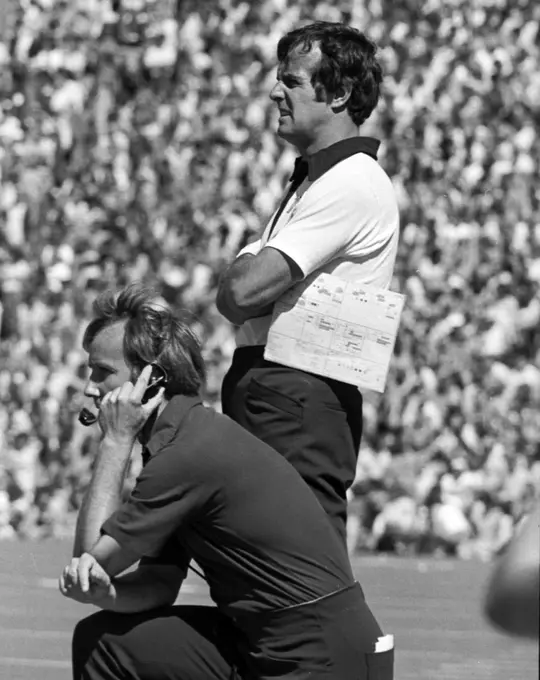
Now, think about what Neal Brown has had to address since his hiring on Jan. 5, 2019:
* A depleted football roster playing in the Big 12 Conference
* Consistently low scholarship numbers
* COVID-19
* Name, Image and Likeness
* Immediate one-time transfers
Combined, these circumstances have made this one of West Virginia football’s most challenging environments since World War II, in my opinion.
No question, the Big 12 is comparable to what the Mountaineers faced as an Eastern independent in the late 1970s and 1980s, or when the Big East was at its strongest in the late 1990s/early 2000s when Miami and Virginia Tech were at the top of their games. The Big East during those two periods and the Big 12 in its current state are the two strongest football conferences in which West Virginia has ever played.
As for COVID-19, that had a much more profound impact on the development of Brown’s football program than we probably realized. When you are in the developmental business and you don’t have a full calendar year to develop your players, most of whom aren’t ready-made, it’s bound to have an effect.
It did.
Name, Image and Likeness (NIL) and the immediate one-time transfer rule have added even more complications to the situation. Can you imagine the impact those two things would have had on West Virginia football when Don Nehlen was building a national power in the late 1980s, or in the mid-2000s when Rich Rodriguez had the Mountaineers back near the top of the mountain?
Nehlen’s football philosophy was based on player development and redshirting. During his last 15 years at the helm, he was in a pattern of constructing his teams in five-year cycles: 1988, 1993 and 1998. Those were his three most talented West Virginia squads because he was afforded the time to build them.
Could he have done so with NIL and the one-time transfer rule? Would Major Harris have stuck around after the 1988 season, or would he have put his name into the transfer portal seeking unimaginable riches elsewhere? A 2022 Major Harris would probably say no, but I’m not so sure about the 1989 Major Harris.
What about Steve Slaton in 2007, Pat White in 2008 or Noel Devine in 2010? Do they stick around, or do they see what they can make on the open market?
What about Bill Stewart handoffs Geno Smith, Tavon Austin and Stedman Bailey? Does Dana Holgorsen even get to coach them?
Interesting questions, for sure.
For West Virginia, the good news today is that Brown is also aggressively taking advantage of the transfer portal. Former Georgia quarterback JT Daniels, officially added to the roster earlier this week, was considered one of the top NFL Draft prospects a year ago before his 2021 season ended prematurely after just seven games with the Bulldogs.
The addition of Daniels is in line with Florida’s Will Grier, Notre Dame’s Jake Kelchner and Penn State’s Jeff Hostetler in terms of excitement and enthusiasm for the Mountaineer fan base.
Other portal imports that could see significant playing time this year include Penn State’s Lance Dixon, Clemson’s Lynn-J Dixon, Colorado State’s Brian Polendey, Illinois State’s Charles Woods, Cincinnati’s Zeiqui Lawton, Murray State’s Marcis Floyd, Florida State’s Parker Grothaus, North Dakota State’s Jasir Cox and Georgia Tech's Mike Lockhart, not to mention Virginia Tech’s Doug Nester and Virginia’s Ja’Quay Hubbard from a couple of years ago.
More additions are likely forthcoming.
Meanwhile, the offensive and defensive lines are considered two of the strengths of this year’s team. When was the last time you could legitimately say that about a West Virginia football team?
Influential WVU alums Ken Kendrick and Oliver Luck have also gotten ahead of the curve with their independently operated Country Roads Trust, established to address the current NIL environment.
Despite the numerous obstacles he’s had to deal with, Neal Brown today has West Virginia’s roster in a much better place than it was back in January 2019 when he first took over.
His 17-18 record through three seasons isn’t up to anyone’s standards, for sure, but considering what he was left and the unpredictable challenges his program has encountered over the last 36 months, it’s probably not too far off target.