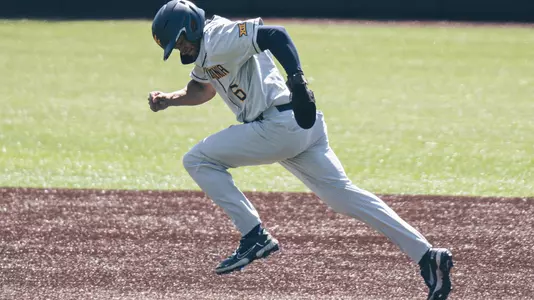
Photo by: WVU Athletic Communications
Running Game Has Turned Into Mountaineers’ Formula For Success
April 08, 2022 03:02 PM | Baseball, Blog
MORGANTOWN, W.Va. – West Virginia's next stolen base will be its 100th with roughly half of its regular season still remaining heading into tonight's Big 12 series-opening game against Baylor.
The Mountaineers, right now, are the most prodigious base stealing team in Power 5 baseball, and it's not even close. Oklahoma, No. 8 overall in the country in stolen bases this week, is 37 stolen bases behind No. 2 West Virginia's 99 heading into weekend play.
Texas Southern leads the Division I ranks with 129 steals as members of the Southwestern Athletic Conference.
Coach Randy Mazey's Mountaineers are on pace to obliterate the school record of 114 stolen bases produced by Dale Ramsburg's 1986 club - a feat that was accomplished in just 39 games that season. WVU had five guys with at least 13 stolen bases, led by Mickey Mamarella's school-record 29 thefts in 30 tries.
West Virginia attempted 134 stolen bases that season.
Since stolen base attempts were first annually recorded in 1980, West Virginia has attempted 100 or more steals only 12 times, with eight of those coming in Mazey's 10 seasons coaching the Mountaineers.
During a three-year period from 1996-98 - arguably the most successful of coach Greg Van Zant's tenure with a 106-61-1 record, an NCAA Tournament appearance and a Big East regular season title - the Mountaineers tried more than 100 steals in each of those seasons with a high of 86 steals in 1998.
Steve Harrick's most successful teams in 1963-64, with speedy All-American Bill Marovic patroling center field, also stole bases at a frenetic clip. The Mountaineers swiped 74 bases on the way to a 30-3 record in 1963, and they had 76 swipes a year later during their 24-5 campaign.
Going deep into West Virginia's history, box score research in the local newspapers reveals 96 stolen bases during the 1908 campaign with shortstop Dick Nebinger leading the way with 21, and 92 thefts in 1909 with second baseman Kemper Shelton stealing 22.
Both of those guys were professional-caliber players who would have been in the school's athletic hall of fame had it been around in those days. Incidentally, those two teams generated records of 23-6 in 1908 and 19-8 in 1909.
The stolen base first became a baseball term in 1870, and it turned into a legitimate weapon in the early 20th century by such players as Ty Cobb and Clyde Milan. Then, when Babe Ruth arrived on the scene in the early 1920s, the emphasis shifted to hitting home runs.
In the 1950s, for example, no player in the majors stole more than 25 bases, and Dom DiMaggio once won the American League stolen base title with just 15 in 1950.
In the early 1960s, however, the stolen base was revived by speedsters Luis Aparicio and Maury Wills, who were regularly swiping more than 50 bases per year. Wills broke Ty Cobb's stolen base record with 104 thefts in 1962, and 12 years later, Lou Brock exceeded that with 114 stolen bases in 1974.
"There were guys back in the day in the big leagues stealing 100 bases a year and that will never happen again," Mazey said before the start of the season. "Bunting was reserved for pitchers in the National League, for the most part, and kids grow up watching that style of baseball now and kids never practice any more. They play travel ball and play games all the time, and that style of baseball is pretty obsolete, really."
Rickey Henderson stole more than 100 bases three times during a four-year period from 1980-83, including a big league-best 130 in 1982. Tim Raines, Vince Coleman, Willie Wilson and Ozzie Smith continued the trend until the long ball once again came into vogue by the late 1980s.
That's the type of player Randy Mazey was when he played at Clemson in the late 1980s when the top college programs embraced the running game. St. John's once stole an NCAA-record 22 bases against Siena in 1978. Texas Pan-American's Don Guillot swiped 107 bags in 60 games in 1987, and Bethune-Cookman's Lawrence Smith averaged nearly two stolen bases per game during the 1988 season.
Coleman, who played at Florida A&M, was a prolific collegiate base stealer as well who once swiped 42 bags in just 27 games in 1982.
"I was a two-way guy who liked to steal bases and put pressure on the defense and I guess you kind of gravitate to liking to coach the way you were as a player," Mazey said.
Today, hitting home runs continues to be the preferred method to score runs with teams not wanting to waste outs on the base paths in hopes of getting a three-run homer.
In this regard, Mazey's Mountaineers are going against the grain.
"In order to get kids at this level to buy into it you have to convince them that you are a part of a team that needs to evolve into a team," he explained. "When you are a part of a team you need to make decisions that sometimes aren't best for myself, but are what's best for the team."
And what's best for West Virginia right now is to run, run and run some more.
The Mountaineers have already stolen home three times this season, including in the first TCU game when the game-deciding run came across the plate when the Horned Frogs were unable to handle the baseball.
 Victor Scott II has 24 stolen bases in 29 attempts, with Austin Davis trailing Scott by only eight steals. Thirteen different players have stolen at least one base and six have swiped eight or more.
This speed also shows up in the field where the Mountaineers are capable of running down balls in the gaps.
It's unusual, it's exciting and it's turned into a winning formula for West Virginia, now 17-10 overall following Wednesday afternoon's 17-8 victory over Marshall.
And unusual has produced lots of success at WVU through the years, whether it was Rich Rodriguez' no-huddle, spread offense in football in the mid-2000s, John Beilein's unorthodox 1-3-1 zone defense in basketball in the mid-2000s or Bob Huggins' "Press Virginia" style that became a national sensation a few years ago.
Embracing the unusual is also setting this year's WVU team apart from the rest of the Big 12.
"It's kind of like the old 'Press Virginia' that Huggins had when people hated to play West Virginia because every player on the court was in your face. I want people to hate playing us in baseball because every guy who gets on base has an opportunity to run and make something happen," Mazey concluded.
The Mountaineers, right now, are the most prodigious base stealing team in Power 5 baseball, and it's not even close. Oklahoma, No. 8 overall in the country in stolen bases this week, is 37 stolen bases behind No. 2 West Virginia's 99 heading into weekend play.
Texas Southern leads the Division I ranks with 129 steals as members of the Southwestern Athletic Conference.
Coach Randy Mazey's Mountaineers are on pace to obliterate the school record of 114 stolen bases produced by Dale Ramsburg's 1986 club - a feat that was accomplished in just 39 games that season. WVU had five guys with at least 13 stolen bases, led by Mickey Mamarella's school-record 29 thefts in 30 tries.
West Virginia attempted 134 stolen bases that season.
Since stolen base attempts were first annually recorded in 1980, West Virginia has attempted 100 or more steals only 12 times, with eight of those coming in Mazey's 10 seasons coaching the Mountaineers.
During a three-year period from 1996-98 - arguably the most successful of coach Greg Van Zant's tenure with a 106-61-1 record, an NCAA Tournament appearance and a Big East regular season title - the Mountaineers tried more than 100 steals in each of those seasons with a high of 86 steals in 1998.
Steve Harrick's most successful teams in 1963-64, with speedy All-American Bill Marovic patroling center field, also stole bases at a frenetic clip. The Mountaineers swiped 74 bases on the way to a 30-3 record in 1963, and they had 76 swipes a year later during their 24-5 campaign.
Going deep into West Virginia's history, box score research in the local newspapers reveals 96 stolen bases during the 1908 campaign with shortstop Dick Nebinger leading the way with 21, and 92 thefts in 1909 with second baseman Kemper Shelton stealing 22.
Both of those guys were professional-caliber players who would have been in the school's athletic hall of fame had it been around in those days. Incidentally, those two teams generated records of 23-6 in 1908 and 19-8 in 1909.
The stolen base first became a baseball term in 1870, and it turned into a legitimate weapon in the early 20th century by such players as Ty Cobb and Clyde Milan. Then, when Babe Ruth arrived on the scene in the early 1920s, the emphasis shifted to hitting home runs.
In the 1950s, for example, no player in the majors stole more than 25 bases, and Dom DiMaggio once won the American League stolen base title with just 15 in 1950.
In the early 1960s, however, the stolen base was revived by speedsters Luis Aparicio and Maury Wills, who were regularly swiping more than 50 bases per year. Wills broke Ty Cobb's stolen base record with 104 thefts in 1962, and 12 years later, Lou Brock exceeded that with 114 stolen bases in 1974.
"There were guys back in the day in the big leagues stealing 100 bases a year and that will never happen again," Mazey said before the start of the season. "Bunting was reserved for pitchers in the National League, for the most part, and kids grow up watching that style of baseball now and kids never practice any more. They play travel ball and play games all the time, and that style of baseball is pretty obsolete, really."
Rickey Henderson stole more than 100 bases three times during a four-year period from 1980-83, including a big league-best 130 in 1982. Tim Raines, Vince Coleman, Willie Wilson and Ozzie Smith continued the trend until the long ball once again came into vogue by the late 1980s.
That's the type of player Randy Mazey was when he played at Clemson in the late 1980s when the top college programs embraced the running game. St. John's once stole an NCAA-record 22 bases against Siena in 1978. Texas Pan-American's Don Guillot swiped 107 bags in 60 games in 1987, and Bethune-Cookman's Lawrence Smith averaged nearly two stolen bases per game during the 1988 season.
Coleman, who played at Florida A&M, was a prolific collegiate base stealer as well who once swiped 42 bags in just 27 games in 1982.
"I was a two-way guy who liked to steal bases and put pressure on the defense and I guess you kind of gravitate to liking to coach the way you were as a player," Mazey said.
Today, hitting home runs continues to be the preferred method to score runs with teams not wanting to waste outs on the base paths in hopes of getting a three-run homer.
In this regard, Mazey's Mountaineers are going against the grain.
"In order to get kids at this level to buy into it you have to convince them that you are a part of a team that needs to evolve into a team," he explained. "When you are a part of a team you need to make decisions that sometimes aren't best for myself, but are what's best for the team."
And what's best for West Virginia right now is to run, run and run some more.
The Mountaineers have already stolen home three times this season, including in the first TCU game when the game-deciding run came across the plate when the Horned Frogs were unable to handle the baseball.
Victor Scott II has 24 stolen bases in 29 attempts, with Austin Davis trailing Scott by only eight steals. Thirteen different players have stolen at least one base and six have swiped eight or more.This speed also shows up in the field where the Mountaineers are capable of running down balls in the gaps.
It's unusual, it's exciting and it's turned into a winning formula for West Virginia, now 17-10 overall following Wednesday afternoon's 17-8 victory over Marshall.
And unusual has produced lots of success at WVU through the years, whether it was Rich Rodriguez' no-huddle, spread offense in football in the mid-2000s, John Beilein's unorthodox 1-3-1 zone defense in basketball in the mid-2000s or Bob Huggins' "Press Virginia" style that became a national sensation a few years ago.
Embracing the unusual is also setting this year's WVU team apart from the rest of the Big 12.
"It's kind of like the old 'Press Virginia' that Huggins had when people hated to play West Virginia because every player on the court was in your face. I want people to hate playing us in baseball because every guy who gets on base has an opportunity to run and make something happen," Mazey concluded.

Players Mentioned

OF
/ Baseball
OF
/ BaseballWVU Baseball Regional Atmosphere
Thursday, June 04
BSB: Morgantown Regional Recap
Thursday, June 04
TV Highlights: Morgantown Regional vs. Kentucky (Game 7)
Tuesday, June 02
NCAA Regional - WVU Baseball | WVU 6, UK 5 | May 31
Tuesday, June 02