
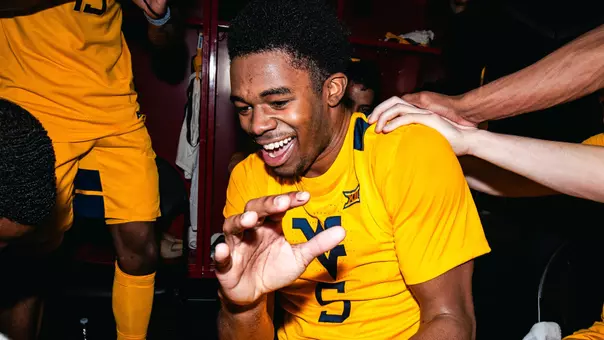
Photo by: All Pro Photography/Dale Sparks
WVU Hoop Schedule Puts it in Great Shape Heading Into Big 12 Play
December 26, 2022 12:15 PM | Men's Basketball, Blog
MORGANTOWN, W.Va. – Scheduling is a tricky deal.
There is a fine line between putting together a great schedule that helps you at the end of the season and getting yourself buried, especially if you play in a Power 5 conference like the Big 12.
Through games as of Dec. 25, the Big 12 currently has all 10 of its men's basketball teams ranked in the top 60 in this week's NCAA NET Rankings.
For West Virginia, that means all 19 games left on its schedule are going to be played against top 60 teams - as of today.
That means two games against No. 5 Kansas, two games against No. 9 Texas, two games against No. 19 Baylor, two games against No. 32 Iowa State, two games against No. 33 Kansas State, two games against No. 46 Oklahoma State, two games against No. 47 Oklahoma, two games against No. 55 Texas Tech, two games against No. 60 TCU and a game against No. 28 Auburn in the Big 12 SEC-Challenge.
Therefore, based on the NCAA's Quadrant 1 criteria of home games against top 30 teams and road games versus to 75 teams, WVU could potentially have 13 of its 19 remaining games against Quadrant 1 competition.
Now, it likely won't end up that way because teams will beat each other in conference play and some of them will eventually fall below 75, but when Bob Huggins talks about facing one of the most difficult schedules in school history, he's not kidding.
The website SportsReference.com lists the average strength of schedules for each West Virginia men's basketball season dating back to 1950. The rating represents a denomination in points above or below average, with zero being average. Non-Division I games are excluded.
There have been six instances when West Virginia's schedule was rated a 10.0 or higher – all six occurring since 2011 when the Mountaineers were still playing in the Big East. According to this, West Virginia's 2010-11 schedule was considered the toughest in school history with an 11.03 rating.
Four of the six have come since West Virginia joined the Big 12, including last year's 10.74 strength of schedule rating, which represents the second-most difficult in school history. The weakest slate WVU has faced since joining the Big 12 was in 2013-14 (8.02) and that is still far beyond anything the Mountaineers ever faced when they played as Independents in the Atlantic 10 or in the Southern Conference.
In fact, during the so-called "Golden Era" of Mountaineer basketball in the 1950s and early 1960s, West Virginia consistently faced schedules that were considered below average, and in the case of 1954 (-7.90), 1952 (-7.40), 1951 (-7.11), 1953 (-5.81), 1956 (-5.67) and 1968 (-5.35), far below average.
In 1989, when West Virginia won 26 of 31 games and nearly upset Duke in the second round of the NCAA Tournament, the Mountaineers had a below average schedule rating of -0.86. In 1982, when West Virginia won 23 straight games and climbed to No. 6 in the polls, that was against a schedule rated West Virginia's 14th easiest since 1950 at -1.34.
You could go on and on cherry picking different successful seasons to prove a point, but the bottom line is schedules do matter. How you schedule can determine a lot of things, such as wins and losses with average teams to NCAA Tournament seedings with above average teams.
Nobody understands the numbers better than Huggins, who used to devour the Sagarin Ratings published in the USA Today when he coached at Akron.
His formula for success there was to identify the teams he thought he had the best chance to beat with the highest Sagarin Rating at the end of the year. Why go and hunt for one big win at a major school when you have an opportunity to get a bunch of solid victories against mid-level schools on more equal terms?
That was basically Huggins' rationale.
"I was smarter than the average bear because I knew we couldn't go beat some of those people, so why would we go get beat by those people when we could play somebody who was at least at our level or maybe a little better – somewhere between us and the big boys," he explained a few weeks ago. "If you go back and look at who I scheduled and people were like, 'Why would you play them?' Back then it was pretty much all the Sagarin. Well, I did everything I could do to continue to rise in the Sagarin ratings without getting our brains beat in."
During the five seasons he coached at Akron, he played at Ohio State during the 1986 season, at Pitt in 1987 and 1988, and at NC State and against Kansas State in 1989. That's it. The rest were against teams he had a reasonable chance of beating.
When he got to a Cincinnati, where things were more equal, he began to play much harder schedules. That trend has continued at West Virginia.
With one nonconference game remaining against No. 28 Auburn, West Virginia has already put itself in great position with the teams it has faced through Dec. 23. Yes, even the Mountaineers' lackluster performance against Stony Brook last Thursday night didn't harm them too much in the NET.
West Virginia's NET ranking dropped to just 11th, meaning the Mountaineers are in great shape if they can take care of business in conference play. If you look at what West Virginia has played so far this year, there is a lot of very good and good, and not a lot of bad and very bad.
This was by design.
"That was the plan going in," Huggins explained. "A lot of times it doesn't work out that way. We knew we were going to play people in the PK85, so you've kind of got that in the bag and then you try and schedule non-conference, but it's hard. It's become harder and harder with the advent of all those (preseason tournaments). It used to be you had a couple of these tournaments and now they're everywhere.
"Your schedule is a lot harder to make because of all of the opportunities that people have to go and play places," he added.
The bottom line with scheduling is you've got to strike a balance between playing a slate that appeals to the numbers and metrics, but also gives you a chance for success.
"Where we are at the Power 5 level, we're not going to run from anybody … and I think that's how most Power 5 people look at things, but when you are that notch below you've got to be careful. You can beat yourself to death," Huggins concluded.
There is a fine line between putting together a great schedule that helps you at the end of the season and getting yourself buried, especially if you play in a Power 5 conference like the Big 12.
Through games as of Dec. 25, the Big 12 currently has all 10 of its men's basketball teams ranked in the top 60 in this week's NCAA NET Rankings.
For West Virginia, that means all 19 games left on its schedule are going to be played against top 60 teams - as of today.
That means two games against No. 5 Kansas, two games against No. 9 Texas, two games against No. 19 Baylor, two games against No. 32 Iowa State, two games against No. 33 Kansas State, two games against No. 46 Oklahoma State, two games against No. 47 Oklahoma, two games against No. 55 Texas Tech, two games against No. 60 TCU and a game against No. 28 Auburn in the Big 12 SEC-Challenge.
Therefore, based on the NCAA's Quadrant 1 criteria of home games against top 30 teams and road games versus to 75 teams, WVU could potentially have 13 of its 19 remaining games against Quadrant 1 competition.
Now, it likely won't end up that way because teams will beat each other in conference play and some of them will eventually fall below 75, but when Bob Huggins talks about facing one of the most difficult schedules in school history, he's not kidding.
The website SportsReference.com lists the average strength of schedules for each West Virginia men's basketball season dating back to 1950. The rating represents a denomination in points above or below average, with zero being average. Non-Division I games are excluded.
There have been six instances when West Virginia's schedule was rated a 10.0 or higher – all six occurring since 2011 when the Mountaineers were still playing in the Big East. According to this, West Virginia's 2010-11 schedule was considered the toughest in school history with an 11.03 rating.
Four of the six have come since West Virginia joined the Big 12, including last year's 10.74 strength of schedule rating, which represents the second-most difficult in school history. The weakest slate WVU has faced since joining the Big 12 was in 2013-14 (8.02) and that is still far beyond anything the Mountaineers ever faced when they played as Independents in the Atlantic 10 or in the Southern Conference.
In fact, during the so-called "Golden Era" of Mountaineer basketball in the 1950s and early 1960s, West Virginia consistently faced schedules that were considered below average, and in the case of 1954 (-7.90), 1952 (-7.40), 1951 (-7.11), 1953 (-5.81), 1956 (-5.67) and 1968 (-5.35), far below average.
In 1989, when West Virginia won 26 of 31 games and nearly upset Duke in the second round of the NCAA Tournament, the Mountaineers had a below average schedule rating of -0.86. In 1982, when West Virginia won 23 straight games and climbed to No. 6 in the polls, that was against a schedule rated West Virginia's 14th easiest since 1950 at -1.34.
You could go on and on cherry picking different successful seasons to prove a point, but the bottom line is schedules do matter. How you schedule can determine a lot of things, such as wins and losses with average teams to NCAA Tournament seedings with above average teams.
Nobody understands the numbers better than Huggins, who used to devour the Sagarin Ratings published in the USA Today when he coached at Akron.
His formula for success there was to identify the teams he thought he had the best chance to beat with the highest Sagarin Rating at the end of the year. Why go and hunt for one big win at a major school when you have an opportunity to get a bunch of solid victories against mid-level schools on more equal terms?
That was basically Huggins' rationale.
"I was smarter than the average bear because I knew we couldn't go beat some of those people, so why would we go get beat by those people when we could play somebody who was at least at our level or maybe a little better – somewhere between us and the big boys," he explained a few weeks ago. "If you go back and look at who I scheduled and people were like, 'Why would you play them?' Back then it was pretty much all the Sagarin. Well, I did everything I could do to continue to rise in the Sagarin ratings without getting our brains beat in."
During the five seasons he coached at Akron, he played at Ohio State during the 1986 season, at Pitt in 1987 and 1988, and at NC State and against Kansas State in 1989. That's it. The rest were against teams he had a reasonable chance of beating.
When he got to a Cincinnati, where things were more equal, he began to play much harder schedules. That trend has continued at West Virginia.
With one nonconference game remaining against No. 28 Auburn, West Virginia has already put itself in great position with the teams it has faced through Dec. 23. Yes, even the Mountaineers' lackluster performance against Stony Brook last Thursday night didn't harm them too much in the NET.
West Virginia's NET ranking dropped to just 11th, meaning the Mountaineers are in great shape if they can take care of business in conference play. If you look at what West Virginia has played so far this year, there is a lot of very good and good, and not a lot of bad and very bad.
This was by design.
"That was the plan going in," Huggins explained. "A lot of times it doesn't work out that way. We knew we were going to play people in the PK85, so you've kind of got that in the bag and then you try and schedule non-conference, but it's hard. It's become harder and harder with the advent of all those (preseason tournaments). It used to be you had a couple of these tournaments and now they're everywhere.
"Your schedule is a lot harder to make because of all of the opportunities that people have to go and play places," he added.
The bottom line with scheduling is you've got to strike a balance between playing a slate that appeals to the numbers and metrics, but also gives you a chance for success.
"Where we are at the Power 5 level, we're not going to run from anybody … and I think that's how most Power 5 people look at things, but when you are that notch below you've got to be careful. You can beat yourself to death," Huggins concluded.



SWIM: Paper Airplane Competition
Wednesday, February 11
WRES: 2026 Senior Recognition Ceremony
Tuesday, February 10
Reese Bassinger | Feb. 9
Monday, February 09
Steve Sabins | Feb. 9
Monday, February 09