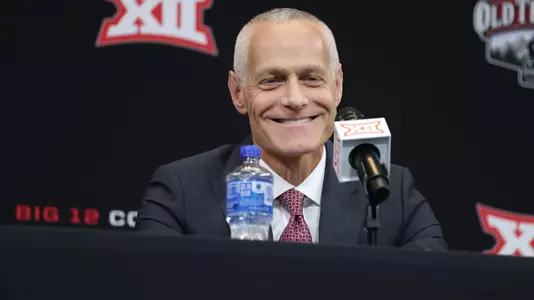
Photo by: Liz Parke
October 31, 2022 11:45 AM | Football, Men's Basketball, Blog
MORGANTOWN, W.Va. – New Big 12 commissioner Brett Yormark is now 1-0 in negotiating media rights deals.
According to Sports Business Journal's Michael Smith and John Ourand, the conference yesterday came to terms with ESPN and FOX on a new, six-year media rights deal valued at nearly $2.3 billion, with an annual average of $380 million.
The conference has two years left on its current agreement, which includes Texas and Oklahoma, at an annual average of $220 million over its final two years. The extension begins in 2025-26 and runs through 2030-31.
When adding NCAA men's basketball tournament and expected additional College Football Playoff revenue from an expanded field, individual league members could boost their potential yearly revenue from approximately $42 million this past year to more than $50 million per school when the new deal begins.
This is considerably more than what current schools were anticipating a year ago after Texas and Oklahoma announced they were making the jump to the SEC following the 2024-25 season. Former Big 12 commissioner Bob Bowlsby told Texas lawmakers last year that the Big 12 was in danger of losing as much as 50% of its media rights revenue with Texas and Oklahoma departing the conference.
So, from that perspective, the Big 12's new media rights agreement is a major victory for a league that was dealing with what industry experts considered to be a destabilizing blow with the imminent departures of its two bell-cow schools.
Next year, the Big 12 will be adding BYU, Houston, Central Florida and Cincinnati, which gives the conference three of the four major time zones with Yormark indicating his willingness to expand to the West Coast time zone if expansion candidates are, in his words, "additive."
According to The Athletic and Sports Illustrated, the new media rights agreement is expected to include a pro rata clause, which would increase the revenue payout for any additional schools.
Yormark chose to convince the networks to begin negotiating an extension two years early when the Pac-12 was unable to get a favorable deal earlier this fall and opted to take its media rights inventory to the open market.
The Pac-12, which will be losing USC and UCLA to the Big Ten Conference, is hopeful of getting a more lucrative deal by including non-linear entities such as Amazon and Apple into the equation. That's risky considering Amazon has just gotten into live sports programming with its weekly Thursday night NFL coverage.
ESPN's interest in the Pac-12 will now be closely watched, according to ESPN.com college football reporter Pete Thamel.
Yormark has indicated he's also interested in the Big 12 pursuing additional revenue opportunities through what he calls "tentpole" events outside of the Big 12 Football Championship Game and the men's basketball tournament in Kansas City. What those standalone "tentpole" events are remain unknown.
From an individual school perspective, the biggest benefit is an increase in yearly revenue, even with the additional four schools sharing the pie. This solidifies the Big 12's immediate future, and by choosing a six-year deal instead of a longer agreement, the conference's media rights will go back to market before the current SEC and ACC deals expire.
If Yormark can continue his goal of growing the Big 12's national brand, he's hopeful that will bode well for the league when it resumes negotiations in 2031.
Another benefit is the Big 12 maintaining a major presence with traditional linear broadcasters. Industry experts believe that is the safer play than potentially loading up on unproven streaming services. Would Amazon, Apple or other streaming services throw a bunch of money at the Big 12 for its live events?
Possibly.
But on a personal basis, the Thursday night football game on Amazon is not really compelling enough for me to purchase an Amazon subscription. Will sports fans continue to pay multiple subscription fees to watch live sporting events on different platforms? That remains to be seen, especially in today's uncertain economy.
Also, Amazon, Apple and other potential streaming services cannot promote the Big 12 the way industry leaders ESPN and FOX can, which would make a move away from them to other platforms even riskier.
One other factor that played a role in the current Big 12 media rights deal is the success men's basketball has enjoyed over the last four or five years as the nation's No. 1-ranked conference. The Big 12 has produced two national champions the last three years in Baylor and Kansas, a runner-up in Texas Tech in 2019, and the league wisely touted that success, especially with FOX, which is eager to increase its men's basketball presence.
Therefore, the net of this is positive news for the remaining Big 12 schools and for Yormark, whose goal when he took over in August was to calm the waters by negotiating a new media rights deal.
Now, all eyes turn west to see what happens with the Pac-12.
Wednesday, October 21
Wednesday, October 21
Wednesday, October 21
Tuesday, October 20