Photo by: All Pro Photography/Dale Sparks
Deep and Talented Mountaineer Baseball Team Readies For Stacked Year of College Baseball
February 11, 2021 12:27 PM | Baseball, Blog
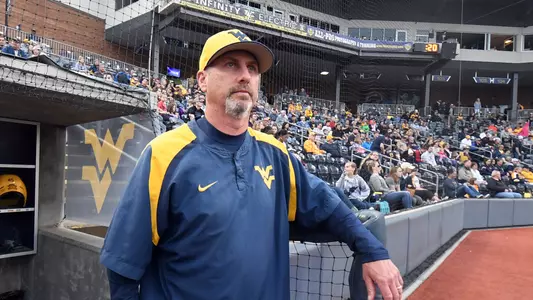
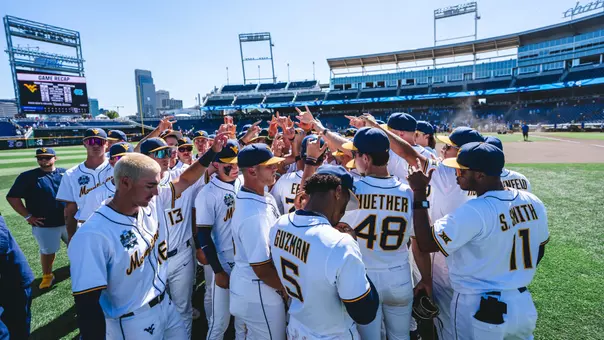
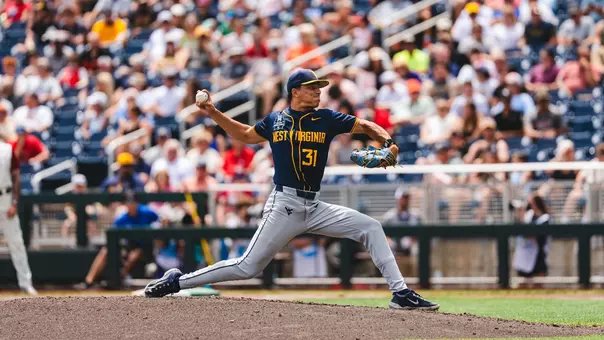
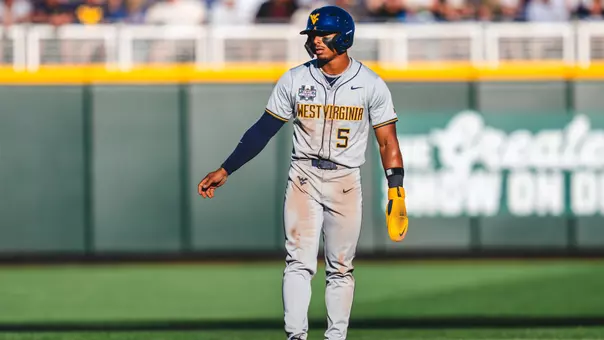
MORGANTOWN, W.Va. – How can a team ranked in all of this year's preseason polls, including 14th in one, only get enough votes to place sixth in its own preseason conference poll?
That was a question posed to West Virginia's Randy Mazey last week about his Mountaineers, recently slotted sixth in the Big 12 Conference's polling of its baseball coaches.
"That's probably about right," he said. "The sixth place team in our league should be in the top 20 this year."
Mazey knows he's got a talented team returning at West Virginia – perhaps the deepest and most talented in school history – but he also sees what everybody else has returning, not just in the Big 12, but across the board nationally.
Last year, COVID-19 not only ended the college baseball season prematurely, but it basically put the sport in suspended animation. Players competing last season were permitted to have an extra year of eligibility in 2021, and most of them are taking advantage of it because Major League Baseball didn't scoop them up as it has done in years past.
Last year's draft consisted of just five rounds, meaning hundreds of players normally cycling on to professional baseball have remained in college.
Consequently, Mazey believes this could potentially be the deepest and most talented season in the history of college baseball.
"There is no doubt this year, the quality of baseball is going to be better, even from the mid-major teams that still hung on to a guy that might have been a 22nd-round draft pick in the past," the veteran coach explained. "Maybe a really good senior pitcher that didn't get drafted or didn't sign as a free agent, now he's back.
"I feel the level of baseball in general is going to be a lot better," he added.
 Aaron Fitt, co-editor and national writer for D1Baseball.com, agrees.
"In the short term, this is an incredible year for college baseball just because of the sheer amount of talent," he said. "I don't think we've ever seen this much talent in the game because with just a five-round draft (last summer), just about everyone drafted in rounds six through 10 almost always signs. And there are always guys in the 10- to 20-round range who sign for sometimes a decent bonus and sometimes less than a decent bonus just to get the opportunity to play (professional baseball).
"Well, this year with getting an extra year of eligibility, a lot of those guys found that it's more beneficial to come back to school, even kind of the fringe guys," Fitt added.
Fitt believes the overall depth, even down to the mid-major conferences, is off-the-charts good this year – not just from returning college players but also top-end high school players going to college this year instead of signing professional contracts with some of the weaker professional baseball organizations who cannot afford to sign high-priced free agents.
This is creating unprecedented depth.
"I think there are more high-end high school players showing up as freshmen this year," Fitt said, pointing to West Virginia's Tyler Chadwick, a 6-foot-5, hard-throwing righthander from Marshall, Wisconsin. "Had the season played out in the springtime and he got more exposure with scouts, he might have been a top two- or three-round guy, in which case there is no way he gets to West Virginia. But instead, here he is and he has a chance to be a first rounder in three years."
Fitt said there are many other examples just like that at other schools.
Within the Big 12, Fitt admitted he had a difficult time arranging the order of the teams this year because all nine of them look good on paper.
"I'm trying to figure out who in that league is going to miss regionals because they all can't go to regionals," he said. "We had to pick somebody to finish last and we picked Kansas – but I like Kansas. When you look at them on paper they look pretty good.
"TCU has got a whole bunch of fifth- and sixth-year guys, and they're good players," he continued. "They maybe are not all elite talents, but experience matters, especially in baseball."
Years ago, when I was involved with college baseball in the 1990s, a popular thing to do at the time was to compare the top-end college baseball teams to lower-level professional baseball. The consensus back then was it wasn't comparable because even the best college programs in the country still had a significant number of fringe players.
Not today.
The power conferences, such as the Big 12, have rosters comparable to lower-level professional baseball, perhaps even a little bit higher now.
"I think at this point the major conferences – the SEC, Big 12, ACC and Pac 12 – those are probably high-A at this stage given how much college baseball programs have invested in infrastructure," Fitt said. "You look at all of the beautiful ballparks. It seems like every year we see a new $50 or $60 million baseball stadium opening. This year, we've got two of them at Florida and Oklahoma State."
Look what happened to West Virginia University once it opened Monongalia County Ballpark in 2015. Six years later, the Mountaineers are in the preseason polls for the first time in the history of the program.
Fitt remembers the pre-Monongalia County Ballpark, pre-Randy Mazey years of West Virginia baseball.
"I can think back to when I started at Baseball America in 2004 and West Virginia was a total non-factor," he recalled. "Even the Jedd Gyorko years – he was a great college player – and they still couldn't sniff a regional. They had a lot of things working against them, obviously facilities, the weather and the conference affiliation at the time.
"I thought when West Virginia moved into the Big 12 they were going to be in big trouble. Why would you think they would move to one of the best leagues in the country and be competitive, given the history of the program and the weather realities?" he continued. "To me, it's incredible what they've built there just from a program standpoint. I thought they were going to be the perennial last-place team in that league when they joined, so it's awesome to see what Randy has done with the culture around their program."
Fitt recalled being blown away with the fan support he witnessed while covering West Virginia in the Wake Forest regional in 2017 – West Virginia's first NCAA Tournament appearance in 21 years.
"They had more fans there than Wake Forest did, and they were loud and into it," he recalled. "Then, of course, the atmosphere they had when they actually got to host a regional in 2019. Watching that on TV I was like, 'wow.'"
The growth, development and interest in college baseball at WVU sort of mirrors the sport in general. There are better players in the game today and the overall coaching and player development is much improved because schools are investing more into hiring top-notch coaches.
Fitt sees one other factor that bodes well for college baseball in the future – Major League Baseball.
The pandemic has caused Major League Baseball to take a hard look at its business model and the old way of doing things may become a relic of the past. The time could be near when Major League Baseball turns to college baseball as its feeder system, much like college football is to the NFL or college basketball is to the NBA.
It costs lots of money for player development, and it seems most professional baseball organizations would rather invest it in the players capable of playing in the Major Leagues.
"You see the commissioner of Major League Baseball (Rob Manfred) come out and say publicly he thinks college is a logical first step for those players, and he's kind of embraced using college as a true feeder system," Fitt said.
"Now that doesn't mean the cream-of-the-crop guys signing out of high school, that will continue to happen, but it's becoming fewer and fewer," Fitt added.
Fitt can envision the professional draft being eventually pared to just 20 or 15 rounds, meaning hundreds of players normally going to the minors will continue their baseball careers in college first.
"Last year kind of changed everything for college baseball and for minor league baseball, really," he noted. "There is no doubt Major League Baseball has wanted for some years to overhaul the system, and they had been telegraphing for a while that they were planning to cut the number of affiliates they had, and by extension, the draft.
"You just don't need as many players in pro ball if you have two fewer levels," Fitt explained. "They used the pandemic as kind of a fig leaf to make that change."
Mazey, for one, welcomes it. He believes one more change needs to be made to make college baseball a profitable entity – pushing the season back.
He believes there is real revenue potential to be realized if college baseball could be played in the warm summer months of June and July. Even pushing the start of the season back a couple of weeks and playing the conference tournaments in late June and the College World Series in mid-July would have a significant impact.
"Before the COVID stuff hit, the coaches were finally on board with pushing the season back," Mazey said. "Nationwide, I think some of the coaches and ADs were getting on board. I think eventually it's going to happen; I just hope it's going to happen in my lifetime."
There has been one benefit to the pandemic as a result of the industry-wide crisis it has created in college sports – decision makers are finally beginning to rethink the way they are doing business. Perhaps some good can come out of this when things return to normal.
Mazey used an example of a video he found on YouTube that he sent to some of the baseball coaches that he believed were most resistant to change. It was a Today Show discussion in 1980 about a cloud of information stored for everybody to use called the Internet.
"If you are going to progress you've got to change," he explained. "Our sport has basically been the same for the last 125 years."
Mazey's West Virginia baseball program is a prime example of the positive things that can happen when some key people are willing to embrace change.
That was a question posed to West Virginia's Randy Mazey last week about his Mountaineers, recently slotted sixth in the Big 12 Conference's polling of its baseball coaches.
"That's probably about right," he said. "The sixth place team in our league should be in the top 20 this year."
Mazey knows he's got a talented team returning at West Virginia – perhaps the deepest and most talented in school history – but he also sees what everybody else has returning, not just in the Big 12, but across the board nationally.
Last year, COVID-19 not only ended the college baseball season prematurely, but it basically put the sport in suspended animation. Players competing last season were permitted to have an extra year of eligibility in 2021, and most of them are taking advantage of it because Major League Baseball didn't scoop them up as it has done in years past.
Last year's draft consisted of just five rounds, meaning hundreds of players normally cycling on to professional baseball have remained in college.
Consequently, Mazey believes this could potentially be the deepest and most talented season in the history of college baseball.
"There is no doubt this year, the quality of baseball is going to be better, even from the mid-major teams that still hung on to a guy that might have been a 22nd-round draft pick in the past," the veteran coach explained. "Maybe a really good senior pitcher that didn't get drafted or didn't sign as a free agent, now he's back.
"I feel the level of baseball in general is going to be a lot better," he added.
Aaron Fitt, co-editor and national writer for D1Baseball.com, agrees."In the short term, this is an incredible year for college baseball just because of the sheer amount of talent," he said. "I don't think we've ever seen this much talent in the game because with just a five-round draft (last summer), just about everyone drafted in rounds six through 10 almost always signs. And there are always guys in the 10- to 20-round range who sign for sometimes a decent bonus and sometimes less than a decent bonus just to get the opportunity to play (professional baseball).
"Well, this year with getting an extra year of eligibility, a lot of those guys found that it's more beneficial to come back to school, even kind of the fringe guys," Fitt added.
Fitt believes the overall depth, even down to the mid-major conferences, is off-the-charts good this year – not just from returning college players but also top-end high school players going to college this year instead of signing professional contracts with some of the weaker professional baseball organizations who cannot afford to sign high-priced free agents.
This is creating unprecedented depth.
"I think there are more high-end high school players showing up as freshmen this year," Fitt said, pointing to West Virginia's Tyler Chadwick, a 6-foot-5, hard-throwing righthander from Marshall, Wisconsin. "Had the season played out in the springtime and he got more exposure with scouts, he might have been a top two- or three-round guy, in which case there is no way he gets to West Virginia. But instead, here he is and he has a chance to be a first rounder in three years."
Fitt said there are many other examples just like that at other schools.
Within the Big 12, Fitt admitted he had a difficult time arranging the order of the teams this year because all nine of them look good on paper.
"I'm trying to figure out who in that league is going to miss regionals because they all can't go to regionals," he said. "We had to pick somebody to finish last and we picked Kansas – but I like Kansas. When you look at them on paper they look pretty good.
"TCU has got a whole bunch of fifth- and sixth-year guys, and they're good players," he continued. "They maybe are not all elite talents, but experience matters, especially in baseball."
Years ago, when I was involved with college baseball in the 1990s, a popular thing to do at the time was to compare the top-end college baseball teams to lower-level professional baseball. The consensus back then was it wasn't comparable because even the best college programs in the country still had a significant number of fringe players.
Not today.
The power conferences, such as the Big 12, have rosters comparable to lower-level professional baseball, perhaps even a little bit higher now.
"I think at this point the major conferences – the SEC, Big 12, ACC and Pac 12 – those are probably high-A at this stage given how much college baseball programs have invested in infrastructure," Fitt said. "You look at all of the beautiful ballparks. It seems like every year we see a new $50 or $60 million baseball stadium opening. This year, we've got two of them at Florida and Oklahoma State."
Look what happened to West Virginia University once it opened Monongalia County Ballpark in 2015. Six years later, the Mountaineers are in the preseason polls for the first time in the history of the program.
Fitt remembers the pre-Monongalia County Ballpark, pre-Randy Mazey years of West Virginia baseball.
"I can think back to when I started at Baseball America in 2004 and West Virginia was a total non-factor," he recalled. "Even the Jedd Gyorko years – he was a great college player – and they still couldn't sniff a regional. They had a lot of things working against them, obviously facilities, the weather and the conference affiliation at the time.
"I thought when West Virginia moved into the Big 12 they were going to be in big trouble. Why would you think they would move to one of the best leagues in the country and be competitive, given the history of the program and the weather realities?" he continued. "To me, it's incredible what they've built there just from a program standpoint. I thought they were going to be the perennial last-place team in that league when they joined, so it's awesome to see what Randy has done with the culture around their program."
Fitt recalled being blown away with the fan support he witnessed while covering West Virginia in the Wake Forest regional in 2017 – West Virginia's first NCAA Tournament appearance in 21 years.
"They had more fans there than Wake Forest did, and they were loud and into it," he recalled. "Then, of course, the atmosphere they had when they actually got to host a regional in 2019. Watching that on TV I was like, 'wow.'"
The growth, development and interest in college baseball at WVU sort of mirrors the sport in general. There are better players in the game today and the overall coaching and player development is much improved because schools are investing more into hiring top-notch coaches.
Fitt sees one other factor that bodes well for college baseball in the future – Major League Baseball.
The pandemic has caused Major League Baseball to take a hard look at its business model and the old way of doing things may become a relic of the past. The time could be near when Major League Baseball turns to college baseball as its feeder system, much like college football is to the NFL or college basketball is to the NBA.
It costs lots of money for player development, and it seems most professional baseball organizations would rather invest it in the players capable of playing in the Major Leagues.
"You see the commissioner of Major League Baseball (Rob Manfred) come out and say publicly he thinks college is a logical first step for those players, and he's kind of embraced using college as a true feeder system," Fitt said.
"Now that doesn't mean the cream-of-the-crop guys signing out of high school, that will continue to happen, but it's becoming fewer and fewer," Fitt added.
Fitt can envision the professional draft being eventually pared to just 20 or 15 rounds, meaning hundreds of players normally going to the minors will continue their baseball careers in college first.
"Last year kind of changed everything for college baseball and for minor league baseball, really," he noted. "There is no doubt Major League Baseball has wanted for some years to overhaul the system, and they had been telegraphing for a while that they were planning to cut the number of affiliates they had, and by extension, the draft.
"You just don't need as many players in pro ball if you have two fewer levels," Fitt explained. "They used the pandemic as kind of a fig leaf to make that change."
Mazey, for one, welcomes it. He believes one more change needs to be made to make college baseball a profitable entity – pushing the season back.
He believes there is real revenue potential to be realized if college baseball could be played in the warm summer months of June and July. Even pushing the start of the season back a couple of weeks and playing the conference tournaments in late June and the College World Series in mid-July would have a significant impact.
"Before the COVID stuff hit, the coaches were finally on board with pushing the season back," Mazey said. "Nationwide, I think some of the coaches and ADs were getting on board. I think eventually it's going to happen; I just hope it's going to happen in my lifetime."
There has been one benefit to the pandemic as a result of the industry-wide crisis it has created in college sports – decision makers are finally beginning to rethink the way they are doing business. Perhaps some good can come out of this when things return to normal.
Mazey used an example of a video he found on YouTube that he sent to some of the baseball coaches that he believed were most resistant to change. It was a Today Show discussion in 1980 about a cloud of information stored for everybody to use called the Internet.
"If you are going to progress you've got to change," he explained. "Our sport has basically been the same for the last 125 years."
Mazey's West Virginia baseball program is a prime example of the positive things that can happen when some key people are willing to embrace change.
Players Mentioned

RHP
/ BaseballWRES: Brody Conley
Friday, June 19
WRES: Brody Conley
Friday, June 19
Steve Sabins, Armani Guzman, Maxx Yehl | College World Series | June 14
Wednesday, June 17
Steve Sabins, Gavin Kelly, Dawson Montesa, Reese Bassinger | College World Series | June 16
Wednesday, June 17