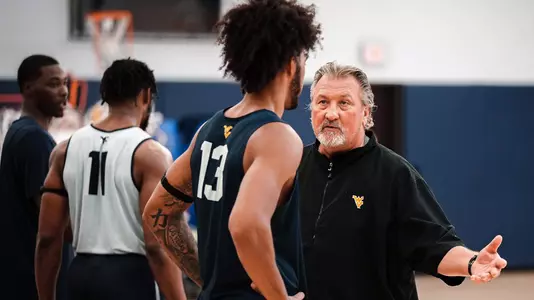
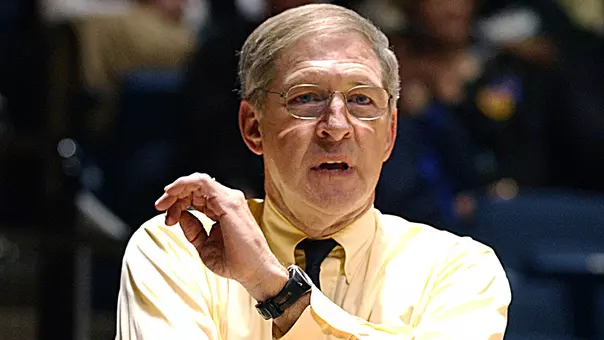
Photo by: WVU Athletic Communications
October 15, 2021 11:44 AM | Men's Basketball, Blog
MORGANTOWN, W.Va. – Bob Huggins' teams have consistently won basketball games because they could stop other teams when they had to.
Only once during his long run of success at Cincinnati did a Bearcat team give up more than 70 points per game. That was in 1995 when UC finished third in the Great Midwest Conference, rallied to win the conference tournament and then bowed out in the second round of the NCAA Tournament with a 22-12 record.
However, two of Huggins' last three West Virginia teams have surrendered more than 70 points per game, including last year's squad that managed to win 19 games and advance to the NCAA Tournament second round despite allowing 72 points per game.
Two years prior, the 2019 team was one of Huggins' poorest, winning just 15 of 36 games while allowing 77.4 points per contest – the most points any Bob Huggins-coached team has ever given up. Even the 2013 team that won only 13 of 32 games held its opponents to an average of 68.1 points per game.
It's clear defense has always been Huggins' formula for success, and the veteran coach admitted Thursday his 2022 squad still has a ways to go in that department.
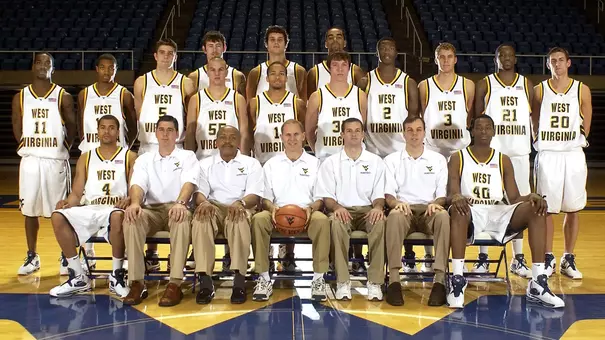
"We don't guard very well right now," he said. "We are putting a lot of time in to guard the ball and guarding without fouling, and we don't make rotations the way we need to. If we could get to the point where we made rotations the way we did when we had Da'Sean (Butler) and those guys we'd be really good. But we're not there; we still have a tendency to stand and watch."
On the flip side, this could be one of the more talented offensive teams Huggins has put on the floor. Depending upon whom he has out there, Huggins could have shot makers at all five positions when Isaiah Cottrell plays center.
This has led him to consider more four- and five-out offensive sets this year to spread the floor and create more space.
"We've got guys that can make shots," he said. "I think they will stretch defenses if they continue to shoot it the way they are shooting it now, Sean (McNeil) and Taz (Sherman) in particular. (Jalen Bridges) has shot it really well so that's three guys on the perimeter.
"I think we can put five guys out there who can all make shots if we play Isaiah and J.B. up front," Huggins added. "When I went back and looked at our last five games last year, J.B. ended up playing a lot of four anyway, and he's a lot bigger and stronger than he was a year ago."
McNeil, who toyed with the idea of leaving school a year early to enter the NBA Draft, said the players on the team this year are more suited for this style of play.
"We're not as big," he explained. "Clearly, we don't have a guy like Derek (Culver) inside. I know Huggs has said that a couple of times already, but we're guard-heavy, which I think can be good. We've got a different play style. We've got a lot of guys that can go in and out, and I think people like watching an up-and-down, quicker-paced game."
Sherman agrees.
"You can't leave us, not only just us two," he said. "We have other people who are just as capable of shooting, and I feel like they are going to show that this year."
But, can West Virginia consistently win basketball games by simply outscoring other teams?
Going back to 1950, the Mountaineers' historical results say no. Using 70 points per game as a benchmark, West Virginia's most successful teams were the ones capable of getting stops when they needed to. That was the case in 1952 when the Mountaineers won 23 of 27 games while holding their opponents to an average of 63.6 points per game.
That was also the case in 1958 when West Virginia rose to No. 1 in the polls by limiting its opponents to just 68.5 points per game, while averaging 86.9.
It was the same for Gale Catlett's three best teams in 1982, 1989 and 1998. All three were capable of scoring but were also formidable enough on defense to keep their opponents below an average of 70 points per game.
Similar to Huggins' best teams, all five John Beilein-coached WVU squads held the other guys to less than 70 points per game, including his two best in 2005 and 2006.
There was only a brief stretch from 1959 until 1963 when West Virginia had enough offensive firepower with All-Americans Jerry West and Rod Thorn to simply outgun the opposition.
During Thorn's sophomore season in 1961, West Virginia gave up an average of 77.8 points per game yet still won 23 of 27 before getting upset in the Southern Conference Tournament. That was the only season during a nine-year period the Mountaineers didn't make the dance.
So it is possible to be successful by simply outscoring the other team, but it's not something on which Hall of Fame-caliber coaches are willing to hang their hats.
"I hate to count on that, especially in this league," Huggins explained. "This is a really athletic league, and they guard pretty good in this league. Texas had us down 20-some and we came back and won. (Texas) Tech had us down pretty good and we came back and won, but you'd hate to try and just outscore people.
"To be a really good defensive team you have to be reactive, but we're still standing and looking where the ball is going instead of reacting to the rotation that we need to make," he pointed out.
It's becoming clear from those to whom you listen that this team has the potential to score lots of points, but Huggins admits there are more unknowns than knowns right now.
"We don't have veteran guys that played a lot of minutes coming back," he said. "I think it's fair to say right now they make up for bad defense because they shoot the ball so well."
But is that a recipe for sustained success?
"Huggs' best teams could always get stops. That's what made them good teams," assistant coach Erik Martin concluded.
You can get your first glimpse of this year's squad tonight at 7 p.m. for the annual Gold-Blue Debut, presented by New Coke Zero. Admission is free and gates open at 6 p.m.
Season tickets are on sale at the Mountaineer Ticket Office in the Coliseum. To order, visit WVUGAME.com or call 1-800-WVU GAME.
Players Mentioned

F
/ Men's Basketball
F
/ Men's BasketballThursday, November 05
Thursday, November 05
Thursday, November 05
Thursday, November 05