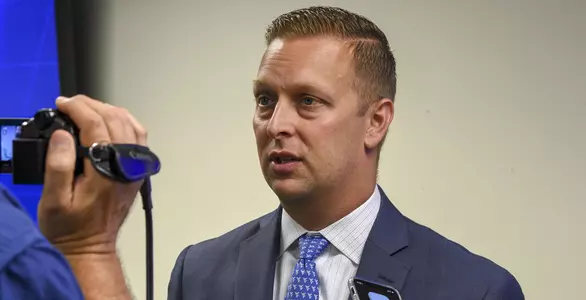
Photo by: All Pro Photography/Dale Sparks
Murray and The Mountaineer Athletic Club Begin the Climb
August 09, 2018 09:26 AM | General
MORGANTOWN, W.Va. - Last Thursday, Director of Athletics Shane Lyons unveiled West Virginia University's ambitious, five-year facility master plan dubbed "Climbing Higher."
The man in charge of leading that climb is Senior Associate Athletic Director Ben Murray, who oversees the Mountaineer Athletic Club as its executive director. Murray has been involved with WVU athletics since 2010 following stints at Old Dominion, UNLV and James Madison.
Murray and his staff of 10 are the ones responsible for raising the $100 million needed to get construction workers on campus and cranes in the air.
"Our staff works well together as a team, and we feel very good about the relationships we've built inside and outside the state. We feel positive about the impact we'll have and the legacy that our donors will leave with the student athletes," Murray said following last Thursday's announcement.
West Virginians have always been generous with what they have, but there is nobody out there like Bill Gates or Amon G. Carter to write one check for the entire campaign.
Therefore, it's going to have to be a collaborative effort to get this done, which Murray admits is really exciting.
"The good thing about Mountaineer Nation is they always push to the limit to give what they can, and we're going to continue to ask them to do that," Murray said. "We don't have that mega booster out there who can just write the check for everything, but that makes this exciting. It's going to be a collaborative effort by a large amount of people, and that's what it's going to take to be successful with this campaign."
More involvement means more Mountaineer fans will have a vested interest in the things being built.
Unlike some past athletic capital fundraising initiatives, this one is well detailed with interactive graphics, conceptual renderings and images Murray and his staff can show potential donors.
According to Murray, having a picture or a video to put in front of a prospective donor is often far more powerful that trying to simply convey an abstract idea.
"Images create excitement," he said. "I can't fully explain the concept to somebody by just talking about it; but pictures and images can express our vision with this campaign. These are all conceptual and things may change during the process, but images and renderings get people excited."
Another thing that gets donors excited is the enthusiastic involvement of the coaches. Murray said two of the biggest fundraisers in the department are coaches Bob Huggins and Dana Holgorsen.
"Our coaches are crucial," he noted. "They're the ones people want to talk with. When I walk in the door it doesn't get everyone excited, but if Bob Huggins or Dana Holgorsen walks through the door people get excited to talk with them about the projects and the affect it will have on their student-athletes."
Murray was part of the senior administrative group Lyons appointed to oversee the planning process for the capital initiative unveiled last Thursday. The entire process took about 18 months and many alternatives were considered.
Murray said that process was also a collaborative effort.
"Everyone put their two cents in," he said. "We were shown many different options and some of them cost more money than we felt comfortable in trying to fund. We focused on our needs – what we need to do to continue to show success and build on the success that we've had."
Because West Virginia is in the Big 12 Conference competing against the likes of Texas and Oklahoma with far greater resources, the Mountaineers are always going to be chasing a moving target.
The other nine schools are much farther along in their capital campaigns because of their long-term association in one of the most lucrative athletic conferences in the country and their location in states with many more Fortune 500 companies.
Even TCU, which joined the Big 12 the same year as West Virginia, was much deeper into its capital projects because of its location in the prosperous Dallas-Fort Worth area. The Horned Frogs last year announced another $100 million in upgrades to Amon G. Carter Stadium just five years after completing a major $164 million renovation to the facility.
Across campus at basketball's Schollmaier Arena, TCU recently finished a $72 million overhaul to that facility.
Murray readily admits that he will borrow good ideas from other conference schools to help with this campaign.
"The great thing about fundraising is we can borrow ideas or we can adjust and use some ideas they may have because we are not competing against each other for prospects or donors," Murray pointed out. "Our staff has experience at other schools, and we try and bring ideas from those places and incorporate that into West Virginia as seen fit.
"However, we're a unique situation in a unique place, and we want to create our ideas and build our own strategies around that," he added.
Murray emphasizes once again what is currently being undertaken is vital for West Virginia University to remain competitive with its peers in the Big 12.
"In all the facilities … these are not wants, they're needs. We really need to fund our Olympic sports areas," he mentioned. "They've done a great job of winning and have had a winning tradition for many, many years, but their facilities have not been up to par with what we're competing against.
"We do have a lot of money coming in (from conference revenue sharing), but our expenses have also grown. If you look at our overall budget, the two areas that can always increase are fundraising and ticket sales. Those are the line items in our budget that can have the greatest impact on our overall success," he explained.
As is the nature with college athletics today, the next capital project is always right around the corner.
And as Lyons noted last Thursday, if you're not building then you're falling behind.
"There is never enough money, and there is always going to be a need or a project," Murray explained, "which is either good or bad job security for us. But we're excited about the opportunity and we're excited to talk to our supporters about it."
So, the climb begins.
The man in charge of leading that climb is Senior Associate Athletic Director Ben Murray, who oversees the Mountaineer Athletic Club as its executive director. Murray has been involved with WVU athletics since 2010 following stints at Old Dominion, UNLV and James Madison.
Murray and his staff of 10 are the ones responsible for raising the $100 million needed to get construction workers on campus and cranes in the air.
"Our staff works well together as a team, and we feel very good about the relationships we've built inside and outside the state. We feel positive about the impact we'll have and the legacy that our donors will leave with the student athletes," Murray said following last Thursday's announcement.
West Virginians have always been generous with what they have, but there is nobody out there like Bill Gates or Amon G. Carter to write one check for the entire campaign.
Therefore, it's going to have to be a collaborative effort to get this done, which Murray admits is really exciting.
"The good thing about Mountaineer Nation is they always push to the limit to give what they can, and we're going to continue to ask them to do that," Murray said. "We don't have that mega booster out there who can just write the check for everything, but that makes this exciting. It's going to be a collaborative effort by a large amount of people, and that's what it's going to take to be successful with this campaign."
More involvement means more Mountaineer fans will have a vested interest in the things being built.
Unlike some past athletic capital fundraising initiatives, this one is well detailed with interactive graphics, conceptual renderings and images Murray and his staff can show potential donors.
According to Murray, having a picture or a video to put in front of a prospective donor is often far more powerful that trying to simply convey an abstract idea.
"Images create excitement," he said. "I can't fully explain the concept to somebody by just talking about it; but pictures and images can express our vision with this campaign. These are all conceptual and things may change during the process, but images and renderings get people excited."
Another thing that gets donors excited is the enthusiastic involvement of the coaches. Murray said two of the biggest fundraisers in the department are coaches Bob Huggins and Dana Holgorsen.
"Our coaches are crucial," he noted. "They're the ones people want to talk with. When I walk in the door it doesn't get everyone excited, but if Bob Huggins or Dana Holgorsen walks through the door people get excited to talk with them about the projects and the affect it will have on their student-athletes."
Murray was part of the senior administrative group Lyons appointed to oversee the planning process for the capital initiative unveiled last Thursday. The entire process took about 18 months and many alternatives were considered.
Murray said that process was also a collaborative effort.
"Everyone put their two cents in," he said. "We were shown many different options and some of them cost more money than we felt comfortable in trying to fund. We focused on our needs – what we need to do to continue to show success and build on the success that we've had."
Because West Virginia is in the Big 12 Conference competing against the likes of Texas and Oklahoma with far greater resources, the Mountaineers are always going to be chasing a moving target.
The other nine schools are much farther along in their capital campaigns because of their long-term association in one of the most lucrative athletic conferences in the country and their location in states with many more Fortune 500 companies.
Even TCU, which joined the Big 12 the same year as West Virginia, was much deeper into its capital projects because of its location in the prosperous Dallas-Fort Worth area. The Horned Frogs last year announced another $100 million in upgrades to Amon G. Carter Stadium just five years after completing a major $164 million renovation to the facility.
Across campus at basketball's Schollmaier Arena, TCU recently finished a $72 million overhaul to that facility.
Murray readily admits that he will borrow good ideas from other conference schools to help with this campaign.
"The great thing about fundraising is we can borrow ideas or we can adjust and use some ideas they may have because we are not competing against each other for prospects or donors," Murray pointed out. "Our staff has experience at other schools, and we try and bring ideas from those places and incorporate that into West Virginia as seen fit.
"However, we're a unique situation in a unique place, and we want to create our ideas and build our own strategies around that," he added.
Murray emphasizes once again what is currently being undertaken is vital for West Virginia University to remain competitive with its peers in the Big 12.
"In all the facilities … these are not wants, they're needs. We really need to fund our Olympic sports areas," he mentioned. "They've done a great job of winning and have had a winning tradition for many, many years, but their facilities have not been up to par with what we're competing against.
"We do have a lot of money coming in (from conference revenue sharing), but our expenses have also grown. If you look at our overall budget, the two areas that can always increase are fundraising and ticket sales. Those are the line items in our budget that can have the greatest impact on our overall success," he explained.
As is the nature with college athletics today, the next capital project is always right around the corner.
And as Lyons noted last Thursday, if you're not building then you're falling behind.
"There is never enough money, and there is always going to be a need or a project," Murray explained, "which is either good or bad job security for us. But we're excited about the opportunity and we're excited to talk to our supporters about it."
So, the climb begins.


Andrew Powdrell | April 15
Thursday, April 16
Coach Pat Kirkland | April 15
Thursday, April 16
Coach Rich Rodriguez | April 15
Thursday, April 16
Alumni Series | Louisa Morgan Hoogduin
Wednesday, April 15