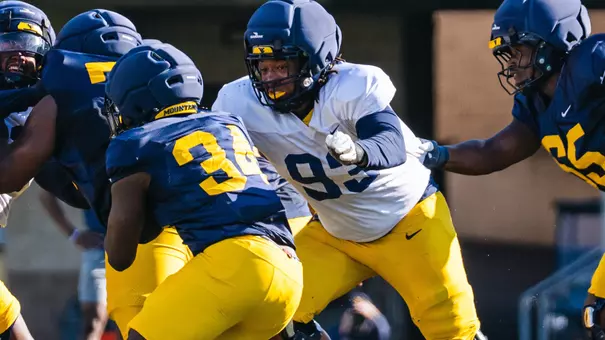
Photo by: All Pro Photography/Dale Sparks
Campus Connection: Weekend Notebook
October 20, 2017 01:57 PM | Football, Blog
Following last Saturday's come-from-behind, 46-35 victory over Texas Tech, West Virginia's Tony Gibson admitted the tide turned for his defense when he dialed back the blitzing.
Because of this, the Red Raider offense was completely shut down in the fourth quarter and the Mountaineers offense got enough possessions to score 22 unanswered points.
Therefore, one must wonder if Gibson has the players to pressure the way he likes.
Veteran defensive line coach Bruce Tall, Gibson's eyes and ears from above on game day, said it depends.
"It depends upon how many they are keeping in the block," Tall said earlier this week. "Usually, they have been giving us six-man protections so you've got to beat one twice to get there and get pressure with three guys rushing.
"With the movement and the stuff we're doing, you'd like to believe our guys are going to win some … and you've got to understand what's winning," Tall continued. "Some people say you have to win every other one. No. It's probably one out of eight, in all honestly. That's winning. But that's probably not a stat that anyone wants to hear."
Tall said he's more interested in his guys cleaning up their technique work. He said there is a lot of room for improvement there.
"We've got to get better," he said. "I know we're young, but we've got to understand what's making a play as a defensive lineman. Everybody wants to make tackles but what is making a play as a defensive lineman? It's playing within the defense."
Tall said it's not practical to put in a bunch of different twists and new wrinkles to try and create more pressure up front. He said it's a matter of covering gaps and playing within the system.
"It's about taking care of your responsibilities and making sure you are eating up a couple of blocks and then escaping," he said. "We've been working hard on escaping blocks faster and we've just got to progress and get better with that."
When that happens, and when the guys in the back end can stick to their guys a little bit closer, that will give Gibson more confidence to dial up more pressure.
This kind of slipped through the cracks last Saturday, but Dana Holgorsen became only the fourth coach in school history to win 50 career football games at WVU.
 He now trails Don Nehlen (149), Rich Rodriguez (60) and Art Lewis (58) among the school's all-time wins leader.
What is so significant about Holgorsen's 50 wins here is that they have come against a major-conference football schedule - not against the Southern Conference or a watered down Big East.
When you take that into consideration, I believe the only other coach who has faced what Holgorsen has gone up against while at WVU is Nehlen, whose entire 21-season career here was coached against Eastern independents and a Big East Conference that included Miami, Virginia Tech and Boston College.
Of Art Lewis' 10 seasons at West Virginia, just three of them were spent in what could be considered a major conference. That's the 1950, 1951 and 1952 seasons in the Southern Conference before the Tobacco Road schools broke off to form the Atlantic Coast Conference.
Pappy's three-year overall record against a pre-ACC Southern Conference? 14-15.
The same goes for Rich Rod, whose seven-year tenure included four seasons coaching against a Big East Conference without Miami, Boston College and Virginia Tech. Against them and the rest of the league, he was 20-17. Afterward when USF replaced Boston College, Louisville replaced Miami and Cincinnati replaced Virginia Tech, he was 40-9.
Just a little something to store in the back of your mind.
I stumbled across a website that keeps track of this year's college football television ratings and I found some of it interesting, especially relative to TV ratings from the past.
Of course, today there are many, many more games televised and the options are nearly endless on a Saturday, unlike a few decades ago when your only options were the noon and late-afternoon time slots on one of the three major networks. And rarely ever did games go up against each other, which is how West Virginia could pull in a 13.8 rating for its regular-season regional game against Syracuse on ABC in 1981.
Now, compare that to the highest rated college football game this season - Alabama-Florida State - which pulled in a 6.9 rating in prime time on ABC on the opening week of the season.
West Virginia's highest-rated game so far this has been the 2.7 its opener against Virginia Tech on ABC got, fifth among all games on the opening weekend. In addition to Alabama-Florida State, the other games rated higher included Michigan-Florida (4.9), Ohio State-Indiana (3.0) and Tennessee-George Tech (2.9).
WVU's next highest-rated game was against TCU two weeks ago, which received an 0.7 rating on FS1. That game reached 1.1 million viewers, including live streams.
So college football games in the past clearly reached more eyeballs, but the problem was few eyeballs rarely saw West Virginia football because the Mountaineers were hardly ever on TV, just 16 times including bowl games during a 10-year period from 1975-84.
Interesting, indeed.
I was doing a little historical research the other day and I came across this: West Virginia first began selling football season tickets way back in 1948. A WVU fan could purchase a season ticket for the Mountaineers' six-game home slate that year featuring Waynesburg, Wooster, South Carolina, Ohio University, Western Reserve and Maryland for the economical price of just $13.50.
That was a $2 savings over the aggregate price to buy six single-game tickets. WVU's four "premium games" that year were against South Carolina, Ohio, Western Reserve and Maryland, based on a single-game price of $2.75 per ticket. The other two games against Waynesburg and Wooster went for $2.25 per ticket.
If you adjust the $13.50 it cost for a season ticket in 1948 to today's dollars, that would come out to about $136 per season ticket. The single-game price for the premium game in today's dollars would amount to about $28 per ticket.
Incidentally, all four of West Virginia's road opponents in 1948 - Temple, Pitt, Penn State and Virginia - charged at least $3 per ticket with Pitt charging the most at $3.90.
West Virginia's game against Washington and Lee at Laidley Field in Charleston also cost $3.
And finally, we had another opportunity to catch up with West Virginia men's basketball coach Bob Huggins as he continues to get his team ready for its season-opening game against Texas A&M in Germany on Friday, November 10.
 He said not much has changed since the last meeting with him a week ago, other than guards Daxter Miles Jr. and James Bolden are back practicing with the team after being slowed by injuries.
Therefore, Thursday afternoon provided another opportunity to pick the brain of one of college basketball's winningest coaches.
The Big Ten recently announced it was going to a 20-game conference schedule in 2018-19 one year ahead of the ACC's planned adoption of a 20-game league slate beginning in 2019-20.
This is most likely in response to the Big 12's 18-game league schedule that many believe has helped it attain its high RPI rankings each year.
The fewer games played outside the league against lesser competition, the higher the RPI so the rationale goes. And it makes a lot of sense.
Could this be the first step in the Power 5s excluding themselves from the mid-majors? Who knows?
College basketball analyst Jon Rothstein, writing for the website FanRag Sports, correctly points out more league games for the Big Ten and ACC means less non-conference opportunities for the mid-majors to play the Power 5s.
The trickle-down is that could ultimately affect the RPIs of the mid-majors to the point that the NCAA Tournament could one day be completely dominated by Power 5 schools.
That's good or bad depending upon which side of the table you are sitting on.
And Huggins has been on both sides.
"That's been the strength of our league playing everybody twice from an RPI standpoint," Huggins admitted.
"If everybody would get together for the good of the game and realize … and I've been there," Huggins said. "I've been in NAIA, Division II and the whole gamut. I understand it better than most do. But (mid-majors) shouldn't be able to compete with us because of everything we're allowed to do that they, financially, can't do. And they shouldn't be expected to."
Huggins continued, "A one-game thing, anybody can play bad and lose one game, but you take any of those people that anybody wants to talk about and say, 'Here is a mid-major who can compete (in a Power 5 Conference).' Have them do it every day. Have them do it 18 times in our league or 20 times in those other leagues. They can't do it.
"The Division III people shouldn't have to play by the same rules we play, but we shouldn't have to play by their rules either. There is such separation (between all levels of basketball). Football realized it and did something about it; we've realized it and we haven't done anything about it."
Perhaps that's about to change.
Have a great weekend everyone!
Because of this, the Red Raider offense was completely shut down in the fourth quarter and the Mountaineers offense got enough possessions to score 22 unanswered points.
Therefore, one must wonder if Gibson has the players to pressure the way he likes.
Veteran defensive line coach Bruce Tall, Gibson's eyes and ears from above on game day, said it depends.
"It depends upon how many they are keeping in the block," Tall said earlier this week. "Usually, they have been giving us six-man protections so you've got to beat one twice to get there and get pressure with three guys rushing.
"With the movement and the stuff we're doing, you'd like to believe our guys are going to win some … and you've got to understand what's winning," Tall continued. "Some people say you have to win every other one. No. It's probably one out of eight, in all honestly. That's winning. But that's probably not a stat that anyone wants to hear."
Tall said he's more interested in his guys cleaning up their technique work. He said there is a lot of room for improvement there.
"We've got to get better," he said. "I know we're young, but we've got to understand what's making a play as a defensive lineman. Everybody wants to make tackles but what is making a play as a defensive lineman? It's playing within the defense."
Tall said it's not practical to put in a bunch of different twists and new wrinkles to try and create more pressure up front. He said it's a matter of covering gaps and playing within the system.
"It's about taking care of your responsibilities and making sure you are eating up a couple of blocks and then escaping," he said. "We've been working hard on escaping blocks faster and we've just got to progress and get better with that."
When that happens, and when the guys in the back end can stick to their guys a little bit closer, that will give Gibson more confidence to dial up more pressure.
***
This kind of slipped through the cracks last Saturday, but Dana Holgorsen became only the fourth coach in school history to win 50 career football games at WVU.
He now trails Don Nehlen (149), Rich Rodriguez (60) and Art Lewis (58) among the school's all-time wins leader.What is so significant about Holgorsen's 50 wins here is that they have come against a major-conference football schedule - not against the Southern Conference or a watered down Big East.
When you take that into consideration, I believe the only other coach who has faced what Holgorsen has gone up against while at WVU is Nehlen, whose entire 21-season career here was coached against Eastern independents and a Big East Conference that included Miami, Virginia Tech and Boston College.
Of Art Lewis' 10 seasons at West Virginia, just three of them were spent in what could be considered a major conference. That's the 1950, 1951 and 1952 seasons in the Southern Conference before the Tobacco Road schools broke off to form the Atlantic Coast Conference.
Pappy's three-year overall record against a pre-ACC Southern Conference? 14-15.
The same goes for Rich Rod, whose seven-year tenure included four seasons coaching against a Big East Conference without Miami, Boston College and Virginia Tech. Against them and the rest of the league, he was 20-17. Afterward when USF replaced Boston College, Louisville replaced Miami and Cincinnati replaced Virginia Tech, he was 40-9.
Just a little something to store in the back of your mind.
***
I stumbled across a website that keeps track of this year's college football television ratings and I found some of it interesting, especially relative to TV ratings from the past.
Of course, today there are many, many more games televised and the options are nearly endless on a Saturday, unlike a few decades ago when your only options were the noon and late-afternoon time slots on one of the three major networks. And rarely ever did games go up against each other, which is how West Virginia could pull in a 13.8 rating for its regular-season regional game against Syracuse on ABC in 1981.
Now, compare that to the highest rated college football game this season - Alabama-Florida State - which pulled in a 6.9 rating in prime time on ABC on the opening week of the season.
West Virginia's highest-rated game so far this has been the 2.7 its opener against Virginia Tech on ABC got, fifth among all games on the opening weekend. In addition to Alabama-Florida State, the other games rated higher included Michigan-Florida (4.9), Ohio State-Indiana (3.0) and Tennessee-George Tech (2.9).
WVU's next highest-rated game was against TCU two weeks ago, which received an 0.7 rating on FS1. That game reached 1.1 million viewers, including live streams.
So college football games in the past clearly reached more eyeballs, but the problem was few eyeballs rarely saw West Virginia football because the Mountaineers were hardly ever on TV, just 16 times including bowl games during a 10-year period from 1975-84.
Interesting, indeed.
***
I was doing a little historical research the other day and I came across this: West Virginia first began selling football season tickets way back in 1948. A WVU fan could purchase a season ticket for the Mountaineers' six-game home slate that year featuring Waynesburg, Wooster, South Carolina, Ohio University, Western Reserve and Maryland for the economical price of just $13.50.
That was a $2 savings over the aggregate price to buy six single-game tickets. WVU's four "premium games" that year were against South Carolina, Ohio, Western Reserve and Maryland, based on a single-game price of $2.75 per ticket. The other two games against Waynesburg and Wooster went for $2.25 per ticket.
If you adjust the $13.50 it cost for a season ticket in 1948 to today's dollars, that would come out to about $136 per season ticket. The single-game price for the premium game in today's dollars would amount to about $28 per ticket.
Incidentally, all four of West Virginia's road opponents in 1948 - Temple, Pitt, Penn State and Virginia - charged at least $3 per ticket with Pitt charging the most at $3.90.
West Virginia's game against Washington and Lee at Laidley Field in Charleston also cost $3.
***
And finally, we had another opportunity to catch up with West Virginia men's basketball coach Bob Huggins as he continues to get his team ready for its season-opening game against Texas A&M in Germany on Friday, November 10.
He said not much has changed since the last meeting with him a week ago, other than guards Daxter Miles Jr. and James Bolden are back practicing with the team after being slowed by injuries.Therefore, Thursday afternoon provided another opportunity to pick the brain of one of college basketball's winningest coaches.
The Big Ten recently announced it was going to a 20-game conference schedule in 2018-19 one year ahead of the ACC's planned adoption of a 20-game league slate beginning in 2019-20.
This is most likely in response to the Big 12's 18-game league schedule that many believe has helped it attain its high RPI rankings each year.
The fewer games played outside the league against lesser competition, the higher the RPI so the rationale goes. And it makes a lot of sense.
Could this be the first step in the Power 5s excluding themselves from the mid-majors? Who knows?
College basketball analyst Jon Rothstein, writing for the website FanRag Sports, correctly points out more league games for the Big Ten and ACC means less non-conference opportunities for the mid-majors to play the Power 5s.
The trickle-down is that could ultimately affect the RPIs of the mid-majors to the point that the NCAA Tournament could one day be completely dominated by Power 5 schools.
That's good or bad depending upon which side of the table you are sitting on.
And Huggins has been on both sides.
"That's been the strength of our league playing everybody twice from an RPI standpoint," Huggins admitted.
"If everybody would get together for the good of the game and realize … and I've been there," Huggins said. "I've been in NAIA, Division II and the whole gamut. I understand it better than most do. But (mid-majors) shouldn't be able to compete with us because of everything we're allowed to do that they, financially, can't do. And they shouldn't be expected to."
Huggins continued, "A one-game thing, anybody can play bad and lose one game, but you take any of those people that anybody wants to talk about and say, 'Here is a mid-major who can compete (in a Power 5 Conference).' Have them do it every day. Have them do it 18 times in our league or 20 times in those other leagues. They can't do it.
"The Division III people shouldn't have to play by the same rules we play, but we shouldn't have to play by their rules either. There is such separation (between all levels of basketball). Football realized it and did something about it; we've realized it and we haven't done anything about it."
Perhaps that's about to change.
Have a great weekend everyone!


2026 Mountaineer Invitational Preview
Thursday, April 09
Nate Gabriel | April 8
Thursday, April 09
Coach Rich Rodriguez | April 8
Thursday, April 09
Coach Rod West | April 8
Thursday, April 09