Celebrating 40 Years of the Coliseum
January 23, 2011 12:17 AM | General
For the next four days MSNsportsNET.com is celebrating the 40th anniversary of the WVU Coliseum – the history behind its construction, as well as the top players, coaches and teams to play in the facility over the last 40 years. Be sure to stop back on Monday to see our list of the 40 memorable moments at the Coliseum
MORGANTOWN, W.Va. - West Virginia University Athletic Director Red Brown waited a long time to get his basketball arena. The topic of a new basketball facility first came up in 1958 when Fred Schaus was being pursued by the University of Washington for its basketball job. Schaus turned down the Huskies when West Virginia agreed to begin exploring the possibility of building a new arena to replace the Field House.
The process took 12 long years to complete. At the end of each year, Brown was required to file a report to Central Administration summing up the athletic season. In each report he sent downtown, he always stuck in a few paragraphs about the need for a new basketball arena.
In the early 1960s, there was finally some interest on the part of university president Paul Miller once Schaus left to take the Los Angeles Lakers job. The preliminary plans for a new arena called for a $6 million facility with bleacher seating. Eventually the $6 million cap was eliminated.
“They reasoned that if we were going to do this, then we better do it right,” said former Sports Information Director Eddie Barrett.
By the mid-1960s West Virginia was undergoing its biggest expansion in school history. In roughly a 10-year period from the late 1950s to the late 1960s, the school had more than doubled in size, forcing the campus to expand out into Evansdale.
Brown finally saw a crack of light in 1967. The state Legislature was willing to consider a bond for the construction of a basketball arena, a new law school and a much-needed addition to the Medical Center.
What eventually transpired was a turf war of competing interests, and WVU basketball coach Bucky Waters said he wound up getting stuck right in the middle of it. “They allocated $20 million for the Law School, the hospital, the new field house and about two other things,” Waters recalled. “Everything else was academic or medical and when all of the bids came back it was over $40 million.
“The Coliseum was over $10 million. So the guys in Charleston said, ‘Boys we gave you $20 million—you figure it out.’ So there was this huge dogfight. The dean of the law school called it ‘Bucky’s Castle.’ Why do we need this thing? We need a law school and we need classrooms.’ It was a great argument.
“I said, ‘If we don’t get this now—you’ve got Cole Field House to the East, Ohio U. has a better arena than we’ve got, never mind St. John’s Arena at Ohio State. We’re surrounded by good facilities and the Mountaineer basketball tradition cannot survive unless we have an incredible run of kids from West Virginia, which at the time we didn’t.”
Brown knew a stand-alone athletic venue would never fly, so he ingeniously got the School of Physical Education involved. He also talked about the value a new basketball arena could mean to the community.
It worked.
“Red calls me the day before the board meets on a Saturday morning,” Waters said. “He said, ‘Okay, you’ve got an audience with the board.’ I said, ‘Great Red, how long do I have?’ He said I had 10 minutes.
“I said, ‘That’s 10 minutes for $10 million.’ He said, ‘I’m sorry that’s the best I can do.’ I had all these charts and comparisons and I just went in there with my heart and I said, ‘It may seem like an extravagance but you have to measure what the Mountaineer tradition means and its continuance. I’m not a miracle worker.’”
Waters was sitting in Brown’s office in the football stadium when the announcement came later that afternoon that the Board of Governors had approved the funding for a new basketball arena, soon to become known as the WVU Coliseum.
Work crews were on-site the following week and the project was completed before the start of the 1970–71 academic year. A number of concerts and events were held that fall in the new WVU Coliseum before the basketball team officially christened it with a 113–92 victory over Colgate Dec. 1, 1970.
“The first time I came back to the Coliseum to do a [television] game it was a Big East game and I said, ‘Red Brown would be just rejoicing right now.’ He wanted something like that so much,” Waters said. “He thought big in hoops.”
Taken from the book Roll Out The Carpet: 101 Seasons of West Virginia University Basketball now available in bookstores everywhere. You can purchase a copy online at WVU Press by clicking here http://wvupressonline.com/antonik_roll_out_the_carpet_9781933202662
MORGANTOWN, W.Va. - West Virginia University Athletic Director Red Brown waited a long time to get his basketball arena. The topic of a new basketball facility first came up in 1958 when Fred Schaus was being pursued by the University of Washington for its basketball job. Schaus turned down the Huskies when West Virginia agreed to begin exploring the possibility of building a new arena to replace the Field House.
The process took 12 long years to complete. At the end of each year, Brown was required to file a report to Central Administration summing up the athletic season. In each report he sent downtown, he always stuck in a few paragraphs about the need for a new basketball arena.
In the early 1960s, there was finally some interest on the part of university president Paul Miller once Schaus left to take the Los Angeles Lakers job. The preliminary plans for a new arena called for a $6 million facility with bleacher seating. Eventually the $6 million cap was eliminated.
“They reasoned that if we were going to do this, then we better do it right,” said former Sports Information Director Eddie Barrett.
By the mid-1960s West Virginia was undergoing its biggest expansion in school history. In roughly a 10-year period from the late 1950s to the late 1960s, the school had more than doubled in size, forcing the campus to expand out into Evansdale.
Brown finally saw a crack of light in 1967. The state Legislature was willing to consider a bond for the construction of a basketball arena, a new law school and a much-needed addition to the Medical Center.
What eventually transpired was a turf war of competing interests, and WVU basketball coach Bucky Waters said he wound up getting stuck right in the middle of it. “They allocated $20 million for the Law School, the hospital, the new field house and about two other things,” Waters recalled. “Everything else was academic or medical and when all of the bids came back it was over $40 million.
“The Coliseum was over $10 million. So the guys in Charleston said, ‘Boys we gave you $20 million—you figure it out.’ So there was this huge dogfight. The dean of the law school called it ‘Bucky’s Castle.’ Why do we need this thing? We need a law school and we need classrooms.’ It was a great argument.
“I said, ‘If we don’t get this now—you’ve got Cole Field House to the East, Ohio U. has a better arena than we’ve got, never mind St. John’s Arena at Ohio State. We’re surrounded by good facilities and the Mountaineer basketball tradition cannot survive unless we have an incredible run of kids from West Virginia, which at the time we didn’t.”
Brown knew a stand-alone athletic venue would never fly, so he ingeniously got the School of Physical Education involved. He also talked about the value a new basketball arena could mean to the community.
It worked.
“Red calls me the day before the board meets on a Saturday morning,” Waters said. “He said, ‘Okay, you’ve got an audience with the board.’ I said, ‘Great Red, how long do I have?’ He said I had 10 minutes.
“I said, ‘That’s 10 minutes for $10 million.’ He said, ‘I’m sorry that’s the best I can do.’ I had all these charts and comparisons and I just went in there with my heart and I said, ‘It may seem like an extravagance but you have to measure what the Mountaineer tradition means and its continuance. I’m not a miracle worker.’”
Waters was sitting in Brown’s office in the football stadium when the announcement came later that afternoon that the Board of Governors had approved the funding for a new basketball arena, soon to become known as the WVU Coliseum.
Work crews were on-site the following week and the project was completed before the start of the 1970–71 academic year. A number of concerts and events were held that fall in the new WVU Coliseum before the basketball team officially christened it with a 113–92 victory over Colgate Dec. 1, 1970.
“The first time I came back to the Coliseum to do a [television] game it was a Big East game and I said, ‘Red Brown would be just rejoicing right now.’ He wanted something like that so much,” Waters said. “He thought big in hoops.”
Taken from the book Roll Out The Carpet: 101 Seasons of West Virginia University Basketball now available in bookstores everywhere. You can purchase a copy online at WVU Press by clicking here http://wvupressonline.com/antonik_roll_out_the_carpet_9781933202662

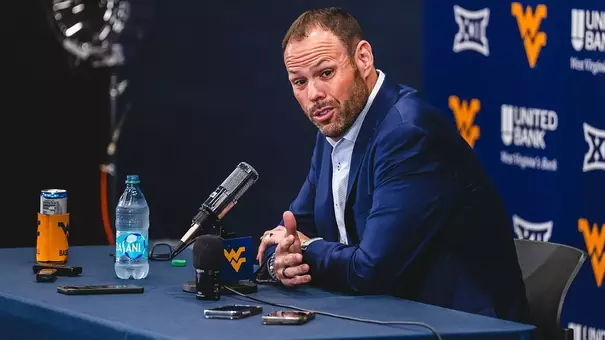


Wren Baker | May 19
Tuesday, May 19
NCAA Selection Show
Wednesday, May 13
WVU Baseball Defensive Highlights
Tuesday, May 12
Kansas Recap
Tuesday, May 12