John Antonik
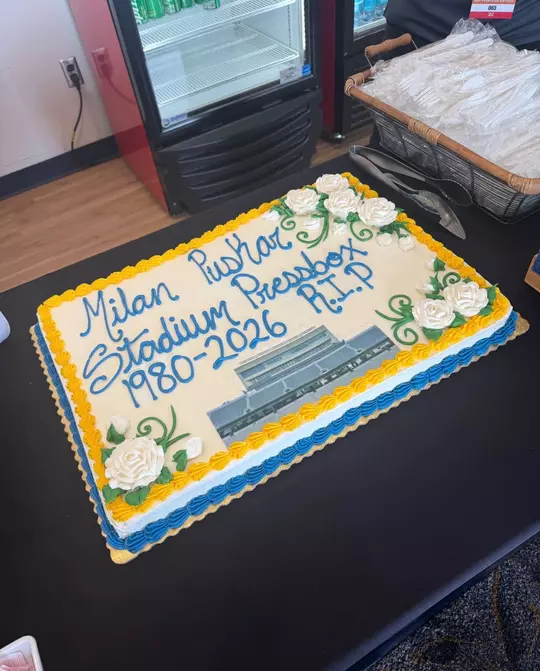
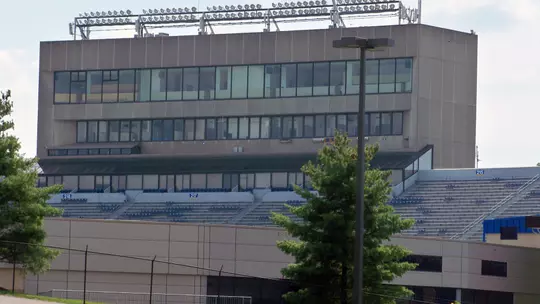
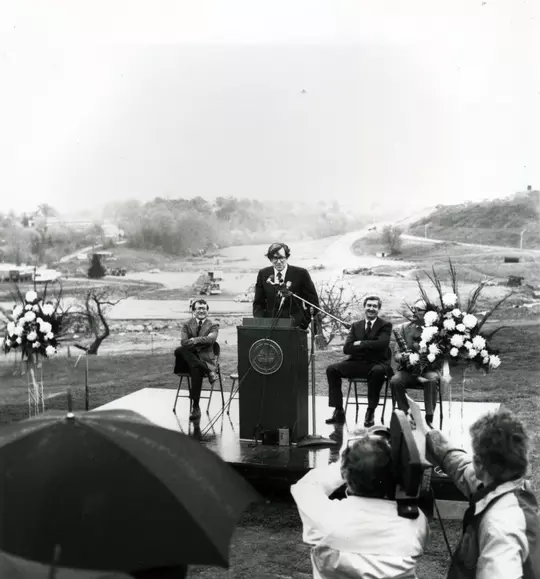
MORGANTOWN, W.Va. – Milan Puskar Stadium’s hulking, 46-year-old press box is meeting the wrecking ball to make way for a new $150 million West Tower scheduled to be completed before the start of the 2028 football season.
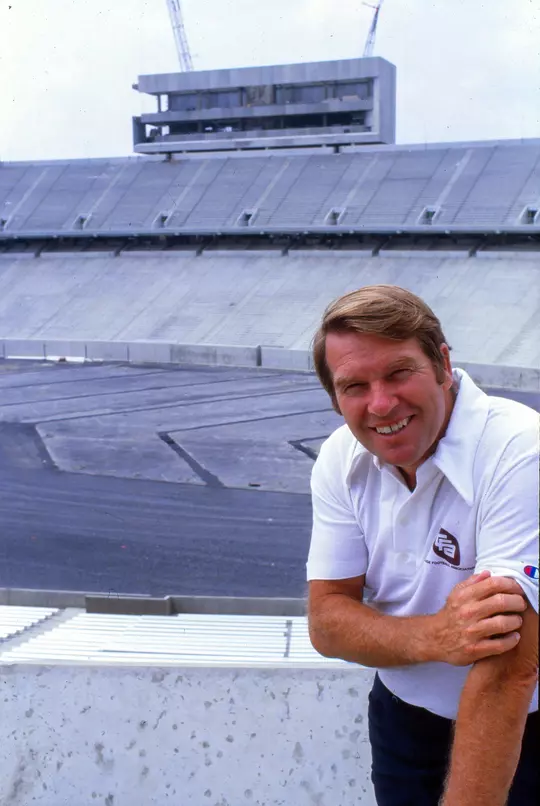
Last Saturday’s game against Houston was the final home event for the concrete monstrosity, the oldest of Mountaineer football’s press box structures and considered among the finest of its kind when it opened in 1980.
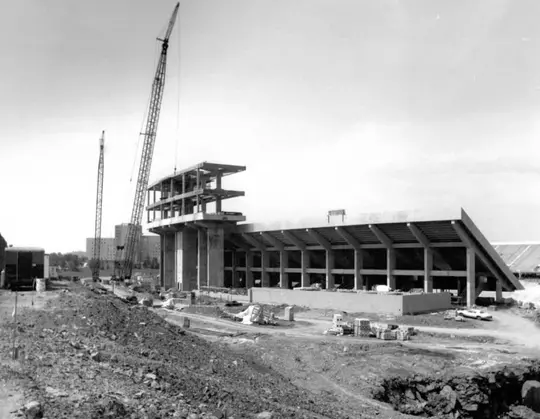
Built at a cost of $2.2 million ($9 million in today’s dollars), contractors labeled it the “most difficult aspect” of the stadium construction project because they were basically putting an entire building 60 feet in the air.
It addressed all of the inadequacies of the old stadium’s press box, which was constructed in 1963 at a cost of approximately $150,000 after cutbacks were made to keep it under budget. Prior to that, the downtown stadium had two small structures on opposite sides, the second one built above Campus Drive in the 1940s to accommodate radio and expanded press coverage.
Former sports information director Rene Henry remembers the two facilities being sufficient for the times.
“We were fine, space-wise, for most games except for the big ones when we had more out-of-town writers,” he recalled recently via email. “Being so distant from Jack Fleming and the broadcasters was a problem.
“We had no phone to the field and were opposite the WVU home bench on the other side, so communication was very difficult,” he said.
Henry remembers providing occasional snacks to the reporters, including a hot dog run to the concession stand for the 1955 Virginia game played on the Saturday after Thanksgiving.
“Virginia didn’t bring an SID nor its band; the Salvation Army played at halftime, and no food was provided, so (WVU assistant athletic director) Lowry Stoops went down to the concession stand and bought hot dogs and drinks for everyone and we took it back to the press box and handed it out to everyone,” Henry said.
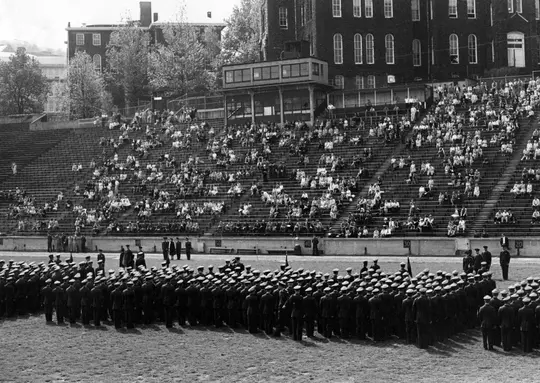
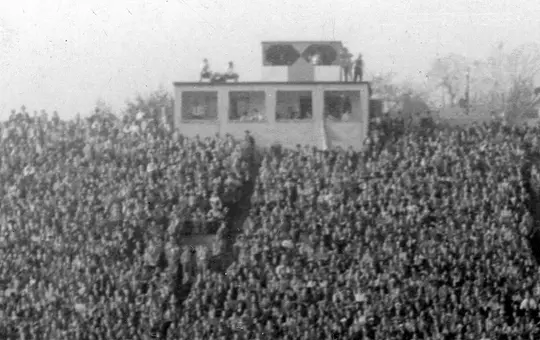
Henry recalls The Associated Press’ Will Grimsley and Pittsburgh Press sports editor Chet Smith attending some games, but media coverage in those days was primarily limited to local writers because Morgantown was so inaccessible.
By the early 1960s, however, the athletic department began exploring the possibility of constructing a new press box to coincide with the state’s Centennial celebration in 1963. Minneapolis Star’s Charley Johnson, who oversaw the sportswriters’ press box committee, listed California, Illinois, Minnesota and Crump Stadium in Memphis as the worst for press facilities.
WVU’s press box was neither praised nor criticized, but it was categorized among the “poor” ones.
When the initial bids for a new press box were received, they came in much higher than anticipated. The Board of Governors rejected bids of $201,600 and $211,300 as “too high” and instructed President Paul A. Miller to meet with architect Robert J. Bennett and athletic department and planning officials to revise the project.
What came out of those cuts was a three-tiered aluminum, glass and steel press box that could seat up to 200 people. The first level held up to 100 University guests and dignitaries with 62 working press, scouts, statisticians and game operation personnel located on the middle level.
The third level provided booths for radio and photographic workers, the public address announcer, scoreboard operator, coach-observers and a film loading room. A camera deck was established on the roof.
Baker & Combs, Inc., of Morgantown produced the winning bid at a cost of $142.820. As a result of tearing out the two enclosed structures, more than 500 choice seats on both sides of the field were opened up to the general public, increasing the stadium’s capacity to 34,000.
Only the five I-beams supporting the press box stood in the way of a completely open stadium.
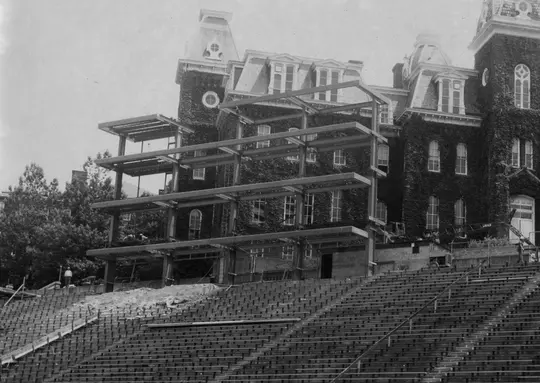
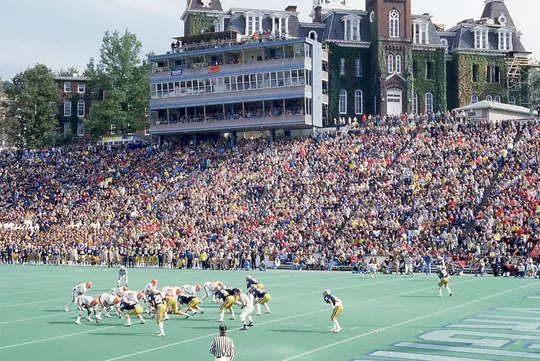
“In the 40 years that Mountaineer Field has been in existence, it has taken virtually no major alterations,” a May 11, 1963, Morgantown Dominion News editorial began. “Except for unbecoming additions to the original press box, the stadium stands as it was built back in 1923-24.
“Now, to celebrate the Centennial year, athletic director Robert “Red” Brown has scheduled what is by far the University’s greatest home array of opponents into the stadium.”
The editorial continued, “having hit the jackpot by luring this attractive opposition to the campus, the University is faced with a crying need to dress up the aging stadium and especially the facilities for press, radio and – now – television. These have grown like topsy over the years.
“They are outgrown, outworn, outmoded and by no stretch of the imagination a place for West Virginia University to put its best foot forward. Proponents of the newly designed press box say it is only ‘functionally adequate’ in size, but they also claim it will be a ‘thing of beauty’ too … with glass, steel and aluminum construction and canted design, it will be a ‘source of pride to the entire state, a modernistic campus landmark.’
“If these claims are true, we need the new press box. State pride needs to be uplifted, especially in this Centennial year, and there are certainly enough landmarks of ancient variety to stand a futuristic new one.
“In this Centennial Year, and thereafter, proud, old Mountaineer Field needs a sprucing up and a new press box,” the editorial concluded.
The phrase “functionally adequate” was telling. The facility didn’t have a reception area for hospitality nor was it big enough for on-site food preparation. Box lunches were provided at halftime to reporters, and photographers were required to eat their meals down on the field.
There was one bathroom – “a one holder” in the words of Wheeling Intelligencer sports editor Bill Van Horne, which made for miserably long waits at halftime.
According to former sports information director Mike Parsons, the WVU Coliseum was often used for visiting media hospitality, which meant a late-morning drive downtown before kickoff.
“It wasn’t a great press box, but it had an incredible view to the field,” Parsons recalled.
Jay Redmond, who ran the electronic scoreboard at the old stadium, came up with a creative solution to his halftime restroom dilemma. He said he would exit the stadium and walk up to Woodburn Hall where he used the third-floor bathroom, which had a window with a clear view of the scoreboard so he could keep track of time.
There was no elevator, which made the press box handicap inaccessible, and you entered each level from a stairwell that was attached to the back of the facility. Photography had to be processed off-site because there was no place to do it in the old stadium.
Chuck Lantz, working for United Press International at the time, had to develop his film across town at Dick Phillips Photography and transmit images to New York from there. Associated Press photos were sent from the Dominion Post, an AP member. There was only room in the back of the press box for one telecopier to transmit and receive scores.
Because field access was limited, the reporters remained in the press box, and a special telephone hookup to the locker room was established for postgame press conferences. Writers would submit their questions to sports information directors Dick Polen and Ron Steiner, and they would relay them to the coaches.
The only reporter who went down to the locker room to get postgame player quotes was Tony Constantine.
By the mid-1970s, as the stadium was developing serious structural issues, the press box began leaning toward the field and was deemed unsafe. Ed Pastilong, in charge of facilities at the time, said it would have needed to be replaced.
“It was becoming hazardous,” he said.
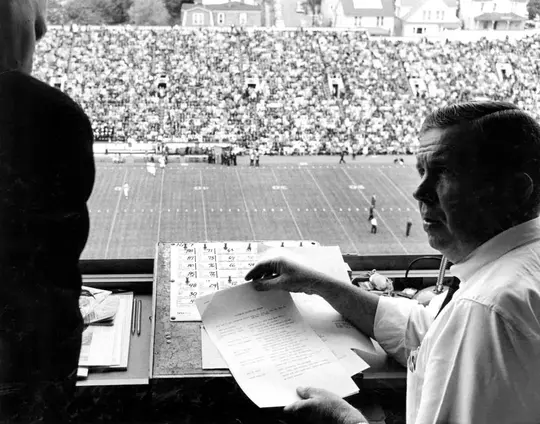
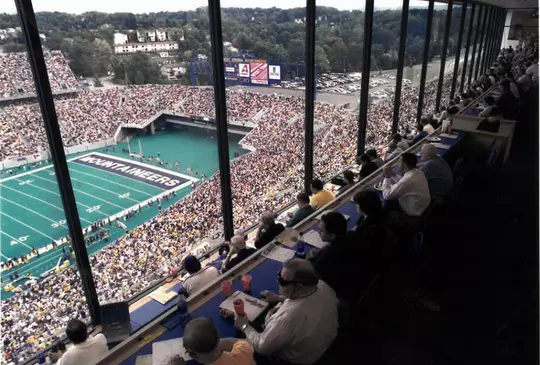
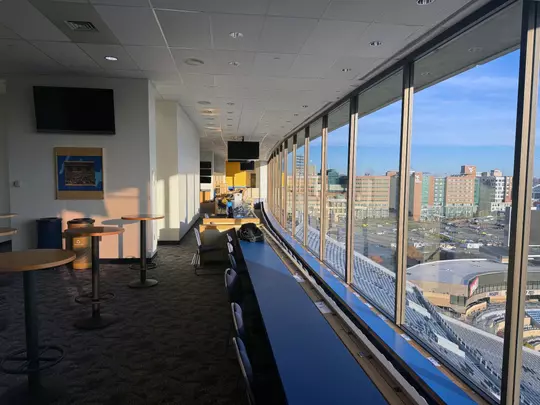
Therefore, the press box that opened at New Mountaineer Field in 1980 was considered a significant upgrade and Parsons believes Steiner played an important role in its design. The interior of the two-level, glass-fronted facility featured wall-to-wall gold and blue carpeting, plenty of space for pregame buffet-style dinners and electrical outlets at each seat to accommodate the mechanized world of sports reporting in the 1980s.
On opening day against Cincinnati, the press box was still unfinished with bare lightbulbs, plywood floors and unpainted drywall clearly visible. The elevator wasn’t operational and the windows were not yet installed, requiring sportswriters to walk up through the stands and access their seats from the top of the stadium.
Parsons recalled Jack Fleming and Mickey Furfari being allowed to use the construction company service elevator to access the press box that afternoon.
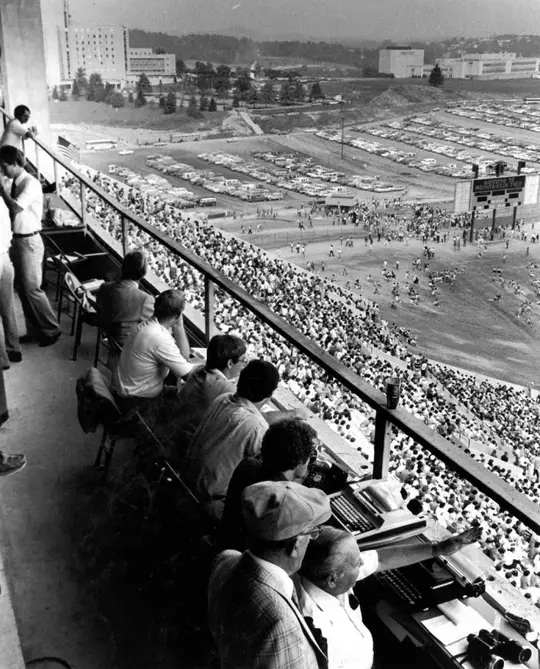
The initial layout of the top level had enough seating to accommodate 100 sportswriters in two neatly arranged rows. Additional box seating for special guests and overflow reporters was available above.
Eventually, a portion of the upper-level press box was cordoned off and used for athletic director/Mountaineer Athletic Club hospitality.
The lower level housed game operations, radio, television and coaching areas, featuring individual sound-proof booths.
In the center of the lower level was a spacious area for stadium public address announcers Frank Stevens, Travis Jones and Bill Nevin, as well as the scoreboard operations staff. In 1980, Redmond sat in front of a massive computer terminal that sent programmed messages to the scoreboard, touted at the time as the “largest in the nation.”
He had a library of about “20-to-25” five-inch floppy discs of animations that he would retrieve and insert into a hard drive that fed the scoreboard. Among them was a one-word message he specifically programmed for when West Virginia defeated Penn State – “Finally” – which sat unused for four years until 1984.
Next to the game operations booth was an area for WVU security and emergency service personnel to sit and observe crowd action and coordinate responses with State Police and emergency medical services.
A booth was also reserved for visiting game officials and dignitaries.
On the backside of the lower level of the press box were plenty of restrooms – not the “one-holders” fortunately – an area for stadium electronics, and at one time, a small dark room with running water for Lantz to process UPI photos. Lantz said the photography processing area in the press box was used up until the late 1990s when digital photography replaced film.
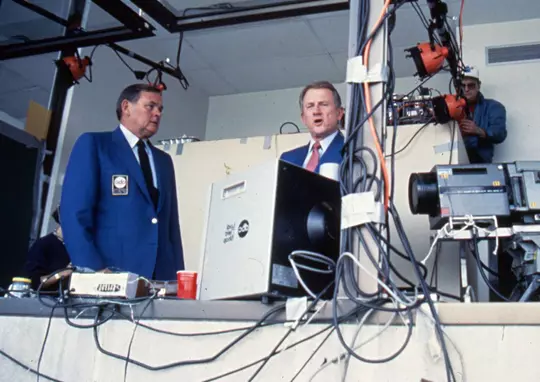
Below the lower level, an exposed camera deck provided plenty of space for game film, video and television cameras. The area at the end of the camera deck was eventually taken to house the video replay crew when that became a part of college football.
“When it opened, the Mountaineer Field press box was far beyond what our rival schools Pitt, Penn State, Virginia Tech and Maryland were offering at the time,” Parsons said. “The only flaw was the inability to conveniently open the lower-level windows.”
Underneath the press box were 12 special luxury suites constructed in 1994 at a cost of $2.5 million. Each suite had enough room to accommodate 26 people with indoor and outdoor seating and was decorated according to the desires of the owner.
The stadium suites required the entrance area at the bottom of the elevators to be completely redesigned to make for a more controlled environment.
At its peak in the late 1980s and the mid-2000s, when West Virginia was ranked high in the national polls, Milan Puskar Stadium’s press box was frequently full and serviced some of the top nation’s top sportswriters such as John Feinstein, Rick Reilly, Doug Looney, Jerry Izenberg, Mike Lupica, Michael Wilbon, Ivan Maisel, Edwin Pope, Tony Barnhart, Dick Weiss, Pat Forde, Dennis Dodd, Bruce Feldman, Mike Wise, Gene Wojciechowski, Herschel Nissenson, Rich Rosenblatt and Sally Jenkins.
In 1993, Bill Rhoden adopted the team and covered the entire season for the New York Times and the game that year against fourth-ranked Miami, Florida, required additional temporary seating to support the overflow.
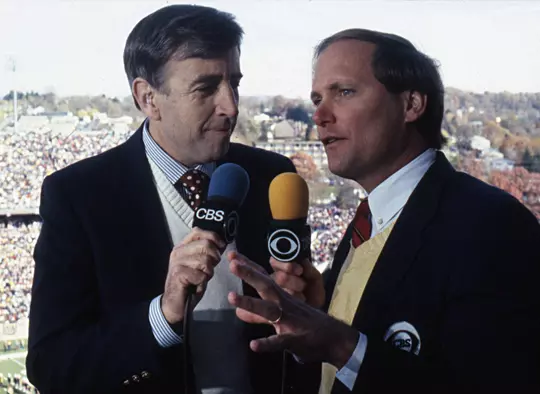
Among the recognized television personalities making appearances in the press box include familiar names Keith Jackson, Frank Broyles, Brent Musburger, Pat Haden, Ray Scott, Beano Cook, Kirk Herbstreit, Ron Franklin, Mike Gottfriend, Chris Fowler, Mike Tirico, Sean McDonough, Dick Vermeil, Todd Blackledge, Gus Johnson and Joel Klatt.
A non-inclusive listing of local sportswriters using the facility includes Mickey Furfari, Tony Constantine, Mitch Vingle, Bob Pastin, Bob Hertzel, Greg Hunter, Boby Bucy, Kevin Kinder, A.L. “Shorty” Hardman, Bill Smith, Jody Jividen, Mike Cherry, Bob Baker, Doug Huff, Bill Van Horne, Nick Bedway, Don Clegg, Alan Robinson, John Raby, Dan Hose, Jim Cochran, Dave Hickman, John Veasey, Cliff Nichols, Bob Smizik, Gerry Dulac, Ron Cook, Gene Collier, Joe Starkey, Phil Axelrod, Jim Mearns, John Miller, Joedy McCreary, Rick Kozlowski, Dave Poe, Mike Casazza, Keenan Cummings, Taylor Kennedy and Greg Carey.
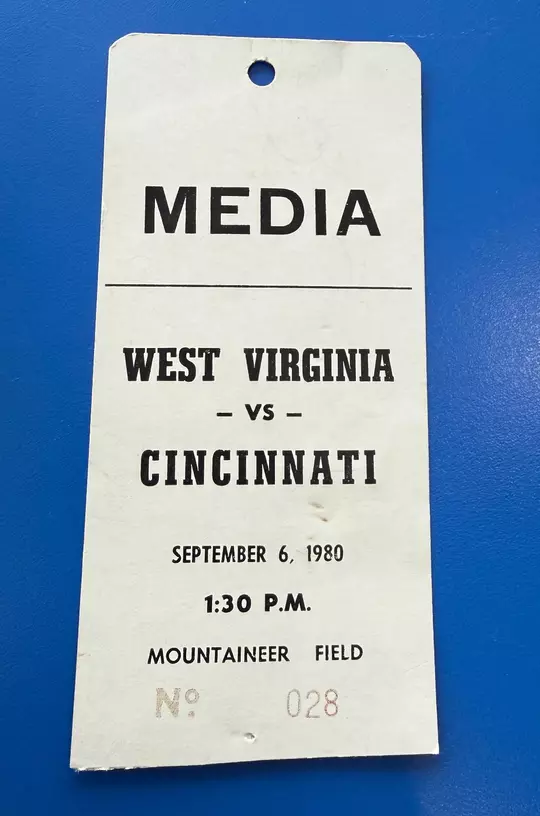
Huff attended Mountaineer football games for all 46 years of the facility’s existence, and among his collection of press box credentials was media pass No. 28 for the first-ever game played at New Mountaineer Field against Cincinnati on Sept. 6, 1980.
Tony Caridi, Hoppy Kercheval, Woody O’Hara, Dale Miller, Dwight Wallace, Jeff Jenkins, Kyle Wiggs, Joe Brocato, Dave Weekly, Mark Martin, Dave McClung, John Dickensheets, Keith Morehouse, Jim Wharton, Dave Stingo, Fred Persinger, Bill Phillips, Rob Metzger, Scott Nolte, John Simonson, Nick Farrell and Sydney Cariel make up some of the notable local electronic media members issued credentials to the press box through the years.
As for operations personnel, Redmond worked every season in the now-decommissioned structure.
Athletic directors responsible for maintenance, upkeep and improvements to the facility were Dick Martin, Fred Schaus, Ed Pastilong, Oliver Luck, Shane Lyons and Wren Baker.
And, of course, the sports information directors tasked with providing first-class accommodations through the years include Mike Parsons, Tim Lilley, Mike Ballweg, Joe Boczek, Shelly Poe, Michael Fragale and Mike Montoro.
Adding the time he spent as a Daily Atheneum reporter, Fragale worked in the press box in all but four years of the facility’s existence.
The press box was a critical addition to Milan Puskar Stadium, and it served media, coaches, scouts, visiting dignitaries and local politicians well during its 46 years.
It finally accomplished what West Virginia University sat out to do in 1963 – construct a modern, futuristic media facility that could be a source of pride to an entire state.