
Just For Kicks!
John Antonik
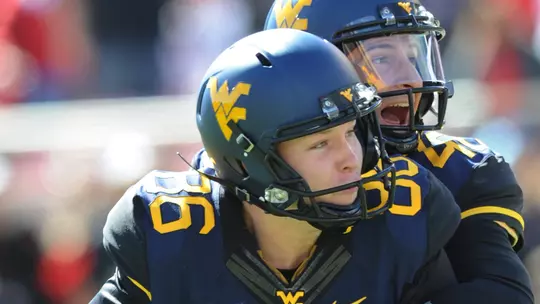
MORGANTOWN, W.Va. – Last week, while watching the “3 Guys Before the Game” podcast with Bill McKenzie, I began thinking about some of the other memorable game-winning, walk-off field goals in Mountaineer football history.
After consulting a panel of WVU football experts that included Jed Drenning, Greg Hunter and Keenan Cummings, as well as our in-house authorities Joe Swan and Michael Fragale, we’ve come up with six.
That’s quite a lot when you consider that Oklahoma has only had it happen once in its long and storied football history, which unfortunately, came against us in 2021. Who can ever forget Gabe Brkic’s 30-yarder that lifted fourth-ranked Oklahoma to a 16-13 victory over West Virginia in Norman that year?
Or, for that matter, Shayne Graham’s 44-yarder at Mountaineer Field in 1999 that kept Virginia Tech’s national championship hopes alive and gave West Virginians permanent heartburn!
I suppose when you’ve been as good as Oklahoma has been for all these years, you don’t really get a lot of walk-off field goal opportunities to win close football games.
Nevertheless, McKenzie is believed to be the first player to do it for West Virginia when his 38-yarder as time expired defeated 20th-ranked Pitt, 17-14.
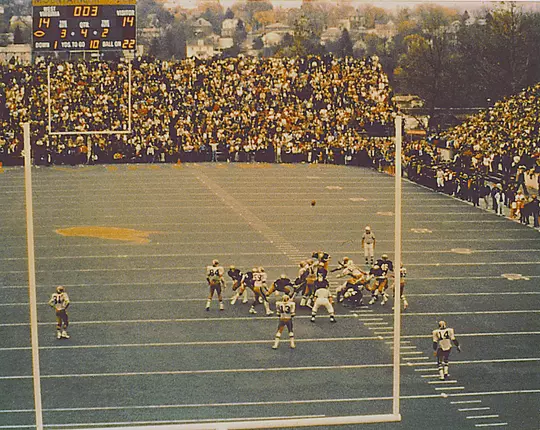
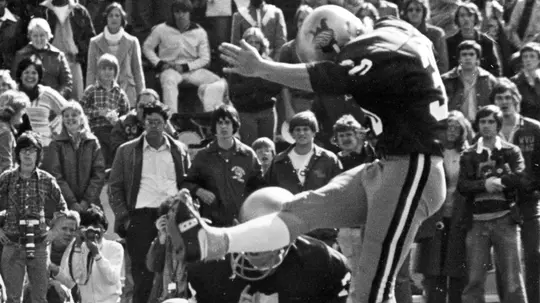
Before becoming a walk-off wonder, McKenzie was walk-on from Warwood who showed up at WVU during a time when the Mountaineers were desperately searching for another reliable kicker after Frank Nester graduated in 1973.
Chuck Klausing, West Virginia’s defensive coordinator, was also in charge of kickers back then, and he held an emergency student body tryout during the fall of 1974 and that’s when McKenzie was discovered. As Klausing once recalled, McKenzie was three-for-six on extra points, attempted no field goals and was required to squib his kickoffs because his high school team was so bad.
Talk about kicking credentials!
As an aside, the Pitt game-winner was only the third field goal McKenzie had made up to that point in his career. His other two were against Virginia Tech and Kent State and, amazingly, West Virginia was the last team in the country to successfully make a field goal that season when his 20-yarder was the deciding score in a 10-7 home victory over Virginia Tech.
That came with 13 minutes to go in the third quarter.
McKenzie almost had another walk-off winner a year later when his 45-yard boot with five seconds left pulled out a 9-6 home victory over Richmond in one of the epic football games in old Mountaineer Field history!
Well, maybe it wasn’t so epic.
All 15 points scored that afternoon were field goals – three by McKenzie and two by Richmond’s Jonnie Jones.
“We were fortunate to win,” was West Virginia’s first-year coach Frank Cignetti’s understated response after glancing at a stat sheet that displayed seven Mountaineer turnovers on fumbles and interceptions.
Incidentally, kicker Ken Juskowich did all the scoring nine years prior when his five field goals defeated rival Pitt 15-0 in similar-type game in 1967.
“A total humiliation,” were the words Pitt coach Dave Hart came up with to describe his team’s performance, which included minus-21 yards rushing and 25 yards of total offense.

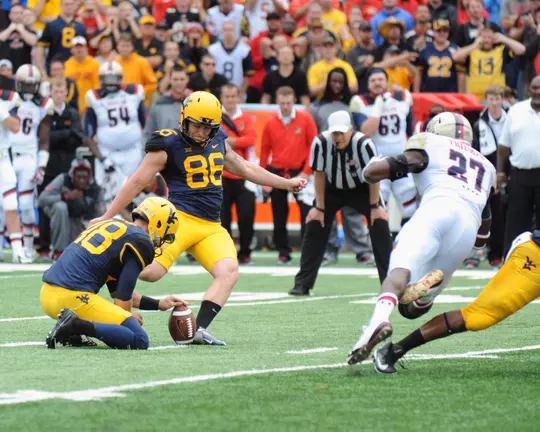
As for walk-off game winners, Josh Lambert owns the most in school history with three. He did it in overtime to defeat TCU 30-27 at Amon G. Carter Stadium in 2013, and he had two more walk-off winners in 2014.
His longest that year was an incredible 55-yarder at windy Texas Tech to culminate an eight-play, 42-yard game-winning drive. A month prior, the Garland, Texas, native booted a 47-yarder with no time left on the clock to give West Virginia a dramatic 40-37 victory over Maryland in College Park.
Lambert’s game-winner overshadowed Clint Trickett’s amazing 511-yard, four-touchdown passing performance and helped deodorize a colossal collapse that saw the Mountaineers nearly blow a 22-point first half lead.
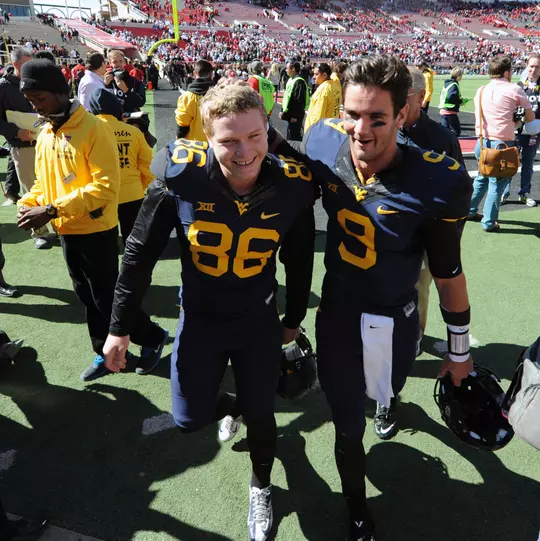
Eight years later, Casey Legg answered Brkic’s 2021 game-winning field goal with one of his own at Milan Puskar Stadium in 2022 to secure West Virginia’s lone victory against the Sooners while the two were members of the Big 12 Conference.
Garrett Greene engineered a fourth-quarter rally that saw West Virginia score the game’s final 10 points, which included Legg’s 25-yard field goal as time expired. At that point, however, most of the 50,281 who attended the game were either in the parking lot or listening on the radio in their cars on their way home.
Legg was just 33 seconds shy of having another walk-off winner earlier that season when his 22-yarder clipped Baylor 43-40.
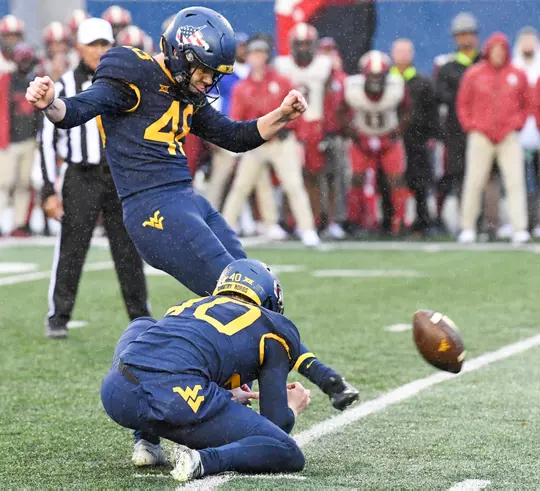
I also seem to recall Ripley’s Mark Johnson once having a late field goal in a non-descript 10-9 victory over Temple in 1991, as did kicking specialist Johnny Thackston, who booted a fourth-quarter field goal to give West Virginia a 10-7 triumph over Richmond on Sept. 26, 1959.
But in both instances, there was still time remaining on the clock.
There were other Mountaineer victories decided by field goals, such as Armin Mahrt’s fourth-quarter dropkick to beat Pitt in 1922, Malcolm Scott’s fourth-quarter field goal to defeat Ohio University in 1911, and Rudolph Munk’s 35-yard field goal in the fourth quarter to upend Marietta in 1909, although it is doubtful those came on the game’s final play.
Besides Lambert, Legg and McKenzie, West Virginia’s other great high-pressure kicker was Tyler Bitancurt.
The Springfield, Virginia, native was a Paul Woodside discovery who booted two unforgettable game winners. His first came in 2009 at the end of a tightly contested, West Virginia-Pitt game at Milan Puskar Stadium.
Only two touchdowns were scored by both teams – one an 88-yard Noel Devine run and the other a Bill Stull 50-yard pass to Jonathan Baldwin. The rest of the points came from Pitt field goal kicker Dan Hutchins and Bitancurt, whose 43-yarder traveling toward the bowl end of the stadium barely got past a leaping Baldwin, whose fingertips were mere inches from deflecting the football.
Ironically, Mountaineer coach Bill Stewart spent the entire game wanting to score touchdowns, not kick field goals, but in the end, he had no other choice.
“I wanted to win,” he said afterward. “I didn’t want to kick field goals against the eighth-ranked team in the country. It just wasn’t what we came here to do.”
That is until he had to: West Virginia 19, Pitt 16.
WVU’s victory over Pitt helped Cincinnati earn its second Big East regular season title and a meeting against Florida in the 2010 Sugar Bowl.
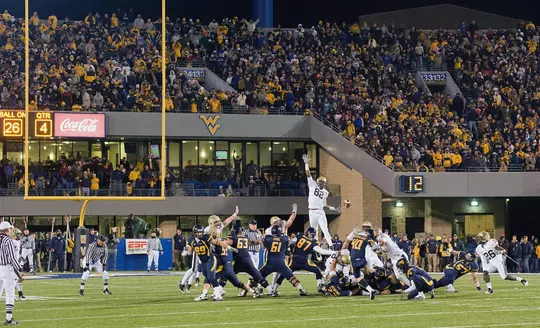
Bitancurt’s other game-winner at USF in 2011 had major bowl implications for 22nd-ranked West Virginia.
The Mountaineers, without any timeouts remaining, needed a diving fourth-down catch from Stedman Bailey at the Bulls’ 15-yard-line with seven seconds left, and then an alert Shawne Alston had to pick up an injured Bailey and help him get lined up so quarterback Geno Smith could spike the football with six seconds remaining.
That gave West Virginia enough time to run Bitancurt onto the field, and he successfully kicked a 28-yard field goal to give it a 30-27 win and the Big East regular season championship in coach Dana Holgorsen’s first season.
Had those events not happened, West Virginia’s record-setting 70-33 victory over Clemson in the Orange Bowl doesn’t happen either!

The Mountaineers, too, have experienced the disappointment of being walked off by opposing kickers. Colorado’s Aric Goodman did it to them in 2008 in overtime, as did Connecticut’s Dave Teggart in 2010.
Pitt’s Ed Frazier kicked a 42-yard field goal with a second left to give Pitt a come-from-behind, 31-all tie in 1989, but to West Virginians everywhere, that one will forever go down as a loss so you can count that one, too.
And way back in 1916, Penn’s Gravy Williams booted a 28-yarder late in the fourth quarter to provide the winning margin in the Quakers' 3-0 victory over West Virginia at Franklin Field. Gravy, whose first name was most likely not Gravy, had never kicked a field goal before in a game.
“It all came about in a peculiar manner,” Gravy’s Penn teammate Neil Mathews said afterward. “I had tried several dropkicks, but I guess I was standing back too far and the West Virginia players swarmed all around me.
“I never saw so many players in my life,” he continued. “In the last period I tried one, and just as I kicked a West Virginia man ran into my leg while it was in the air. My knee twisted, and I found it difficult to walk.”
When it came time for Penn to kick another one, Gravy volunteered to do it.
He did, and it turned out to be the game winner.
Was it on the last play of the game?
The running game summary published in the Philadelphia Inquirer the next day lists Williams’ kick last, so perhaps it was.
I’m sure the fact checkers out there who occasionally email me will have the answer tomorrow morning.
I will be waiting!