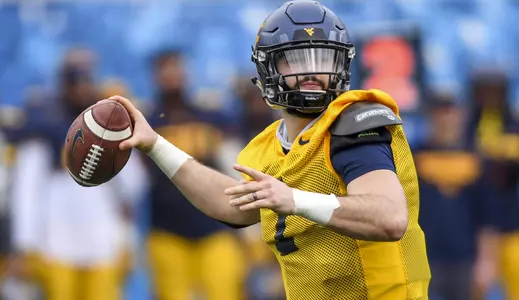
Photo by: All Pro Photography/Dale Sparks
Campus Connection: What to Expect in Year Two of Will Grier
April 06, 2018 04:54 PM | Football, Blog
MORGANTOWN, W.Va. - What is it about a quarterback's second year in an offensive system?
If you go back through time, no matter the era or style of play, the second season for a WVU quarterback is almost always much, much better than his first.
And that also goes for overall team performance, which bodes well for West Virginia as it prepares for Year Two of Will Grier.
Generations ago, Fred Wyant's second year leading Coach Art Lewis' offense in 1953 resulted in an 8-1 regular-season record and an invitation to play Georgia Tech in the Sugar Bowl.
Wyant's stats were better as a freshman in 1952, but his overall command of the offense was far superior during his sophomore season because he better understood how to utilize the weapons around him.
Mike Sherwood's second year operating Jim Carlen's system resulted in a 9-1 regular season record and a victory over South Carolina in the 1969 Peach Bowl in Atlanta.
Sherwood was one of college football's top passers in 1968 as a sophomore before Carlen completely changed his offense to a wishbone attack to accommodate the number of running backs he had in the program.
Sherwood went from directing one of the nation's top passing offenses in 1968 to operating one of college football's top rushing offenses a year later, a remarkable achievement.
Bernie Galiffa's second year in coach Bobby Bowden's offense in 1972 saw him pass for a then-school-record 2,496 yards and 17 touchdowns in leading the Mountaineers to eight regular season wins and a berth in the Peach Bowl.
That season, West Virginia ranked among the national leaders in total offense and scoring.
Year Two for Oliver Luck in Don Nehlen's system in 1981 resulted in 2,448 yards passing and 16 touchdowns, an eight-win regular season and a stunning upset of heavily favored Florida in the Peach Bowl.
Jeff Hostetler's second season in 1983 under Nehlen saw his passing numbers increase from 1,916 yards and 10 touchdowns in 1982 to 2,335 yards and 16 touchdowns as a senior. Hoss led WVU to a pair of nine-win seasons, but his second year the Mountaineers won their bowl game against Kentucky.
Major Harris was a revelation during his second season in West Virginia's offense in 1988 when he led the Mountaineers to an undefeated regular season and a meeting against Notre Dame in the Fiesta Bowl for the national championship.
Harris had better individual numbers as a junior in 1989 primarily because his supporting cast was not quite as good as 1988, and he wasn't able to take advantage of it.
Jake Kelchner's second full year in Don Nehlen's offense saw WVU run the table again in 1993 and meet Florida in the Sugar Bowl. Jake The Snake doubled his touchdown passes and was just a few pass attempts shy of leading the nation in passing efficiency that season.
Marc Bulger's second complete year in West Virginia's offense in 1998 resulted in a record-shattering season that saw him pass for 3,607 yards and 31 touchdowns.
All four of Pat White's seasons at WVU were terrific, including his second year in 2006 when the Mountaineers finished second in the country in rushing, third in scoring and fifth in total offense.
West Virginia was a 10-point defeat at Louisville away from playing in three straight BCS bowls during White's first three seasons playing for Coach Rich Rodriguez.
Geno Smith's second full year in Dana Holgorsen's offense saw him rewrite the school record book with 42 touchdown passes (with just six interceptions) and make a brief run at the Heisman Trophy.
Smith's Baylor performance when he completed 45-of-51 passes for 656 yards and eight touchdowns ranks among the most prolific single-game individual performances in major college football history.
And, most recently Skyler Howard, with a full year under his belt, led West Virginia to a 10-win season and a Top 25 finish in 2016. Howard exceeded his junior season passing totals by completing 247-of-404 attempts for 3,328 yards and 26 touchdowns during his senior year.
He, too, had better command of the offense and the personnel surrounding him.
Now, we turn our attention to senior Will Grier, whose 2017 campaign was already one of the best in school history with 3,490 yards and 34 touchdowns before a broken finger against Texas ended it 2 ½ games prematurely.
When Grier was in the starting lineup, West Virginia won seven of 10 games and was in the national rankings.
He had seven straight 300-yard passing games to begin his career and his performance at Kansas State when he threw for 372 yards and four touchdowns was the deciding factor in the Mountaineers' tough, 28-23 victory.
Grier was also tremendous at Baylor when he completed 26-of-37 passes for 375 yards and a season-high-tying five touchdown passes in a tough road win.
Presently, with 11 games running West Virginia's offense under his belt, one more year in the same meeting room with offensive coordinator Jake Spavital and even more familiarity with the weapons around him, Year Two for Grier has everyone excited, including coach Dana Holgorsen.
"He looks like a fifth-year quarterback to me," he said earlier this spring. "It's his second year in the system, and he's much more comfortable. His timing with the guys is as good as I've seen, so from a quarterback perspective, it's as good as anyone in the country."
Others see it that way, too.
"Will Grier becomes one of college football's biggest stars in returning for his senior year," was the headline above Chip Patterson's story on CBS Sports.com about Grier's decision last December to return for 2018.
In one of his recent mailbags on the subscription website, the Athletic, Stewart Mandel replied that he believes West Virginia "absolutely has a shot of winning the Big 12 title" with Grier under center.
Max Olson, also of the Athletic, recently spent a day in Morgantown interviewing people for a Grier feature to run on that site later this spring.
Athlon Magazine earlier this month sent a photographer to do a photo shoot with Grier and teammate David Sills V that will appear on one of its regional covers later this summer.
Other things are in the works, I am told.
One of the odds makers handicapping this year's Heisman Trophy race lists Grier at 12-1, fifth-best in the country and tops among returning Big 12 players.
Stanford's Bryce Love is the early favorite at 7-1.
Grier will get an opportunity to get a leg up on the field when West Virginia faces Tennessee in the season opener in Charlotte on Saturday, September 1.
Television information for that game has yet to been announced, but it's safe to assume someone will pick it up nationally.
Can Grier match what West Virginia's other great quarterbacks were able to accomplish in year two in the program?
We'll see.
If he does then you might want to keep an eye on ticket prices for this year's Big 12 Championship Game in Arlington, Texas.
If you go back through time, no matter the era or style of play, the second season for a WVU quarterback is almost always much, much better than his first.
And that also goes for overall team performance, which bodes well for West Virginia as it prepares for Year Two of Will Grier.
Generations ago, Fred Wyant's second year leading Coach Art Lewis' offense in 1953 resulted in an 8-1 regular-season record and an invitation to play Georgia Tech in the Sugar Bowl.
Wyant's stats were better as a freshman in 1952, but his overall command of the offense was far superior during his sophomore season because he better understood how to utilize the weapons around him.
Mike Sherwood's second year operating Jim Carlen's system resulted in a 9-1 regular season record and a victory over South Carolina in the 1969 Peach Bowl in Atlanta.
Sherwood was one of college football's top passers in 1968 as a sophomore before Carlen completely changed his offense to a wishbone attack to accommodate the number of running backs he had in the program.
Sherwood went from directing one of the nation's top passing offenses in 1968 to operating one of college football's top rushing offenses a year later, a remarkable achievement.
Bernie Galiffa's second year in coach Bobby Bowden's offense in 1972 saw him pass for a then-school-record 2,496 yards and 17 touchdowns in leading the Mountaineers to eight regular season wins and a berth in the Peach Bowl.
That season, West Virginia ranked among the national leaders in total offense and scoring.
Year Two for Oliver Luck in Don Nehlen's system in 1981 resulted in 2,448 yards passing and 16 touchdowns, an eight-win regular season and a stunning upset of heavily favored Florida in the Peach Bowl.
Jeff Hostetler's second season in 1983 under Nehlen saw his passing numbers increase from 1,916 yards and 10 touchdowns in 1982 to 2,335 yards and 16 touchdowns as a senior. Hoss led WVU to a pair of nine-win seasons, but his second year the Mountaineers won their bowl game against Kentucky.
Major Harris was a revelation during his second season in West Virginia's offense in 1988 when he led the Mountaineers to an undefeated regular season and a meeting against Notre Dame in the Fiesta Bowl for the national championship.
Harris had better individual numbers as a junior in 1989 primarily because his supporting cast was not quite as good as 1988, and he wasn't able to take advantage of it.
Jake Kelchner's second full year in Don Nehlen's offense saw WVU run the table again in 1993 and meet Florida in the Sugar Bowl. Jake The Snake doubled his touchdown passes and was just a few pass attempts shy of leading the nation in passing efficiency that season.
Marc Bulger's second complete year in West Virginia's offense in 1998 resulted in a record-shattering season that saw him pass for 3,607 yards and 31 touchdowns.
All four of Pat White's seasons at WVU were terrific, including his second year in 2006 when the Mountaineers finished second in the country in rushing, third in scoring and fifth in total offense.
West Virginia was a 10-point defeat at Louisville away from playing in three straight BCS bowls during White's first three seasons playing for Coach Rich Rodriguez.
Geno Smith's second full year in Dana Holgorsen's offense saw him rewrite the school record book with 42 touchdown passes (with just six interceptions) and make a brief run at the Heisman Trophy.
Smith's Baylor performance when he completed 45-of-51 passes for 656 yards and eight touchdowns ranks among the most prolific single-game individual performances in major college football history.
And, most recently Skyler Howard, with a full year under his belt, led West Virginia to a 10-win season and a Top 25 finish in 2016. Howard exceeded his junior season passing totals by completing 247-of-404 attempts for 3,328 yards and 26 touchdowns during his senior year.
He, too, had better command of the offense and the personnel surrounding him.
Now, we turn our attention to senior Will Grier, whose 2017 campaign was already one of the best in school history with 3,490 yards and 34 touchdowns before a broken finger against Texas ended it 2 ½ games prematurely.
When Grier was in the starting lineup, West Virginia won seven of 10 games and was in the national rankings.
He had seven straight 300-yard passing games to begin his career and his performance at Kansas State when he threw for 372 yards and four touchdowns was the deciding factor in the Mountaineers' tough, 28-23 victory.
Grier was also tremendous at Baylor when he completed 26-of-37 passes for 375 yards and a season-high-tying five touchdown passes in a tough road win.
Presently, with 11 games running West Virginia's offense under his belt, one more year in the same meeting room with offensive coordinator Jake Spavital and even more familiarity with the weapons around him, Year Two for Grier has everyone excited, including coach Dana Holgorsen.
"He looks like a fifth-year quarterback to me," he said earlier this spring. "It's his second year in the system, and he's much more comfortable. His timing with the guys is as good as I've seen, so from a quarterback perspective, it's as good as anyone in the country."
Others see it that way, too.
"Will Grier becomes one of college football's biggest stars in returning for his senior year," was the headline above Chip Patterson's story on CBS Sports.com about Grier's decision last December to return for 2018.
In one of his recent mailbags on the subscription website, the Athletic, Stewart Mandel replied that he believes West Virginia "absolutely has a shot of winning the Big 12 title" with Grier under center.
Max Olson, also of the Athletic, recently spent a day in Morgantown interviewing people for a Grier feature to run on that site later this spring.
Athlon Magazine earlier this month sent a photographer to do a photo shoot with Grier and teammate David Sills V that will appear on one of its regional covers later this summer.
Other things are in the works, I am told.
One of the odds makers handicapping this year's Heisman Trophy race lists Grier at 12-1, fifth-best in the country and tops among returning Big 12 players.
Stanford's Bryce Love is the early favorite at 7-1.
Grier will get an opportunity to get a leg up on the field when West Virginia faces Tennessee in the season opener in Charlotte on Saturday, September 1.
Television information for that game has yet to been announced, but it's safe to assume someone will pick it up nationally.
Can Grier match what West Virginia's other great quarterbacks were able to accomplish in year two in the program?
We'll see.
If he does then you might want to keep an eye on ticket prices for this year's Big 12 Championship Game in Arlington, Texas.

Players Mentioned

QB
/ Football
WR
/ Football2026 Mountaineer Invitational Preview
Thursday, April 09
Nate Gabriel | April 8
Thursday, April 09
Coach Rich Rodriguez | April 8
Thursday, April 09
Coach Rod West | April 8
Thursday, April 09