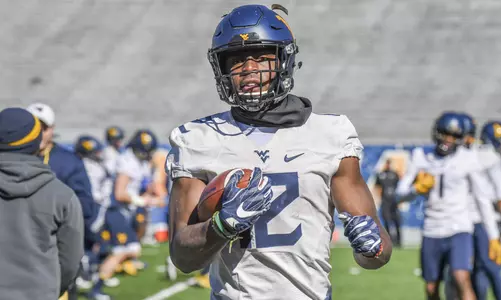
Photo by: All Pro Photography/Dale Sparks
A Big Difference
March 28, 2018 12:30 PM | Football
MORGANTOWN, W.Va. - There's an old saying in football that big, fast guys are more valuable than little, fast guys. Well, West Virginia is going to be putting a bunch of bigger, faster guys out on the football field at wide receiver this year.
Not since probably 1998, when Don Nehlen had 200-plus-pounders David Saunders, Shawn Foreman and Khori Ivy at wide receiver (paired with mobile 250-pound tight end Anthony Becht), have the Mountaineers had this much size, physicality and depth in their receiver corps.
By the way, that group was so talented the best receiver in the program, Jerry Porter, played safety that season before returning to offense in 1999.
"I have always thought size was important when it comes to passing, especially when you get into specific situations in the red zone, goal line or third downs," second-year offensive coordinator Jake Spavital said. "Those bigger bodies, bigger targets , the catch radius is there to where those are more efficient plays."
Coach Dana Holgorsen began making the move to bigger, more physical pass catching targets two years ago when his team struggled mightily to score touchdowns in the red zone.
He fixed that last season when David Sills V led the country with 18 touchdown catches.
"We improved tremendously from 2016 to 2017 in scoring touchdowns near the goal line and a lot of that had to deal with different body types," Spavital pointed out. "The play calls don't change very often. It's a lot about having higher percentage throws and a bigger catch radius, where I thought David Sills was really good in the red zone.
"You throw in Gary and we had Ka'Raun, but now you've got T.J. Simmons and you've got guys like Dom Maiden and then you add these tight-end bodies in there with Jovani Haskins and Trevon Wesco, and they do a good job with that stuff."
Two years since Holgorsen began tinkering with his roster, he is about to have as many as a dozen players weighing near 200 pounds (or exceeding it) when the rest of his freshman class arrives this summer.
West Virginia's top four wideouts right now include 214-pound Gary Jennings Jr. working the middle of the field, 204-pound David Sills V covering the outside, 200-pounder Marcus Simms stretching the field and 200-pound Alabama transfer T.J. Simmons doing all of the above.
He's got a pair of massive pass-catching options at tight end in 238-pound Haskins and 270-pound Wesco, as well as a pair of developing backup wide receivers in Maiden and Reggie Roberson Jr., both of whom possess nice size and physicality.
When fall camp arrives, 240-pound T.J. Banks, 230-pound Mike O'Laughlin and 207-pound Bryce Wheaton will join the group.
"We had to get a little bit more physical than what we were and to me being physical is a mindset," wide receivers coach Tyron Carrier explained. "I don't care what size you are or how big you are, it's a mindset. Usually, the bigger guys have that mindset a little bit better than the smaller guys and as of right now I feel as a group we're pretty physical."
This is important because having bigger, more physical wide receivers can make a big difference when you need to get a tough first down late in a game. It also makes a big difference late in the season when durability becomes an issue.
Last year, Jennings Jr. was the guy most frequently targeted on third down; the Stafford, Virginia, resident made a team-best 18 catches for an average of 14 yards per reception - 15 of those going for first down, third-most in the Big 12 last year behind Texas Tech's Keke Coutee and Iowa State's Allen Lazard. The Mountaineers also targeted Jennings Jr. the most on third and less than six, where he caught eight passes for an average gain of 14.8 yards per reception.
The next most frequent option was departed senior Ka'Raun White, who made 13 third down receptions for an average of 19.5 yards per catch. He caught five passes when it was third and less than six for an average of 9.2 yards per reception.
Of course, Sills V was the guy West Virginia most frequently targeted in the end zone with 12 of his 18 TD grabs coming in the red zone.
That's about it.
No real third option on third and medium (Sills caught three passes for 14 yards on third and less than six), no tight ends to really consider in the passing game and no backups to give the top four guys any rest.
Now, with all of the big, physical guys Holgorsen will have at his disposal at receiver, Jennings Jr. may not have to be targeted quite as much on third and medium where he is likely going to be tackled by a linebacker or strong safety once he catches the ball over the middle.
Now, when West Virginia gets near the goal line, quarterback Will Grier will have more options to consider other than just Sills V.
Now, when the full roster is available this fall, there will be more guys capable of stretching the football field than just Simms.
Grier is also going to have a couple more tight ends to throw the ball to this fall.
All of this is going to make a very, very good passing game even that much better in 2018.
"You are going to have tendencies when you are in the season because, hey, it's working so let's roll with it," Spavital said. "But in the offseason you want to study that and kind of spread it out a little bit more where I think these bigger bodies are going to help out when we get into situational play."
"The more that we're able to spread it around just makes it easier on not just me, but everyone else as a whole," Jennings Jr. added.
The word is Maiden, now a senior, and Roberson Jr., a sophomore, have developed to the point where they are now capable of being viable receiving options as well.
"I think Reggie and Dom look the most improved this spring," Carrier noted. "Reggie looks faster than what he looked last year. A lot of that had to do with Reggie having young legs and Dom being new to this atmosphere, but I'm very pleased with those two guys right now."
This will make a big difference from last year when West Virginia's top four receivers were taking nearly all of the snaps. We saw it in losses to Texas, Oklahoma and Utah when the receivers didn't have the legs to create enough separation during the times they were being targeted.
And while having big, physical receivers is important, it's also vital to have a couple of burners to keep defenses honest, too. That's where Simms, 5-foot-6-inch, 163-pound Tevin Bush, and possibly freshman speedster Sam James come into the picture.
"You still need that speed element, though, to have that ability to scare the defense with a guy who can stretch it vertically and we've got that with Marcus and certain other guys that we can put in the game," Spavital explained.
"We can impose our will when we want to, and that's what we're trying to get to," Carrier concluded.
Not since probably 1998, when Don Nehlen had 200-plus-pounders David Saunders, Shawn Foreman and Khori Ivy at wide receiver (paired with mobile 250-pound tight end Anthony Becht), have the Mountaineers had this much size, physicality and depth in their receiver corps.
By the way, that group was so talented the best receiver in the program, Jerry Porter, played safety that season before returning to offense in 1999.
"I have always thought size was important when it comes to passing, especially when you get into specific situations in the red zone, goal line or third downs," second-year offensive coordinator Jake Spavital said. "Those bigger bodies, bigger targets , the catch radius is there to where those are more efficient plays."
Coach Dana Holgorsen began making the move to bigger, more physical pass catching targets two years ago when his team struggled mightily to score touchdowns in the red zone.
He fixed that last season when David Sills V led the country with 18 touchdown catches.
"We improved tremendously from 2016 to 2017 in scoring touchdowns near the goal line and a lot of that had to deal with different body types," Spavital pointed out. "The play calls don't change very often. It's a lot about having higher percentage throws and a bigger catch radius, where I thought David Sills was really good in the red zone.
"You throw in Gary and we had Ka'Raun, but now you've got T.J. Simmons and you've got guys like Dom Maiden and then you add these tight-end bodies in there with Jovani Haskins and Trevon Wesco, and they do a good job with that stuff."
Two years since Holgorsen began tinkering with his roster, he is about to have as many as a dozen players weighing near 200 pounds (or exceeding it) when the rest of his freshman class arrives this summer.
West Virginia's top four wideouts right now include 214-pound Gary Jennings Jr. working the middle of the field, 204-pound David Sills V covering the outside, 200-pounder Marcus Simms stretching the field and 200-pound Alabama transfer T.J. Simmons doing all of the above.
He's got a pair of massive pass-catching options at tight end in 238-pound Haskins and 270-pound Wesco, as well as a pair of developing backup wide receivers in Maiden and Reggie Roberson Jr., both of whom possess nice size and physicality.
When fall camp arrives, 240-pound T.J. Banks, 230-pound Mike O'Laughlin and 207-pound Bryce Wheaton will join the group.
"We had to get a little bit more physical than what we were and to me being physical is a mindset," wide receivers coach Tyron Carrier explained. "I don't care what size you are or how big you are, it's a mindset. Usually, the bigger guys have that mindset a little bit better than the smaller guys and as of right now I feel as a group we're pretty physical."
This is important because having bigger, more physical wide receivers can make a big difference when you need to get a tough first down late in a game. It also makes a big difference late in the season when durability becomes an issue.
Last year, Jennings Jr. was the guy most frequently targeted on third down; the Stafford, Virginia, resident made a team-best 18 catches for an average of 14 yards per reception - 15 of those going for first down, third-most in the Big 12 last year behind Texas Tech's Keke Coutee and Iowa State's Allen Lazard. The Mountaineers also targeted Jennings Jr. the most on third and less than six, where he caught eight passes for an average gain of 14.8 yards per reception.
The next most frequent option was departed senior Ka'Raun White, who made 13 third down receptions for an average of 19.5 yards per catch. He caught five passes when it was third and less than six for an average of 9.2 yards per reception.
Of course, Sills V was the guy West Virginia most frequently targeted in the end zone with 12 of his 18 TD grabs coming in the red zone.
That's about it.
No real third option on third and medium (Sills caught three passes for 14 yards on third and less than six), no tight ends to really consider in the passing game and no backups to give the top four guys any rest.
Now, with all of the big, physical guys Holgorsen will have at his disposal at receiver, Jennings Jr. may not have to be targeted quite as much on third and medium where he is likely going to be tackled by a linebacker or strong safety once he catches the ball over the middle.
Now, when West Virginia gets near the goal line, quarterback Will Grier will have more options to consider other than just Sills V.
Now, when the full roster is available this fall, there will be more guys capable of stretching the football field than just Simms.
Grier is also going to have a couple more tight ends to throw the ball to this fall.
All of this is going to make a very, very good passing game even that much better in 2018.
"You are going to have tendencies when you are in the season because, hey, it's working so let's roll with it," Spavital said. "But in the offseason you want to study that and kind of spread it out a little bit more where I think these bigger bodies are going to help out when we get into situational play."
"The more that we're able to spread it around just makes it easier on not just me, but everyone else as a whole," Jennings Jr. added.
The word is Maiden, now a senior, and Roberson Jr., a sophomore, have developed to the point where they are now capable of being viable receiving options as well.
"I think Reggie and Dom look the most improved this spring," Carrier noted. "Reggie looks faster than what he looked last year. A lot of that had to do with Reggie having young legs and Dom being new to this atmosphere, but I'm very pleased with those two guys right now."
This will make a big difference from last year when West Virginia's top four receivers were taking nearly all of the snaps. We saw it in losses to Texas, Oklahoma and Utah when the receivers didn't have the legs to create enough separation during the times they were being targeted.
And while having big, physical receivers is important, it's also vital to have a couple of burners to keep defenses honest, too. That's where Simms, 5-foot-6-inch, 163-pound Tevin Bush, and possibly freshman speedster Sam James come into the picture.
"You still need that speed element, though, to have that ability to scare the defense with a guy who can stretch it vertically and we've got that with Marcus and certain other guys that we can put in the game," Spavital explained.
"We can impose our will when we want to, and that's what we're trying to get to," Carrier concluded.

Players Mentioned
RB
/ Football
QB
/ Football
TE/FB
/ Football
WR
/ Football
WR
/ Football
WR
/ Football
WR
/ Football
TE/FB
/ Football
WR
/ FootballRyan Ward | April 6
Monday, April 06
Coach Ryan Garrett | April 6
Monday, April 06
Coach Rich Rodriguez | April 6
Monday, April 06
Geimere Latimer | April 2
Thursday, April 02