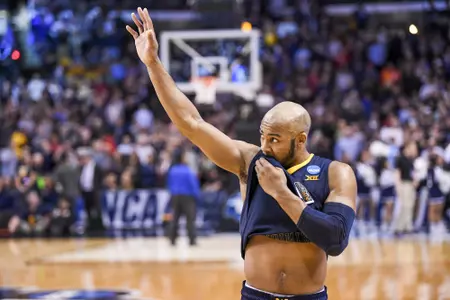
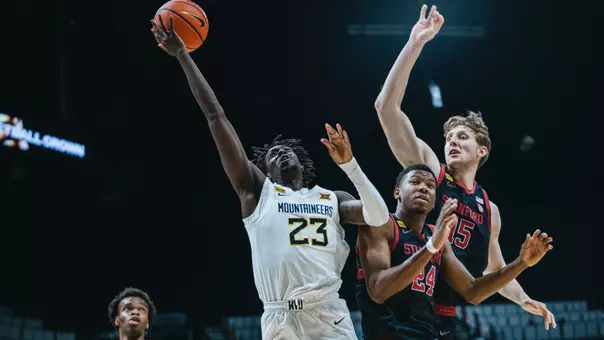
Photo by: All Pro Photography/Dale Sparks
Jevon Carter's Mountaineer Legacy Solidified
March 25, 2018 12:55 PM | Men's Basketball
MORGANTOWN, W.Va. - So, where does Jevon Carter's name fit among the greatest men's basketball players in West Virginia University history?
Once you remove Jerry West from the conversation, Jevon is fair game with everyone else because it's solely a matter of personal preference, as my buddy Jimmy Lewis once told me.
And he's right.
We've got some Hot Rod Hundley supporters out there who will argue convincingly that Hot Rod's value to WVU basketball expanded far beyond the court. No Mountaineer player - West included - can match the showmanship and entertainment value Hundley provided WVU basketball fans in the mid-1950s.
That will be on display for college basketball fans to revisit when the Hundley documentary produced by Pikewood Creative airs locally next month.
There are still plenty of Rod Thorn backers who point out the impossible task Thorn had of trying to follow West, right down to wearing Jerry's famous No. 44.
But Thorn, a great player in his own right, didn't quite have the supporting cast West had around him in the late 1950s, or an experienced coach capable of navigating the landmines and trip wires that frequently pop up during the season.
George King turned out to be a tremendous college basketball coach at Purdue, leading the Boilermakers to the national championship game in 1969, but his five seasons at West Virginia were spent learning how to coach and how to handle complicated superstar players.
Ron "Fritz" Williams, perhaps more than any other player in school history, was hamstrung by a coaching transition that led to a system that really wasn't suited for his style of play.
Whereas Kevin Pittsnogle's Mountaineer career benefited greatly in the transition from Gale Catlett to John Beilein, WVU fans never got to see the Fritz Williams who dominated the local prep basketball scene in the early 1960s.
King's motion offense and freewheeling style of play was perfectly geared toward Williams' immense talents, not the structured, Vic Bubas Duke system Bucky Waters brought to West Virginia when he became head coach in 1966.
Waters has since said that he wanted Williams to play more freely during his three seasons at West Virginia, but that never really happened for whatever reason.
Wil Robinson did play freely during the early 1970s, especially his senior season in 1972 when he amassed incredible numbers, but that was out of necessity after a tragic car accident and some academic suspensions completely gutted the program.
Early-1980s guard Greg Jones was one of the few players coach Gale Catlett allowed to play freely during his long coaching tenure at WVU, and Jones' outside shooting and upper body strength finishing at the basket should have translated into a long and successful NBA career.
But Jonesy could never conquer his personal demons and his brilliant play has since become a fading memory.
More recently, Da'Sean Butler and Kevin Jones were tremendous players who performed at the highest level of college basketball.
Both played in the Big East Conference when it was at its strongest, going up against competition on a nightly basis none of their predecessors faced during their Mountaineer careers, West included.
Butler led West Virginia to the Final Four in 2010, but a serious knee injury in the second half of the national semifinal game against Duke eliminated the opportunity of yet one more comeback victory for the Mountaineers that season.
K.J. put up staggering numbers during his four seasons at WVU, including an amazing senior season in 2012 when he averaged nearly 20 points and 11 rebounds per game and should have been the Big East player of the year.
But Marquette's Jae Crowder won the award that year because Marquette was still in the league and West Virginia was not, the Mountaineers announcing their departure for the Big 12 before the season began.
Butler and Jones are the two names Bob Huggins frequently mentions when discussing his best West Virginia players.
Now, Jevon Carter will make three.
Carter's run at WVU included four straight trips to the NCAA Tournament, three Sweet 16 visits and with the exception of a couple of weeks during his freshman season in 2015, weekly residence in college basketball's top 25.
Just a handful of players in school history have participated in four NCAA Tournaments, played in three Sweet 16s or spent practically their entire careers in the Top 25.
Jevon Carter is one of them.
Huggins, sitting next to Carter and senior guard Daxter Miles Jr. (another 1,000-point scorer) at the dais on Friday night, took a minute to heap praise on both following West Virginia's 90-78 loss to Villanova in the East regional semifinals.
"They're going to go down as the best four-year backcourt in the history of West Virginia basketball, and that's saying a lot," Huggins said. "When they came in, we were struggling - really struggling - and I underestimated the switch from the Big East and how they played in the Big East to the Big 12, and we had the wrong guys.
"And these guys came in, and we had guys that really didn't want to play, and we made a conscious effort to recruit guys who really love to play. These two guys, they are at the head of the class. They work. I've never had one complaint about either one of them. I've never had one issue with either of them. They're great people."
Thumb through the pages of West Virginia's media guide when it comes out next year, and you will see Jevon Carter's name in almost every category, at or near top in most of them including assists and steals.
His 1,758 career points scored rank eighth in school history behind just West, Hundley, Butler, Robinson, Kevin and Greg Jones and Thorn.
More importantly, J.C. was involved in 105 victories during his fabulous four-year run that ended Friday night in Boston.
Only Butler, with 107, has been involved in more victories as a Mountaineer player.
Carter wasn't the best shooter. He wasn't the best ball handler, nor the best passer nor the best scorer, but his competitiveness, toughness and will to win ranks right up there with the best.
The three visits Carter's Mountaineer teams made to the Sweet 16 had them pitted against three terrific college basketball programs - an underachieving, one-defeat Kentucky squad in 2015 full of first-round draft picks that lost to Wisconsin in the national semifinals, an overachieving Gonzaga team last year that jelled at the right time to reach the national championship game and a well-oiled Villanova machine this year that is capable of winning it all.
Carter gave it everything he had and came up just a little bit short in the last two - certainly nothing to hang his head over, which he didn't.
He walked out of TD Garden Friday night with his head held high, waving once more to a group of West Virginia fans who stood up and applauded his great college career that came to a close and is now relegated to the history books with the other Mountaineer greats.
"They came out and supported us from day one, since I've been here," Carter explained afterward. "They've always believed in me. Mountaineer Nation, man. They travel thousands of miles to come see us play, and I do my best to go out there and give them a good show to watch."
Where precisely Jevon Carter's name fits beyond West among the rest of the Mountaineer immortals will be a matter of personal preference.
That his name is worthy of consideration is not a matter of personal preference. It's a certainty.
Once you remove Jerry West from the conversation, Jevon is fair game with everyone else because it's solely a matter of personal preference, as my buddy Jimmy Lewis once told me.
And he's right.
We've got some Hot Rod Hundley supporters out there who will argue convincingly that Hot Rod's value to WVU basketball expanded far beyond the court. No Mountaineer player - West included - can match the showmanship and entertainment value Hundley provided WVU basketball fans in the mid-1950s.
That will be on display for college basketball fans to revisit when the Hundley documentary produced by Pikewood Creative airs locally next month.
There are still plenty of Rod Thorn backers who point out the impossible task Thorn had of trying to follow West, right down to wearing Jerry's famous No. 44.
But Thorn, a great player in his own right, didn't quite have the supporting cast West had around him in the late 1950s, or an experienced coach capable of navigating the landmines and trip wires that frequently pop up during the season.
George King turned out to be a tremendous college basketball coach at Purdue, leading the Boilermakers to the national championship game in 1969, but his five seasons at West Virginia were spent learning how to coach and how to handle complicated superstar players.
Ron "Fritz" Williams, perhaps more than any other player in school history, was hamstrung by a coaching transition that led to a system that really wasn't suited for his style of play.
Whereas Kevin Pittsnogle's Mountaineer career benefited greatly in the transition from Gale Catlett to John Beilein, WVU fans never got to see the Fritz Williams who dominated the local prep basketball scene in the early 1960s.
King's motion offense and freewheeling style of play was perfectly geared toward Williams' immense talents, not the structured, Vic Bubas Duke system Bucky Waters brought to West Virginia when he became head coach in 1966.
Waters has since said that he wanted Williams to play more freely during his three seasons at West Virginia, but that never really happened for whatever reason.
Wil Robinson did play freely during the early 1970s, especially his senior season in 1972 when he amassed incredible numbers, but that was out of necessity after a tragic car accident and some academic suspensions completely gutted the program.
Early-1980s guard Greg Jones was one of the few players coach Gale Catlett allowed to play freely during his long coaching tenure at WVU, and Jones' outside shooting and upper body strength finishing at the basket should have translated into a long and successful NBA career.
But Jonesy could never conquer his personal demons and his brilliant play has since become a fading memory.
More recently, Da'Sean Butler and Kevin Jones were tremendous players who performed at the highest level of college basketball.
Both played in the Big East Conference when it was at its strongest, going up against competition on a nightly basis none of their predecessors faced during their Mountaineer careers, West included.
Butler led West Virginia to the Final Four in 2010, but a serious knee injury in the second half of the national semifinal game against Duke eliminated the opportunity of yet one more comeback victory for the Mountaineers that season.
K.J. put up staggering numbers during his four seasons at WVU, including an amazing senior season in 2012 when he averaged nearly 20 points and 11 rebounds per game and should have been the Big East player of the year.
But Marquette's Jae Crowder won the award that year because Marquette was still in the league and West Virginia was not, the Mountaineers announcing their departure for the Big 12 before the season began.
Butler and Jones are the two names Bob Huggins frequently mentions when discussing his best West Virginia players.
Now, Jevon Carter will make three.
Carter's run at WVU included four straight trips to the NCAA Tournament, three Sweet 16 visits and with the exception of a couple of weeks during his freshman season in 2015, weekly residence in college basketball's top 25.
Just a handful of players in school history have participated in four NCAA Tournaments, played in three Sweet 16s or spent practically their entire careers in the Top 25.
Jevon Carter is one of them.
Huggins, sitting next to Carter and senior guard Daxter Miles Jr. (another 1,000-point scorer) at the dais on Friday night, took a minute to heap praise on both following West Virginia's 90-78 loss to Villanova in the East regional semifinals.
"They're going to go down as the best four-year backcourt in the history of West Virginia basketball, and that's saying a lot," Huggins said. "When they came in, we were struggling - really struggling - and I underestimated the switch from the Big East and how they played in the Big East to the Big 12, and we had the wrong guys.
"And these guys came in, and we had guys that really didn't want to play, and we made a conscious effort to recruit guys who really love to play. These two guys, they are at the head of the class. They work. I've never had one complaint about either one of them. I've never had one issue with either of them. They're great people."
Thumb through the pages of West Virginia's media guide when it comes out next year, and you will see Jevon Carter's name in almost every category, at or near top in most of them including assists and steals.
His 1,758 career points scored rank eighth in school history behind just West, Hundley, Butler, Robinson, Kevin and Greg Jones and Thorn.
More importantly, J.C. was involved in 105 victories during his fabulous four-year run that ended Friday night in Boston.
Only Butler, with 107, has been involved in more victories as a Mountaineer player.
Carter wasn't the best shooter. He wasn't the best ball handler, nor the best passer nor the best scorer, but his competitiveness, toughness and will to win ranks right up there with the best.
The three visits Carter's Mountaineer teams made to the Sweet 16 had them pitted against three terrific college basketball programs - an underachieving, one-defeat Kentucky squad in 2015 full of first-round draft picks that lost to Wisconsin in the national semifinals, an overachieving Gonzaga team last year that jelled at the right time to reach the national championship game and a well-oiled Villanova machine this year that is capable of winning it all.
Carter gave it everything he had and came up just a little bit short in the last two - certainly nothing to hang his head over, which he didn't.
He walked out of TD Garden Friday night with his head held high, waving once more to a group of West Virginia fans who stood up and applauded his great college career that came to a close and is now relegated to the history books with the other Mountaineer greats.
"They came out and supported us from day one, since I've been here," Carter explained afterward. "They've always believed in me. Mountaineer Nation, man. They travel thousands of miles to come see us play, and I do my best to go out there and give them a good show to watch."
Where precisely Jevon Carter's name fits beyond West among the rest of the Mountaineer immortals will be a matter of personal preference.
That his name is worthy of consideration is not a matter of personal preference. It's a certainty.
Players Mentioned

G
/ Men's Basketball
G
/ Men's BasketballRoss Hodge, Honor Huff & Brenen Lorient | Oklahoma Postgame
Sunday, April 05
Ross Hodge, Treysen Eaglestaff & Brenen Lorient | Creighton Postgame
Saturday, April 04
Ross Hodge & Honor Huff | Stanford Postgame
Thursday, April 02
Ross Hodge | College Basketball Crown Preview
Monday, March 30